
Collibra Data Intelligence Platform
A data intelligence platform powered by active metadata
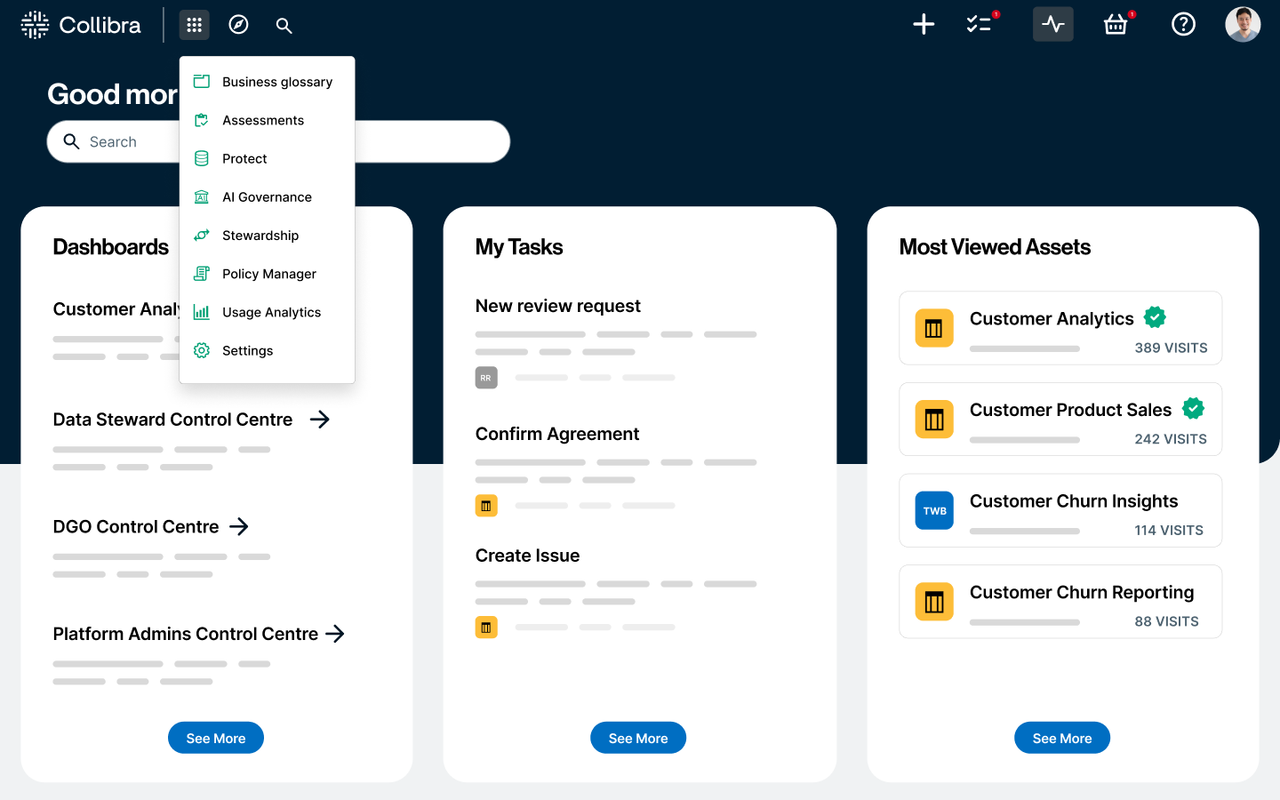
With active metadata at its core, Collibra Data Intelligence Platform delivers trusted data for every user, every use case and across every source. Collibra creates the critical alignment that accelerates smarter decision making. Increase productivity and drive innovation — while minimizing risk and reducing costs — by using our unified data intelligence platform.
$9.1M
per year in business benefits1
484%
3-year ROI1
28%
higher productivity of data governance teams1
13%
higher productivity of data analytics teams1

Unite business and IT to deliver trusted data
Foster a data-driven culture with a unified platform that connects business and IT teams to deliver trusted data for every use, for every user and across every source to create business value.
-
AI Governance
-
Data Catalog
-
Data Governance
-
Data Quality & Observability
-
Data Lineage
-
Protect
-
Data Privacy
Improve AI model effectiveness and lower data risk
Catalog, assess and monitor any AI use case to deliver trusted and valuable AI.
Find and understand data assets
Deliver faster insights with automated discovery and classification.
Simplify governance with business collaboration
Increase transparency into the data landscape to maximize data usage while minimizing risk.
Monitor, validate and certify data health
Monitor data quality, validate data health and remediate with no-code and self-service rules.
Gain end-to-end visibility into data
Visualize how data flows, transforms and is used across the data landscape.
Protect critical data and enforce access policies
Define data access policies and automatically enforce them to protect sensitive data.
Discover and mitigate data privacy risk
Automate the enforcement of data privacy, while assessing the regulatory risk from sensitive data.

Core services
Accelerate innovation across a wide range of use cases with our open, scalable architecture. Leverage enterprise-grade security and a flexible operating model.

Integrations & APIs
Take advantage of out-of-the-box integrations to connect your entire data ecosystem to Collibra Data Intelligence Platform.

Latest release notes
Get the latest release notes about updates to Collibra Data Intelligence Platform. Access compatibility and API updates, announcements, known issues and more.
Customer stories





Learn more about data intelligence
-
Resources
-
Blog and community

Blog
Collibra Data Intelligence: tackle 2023’s biggest data challenges

Blog
A window to your data: introducing the Collibra Data Marketplace


Community
Learn, share and collaborate with other data citizens
Ready to do more with trusted data?
Get started today.
-
Take a tour
Explore our platform with an interactive tour to experience how Collibra enables you to do more with trusted data.
-
Request a demo
Speak one-on-one with a Collibra expert and get a personalized demo of the Collibra Data Intelligence Platform.
-
Start a free trial
Install Collibra Data Quality & Observability in your own environment and try it with your own data for 20 days at no cost.