










The context AI needs. The control you require.
Share on:



Why we evolved from unified governance to context governance, and what it means for every enterprise running AI in production.
The world changed. Our category had to follow.
For two decades, the promise of enterprise data was intelligence. Build a clean warehouse. Connect it to a BI tool. Give analysts a dashboard. Let humans make the call.
That model worked because humans were the last mile. When a metric was ambiguous, someone asked a question and got clarification. When two systems disagreed on what "Customer" meant, a data steward reconciled them. When a definition was missing, it got filled in over coffee.
Because humans interpreted the reports, the underlying data didn't need to be perfect.
That era is over.
Today, the consumer of business data is not an analyst. It is an agent. Agents do not interpret; they predict. They do not pause to ask a clarifying question. They pick the definition that scores highest in their context window and proceed. A confused dashboard would have wasted an analyst's morning. A confused agent reroutes a customer escalation, approves a transaction, or files a regulatory disclosure.
The ambiguity is the same. The cost is not.
Data intelligence was the right frame for a world where humans were in the loop. Context governance is the right frame for a world where agents are. That is why we are making this shift: not as a rebrand, but as a recognition of where enterprise AI actually is in 2026.
The problem every enterprise is hitting right now
Every AI agent in production has to answer three questions before it acts on enterprise data. Most cannot.
What does this data actually mean?
"Customer" in wealth management is the household. In institutional banking, it is the counterparty. In retail banking, it is the individual account holder. Same word. Three different meanings. Three different answers. Without governed context, the agent picks whichever definition scores highest and proceeds, confidently and often wrong.
Is this data trustworthy right now?
Is the definition current? Has the source been refreshed? Did the quality check pass? Does the lineage hold? Without governed context, the agent treats stale data as live and authoritative. It does not know what it does not know.
What am I allowed to do with it?
Which policies apply? Which jurisdictions restrict the action? Who owns the definition? Without governed context, the agent acts inside the data and outside the policy. Every action becomes an unreviewed risk.
These are not metadata problems. They are an ontology problem. Meaning, trust and policy must be connected, not just documented in isolation. A semantic layer tells an agent what each word means. An ontology, tells the agent how meaning, trust and policy relate to each other. Without the grammar, agents reason about isolated terms. With it, agents reason about your enterprise.
And then there is the control problem. Once an agent is in production, the enterprise has to answer: who authorized it, what has it actually done, and if something goes wrong, can we prove it? Today, most enterprises cannot. Manual oversight works for five agents. It collapses at twenty. At fifty, it is an enterprise -level risk.
This is the hallucination tax: the hidden, compounding cost of manual oversight, rework, and risk that grows with every agent in production. Gartner predicts more than 40% of agentic AI projects will be cancelled by the end of 2027. The reasons cited are not model failure. They are escalation costs, unclear business value and inadequate risk controls. That is a governance problem. It is the problem context governance is built to solve.
What changes when you add Collibra to your AI stack
Context governance is not an audit exercise or a compliance checkbox. It is the operating infrastructure that makes enterprise AI economically viable at scale. The ROI shows up in three places.
Agents that get the right answer the first time
In a controlled benchmark at KU Leuven, agents with governed context achieved 92% task completion. Without it: 62%. The failure rate dropped fivefold. On the most complex, definition-dependent questions, the kind a CFO actually asks, the ungoverned agent went zero for four and was confident every time. Governed context does not make a good agent a little better. It decides whether you get the right answer or a confident wrong one, precisely where the stakes are highest.
Dramatically lower token costs
An LLM left to navigate unstructured, ungoverned data burns five to ten times the tokens, chasing definitions it never finds, retrying tool calls, reasoning through ambiguity it should not have to resolve. Governed context hands the agent the right data slice, the right definition, and the applicable policy upfront. The result is better outcomes at lower cost, the kind of unit economics that scale from five agents to fifty without breaking the budget.
Agents that make it to production and stay there
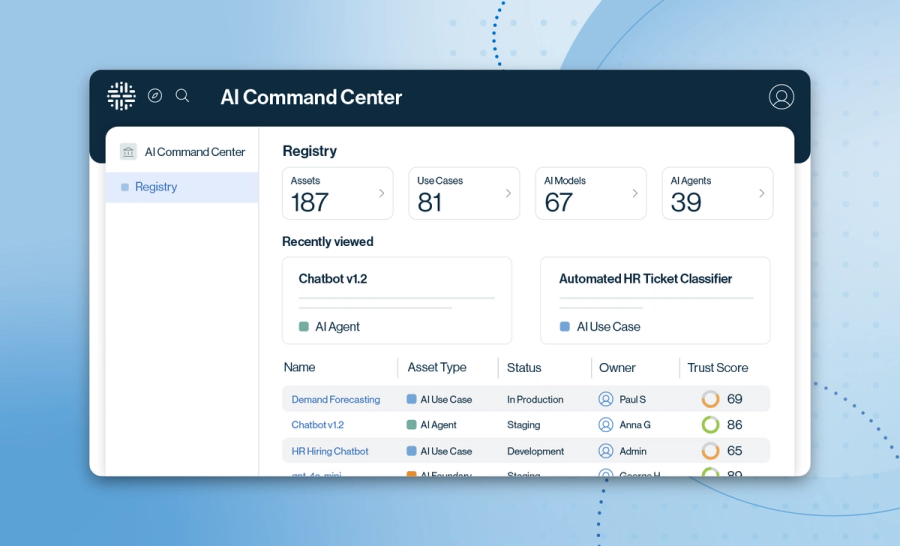
The biggest ROI killer is the agent that never leaves pilot because no one can prove it is safe. With the AI Command Center, AI leaders can see every agent deployed across the enterprise, trace every decision it made, and catch drift before it becomes an incident. What used to be a manual forensic exercise becomes a continuous operational control. Faster time to production. Lower risk. A defensible audit trail the regulator and the board both need.
And for the 80% of enterprise data that is unstructured, the contracts, call transcripts, support tickets, emails, and documentation that never lived in a table, Deasy Labs extends context governance into that layer at petabyte scale. The proprietary knowledge that makes your enterprise's AI smarter than a general-purpose LLM lives in unstructured data. Deasy makes it governable. Months of data preparation, compressed into minutes.
Why this matters now and why it only gets more urgent
The model bottleneck is gone. Frontier models now make agentic work viable. That shifts the binding constraint. The missing layer is not more intelligence; it is trusted, retrievable business context. Our own Harris Poll data makes the gap visible: 91% of enterprises are building or rolling out agentic AI, 86% expect ROI, and only 48% have formal governance policies to deliver it.
That gap is the difference between AI as a science project and AI as a business outcome
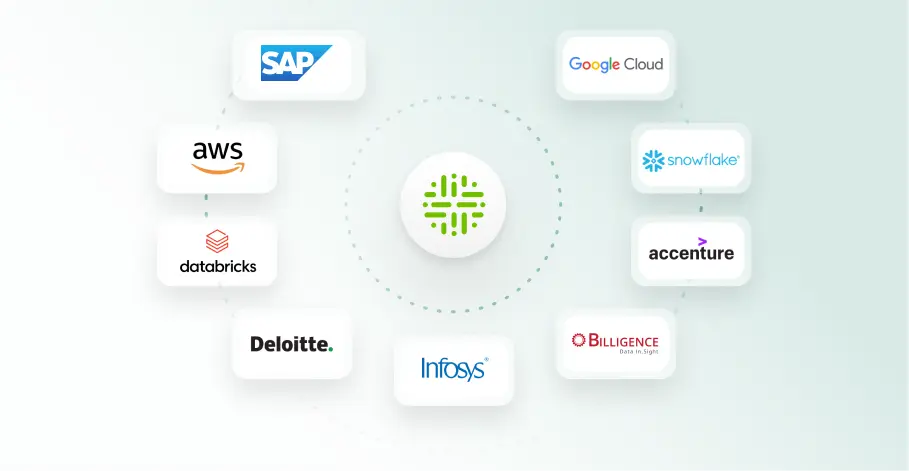
There is a structural reality underneath the numbers. Every cloud platform is building a context layer for AI. Databricks has Unity Catalog Business Semantics. Snowflake has Horizon. Google has the Cloud Knowledge Catalog. Each is good at what it was built for. Each governs its own platform well.
But no enterprise runs on just one platform. Six to ten major systems is normal. An agent answering a question for the CFO might need data from three clouds and four SaaS applications. A definition of "Revenue" is not owned by Databricks or Snowflake; it is owned by the enterprise. That definition has to travel across every platform the data touches, every model that retrieves it, every agent that acts on it.
Collibra is platform-neutral by design. We sit above every platform you already run and govern the same context across all of them. Not instead of Unity Catalog or Horizon, but on top of them. The hyperscalers bring the data and the compute. Collibra brings the context and control that crosses their boundaries. Context has gravity. The decision you make now about where your enterprise's ontology lives will shape how your agents reason for the next decade.
We made the bet eighteen years ago that the meaning of your data and the governance of how it is used is the foundation everything else runs on. That bet was made in the era of dashboards and analytics. It is the architecture that the era of agents demands.
The names change. The need does not.

Collibra
Collibra
Enterprise AI Control Plane
Share on:
Related articles
June 2, 2026
Trusted data, smarter AI: Unified governance for Snowflake
Data GovernanceJune 26, 2026
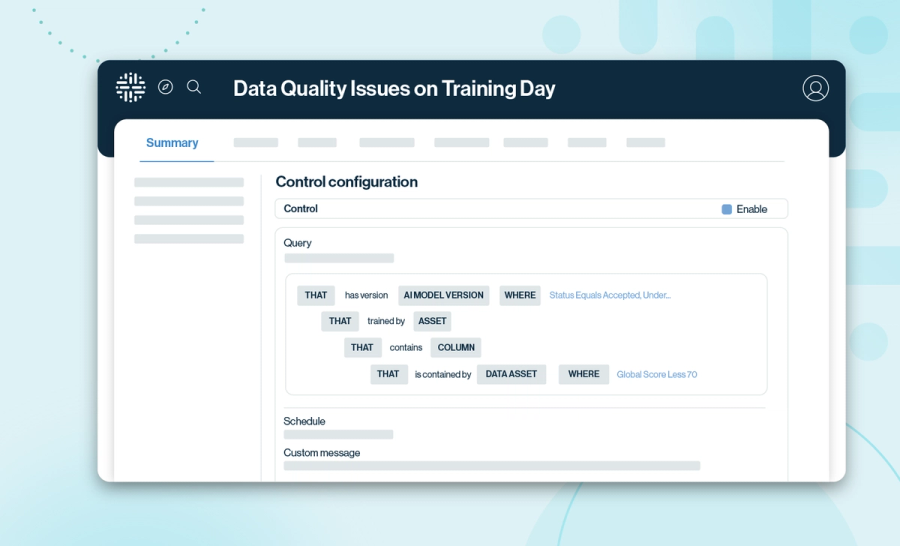
Control Tower: OOTB controls to govern AI by exception
Collibra PlatformMay 21, 2024
Collibra wins prestigious 2024 Communicator Award for AI Governance campaign
Data GovernanceMarch 31, 2026
Unified AI registry: Your central inventory for AI use cases, models and agents
Keep up with the latest from Collibra
I would like to get updates about the latest Collibra content, events and more.
Thanks for signing up
You'll begin receiving educational materials and invitations to network with our community soon.