













Unified AI registry: Your central inventory for AI use cases, models and agents
Share on:


As organizations scale AI initiatives, AI assets are increasingly created across multiple heterogeneous environments such as Google Vertex AI, Azure and Databricks. This makes it difficult to maintain a clear inventory of AI use cases, models and agents across the enterprise. Without centralized visibility, organizations struggle to understand which AI systems exist, who owns them and how they evolve over time. A unified registry becomes essential to track AI initiatives consistently and establish the governance foundation needed to manage AI responsibly at scale.
What’s new: Unified AI registry
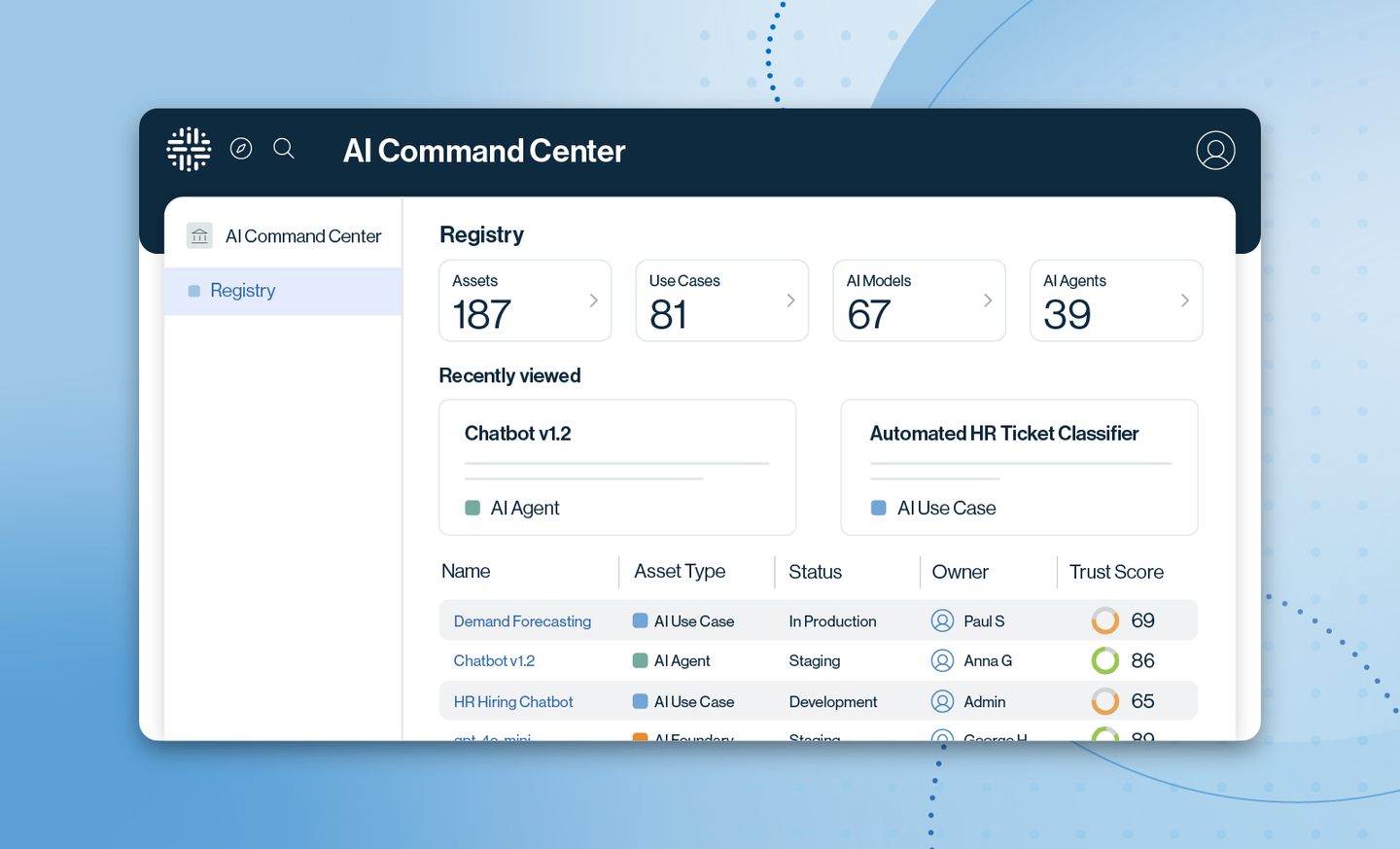
The unified AI registry provides a central place to register and manage AI-related assets across the organization. It acts as a single inventory where teams can track AI use cases, models and agents while maintaining governance context such as ownership, lifecycle status and trust metrics.
As organizations build AI systems across heterogeneous machine learning environments—including Google Vertex AI, Amazon SageMaker and Databricks—AI initiatives often become fragmented across platforms and teams. The unified registry addresses this challenge by providing a consistent layer where AI assets can be registered and governed independently of the underlying development platform.
From a single interface, users can register new AI use cases, models or agents, explore recently viewed projects and monitor the scale of AI initiatives across the enterprise. By centralizing these assets in one place, organizations gain a structured foundation for AI governance that begins early in the AI lifecycle.
How AI registry helps
As AI adoption accelerates, organizations often struggle to answer a simple question: can this AI system be trusted? Evaluating readiness usually requires reviewing multiple governance signals—documentation, data lineage, lifecycle progress, risk classifications and compliance evidence—across different tools and teams. This fragmented process slows deployment and makes it difficult for leaders to assess risk quickly. The AI trust score addresses this challenge by aggregating governance indicators into a single standardized metric. By translating governance signals into a clear trust indicator, teams can identify gaps earlier, prioritize remediation and make faster deployment decisions.
Collibra’s unified AI registry helps solve for:
• Lack of visibility into AI use cases and models across teams
• Difficulty tracking AI ownership and lifecycle status
• Fragmented inventories across machine learning platforms
• Limited governance coverage for newly created AI systems
How the unified registry works
The unified registry provides a centralized interface where organizations can register and manage AI assets across their environment. Teams can quickly view the number of tracked assets—including AI use cases, models and agents—while navigating directly into each asset to explore governance context.
Users can register new AI use cases, models or agents directly from the registry interface and associate them with metadata such as lifecycle stage, ownership and trust score. This creates a living inventory of AI systems that evolves as projects move from experimentation to production.
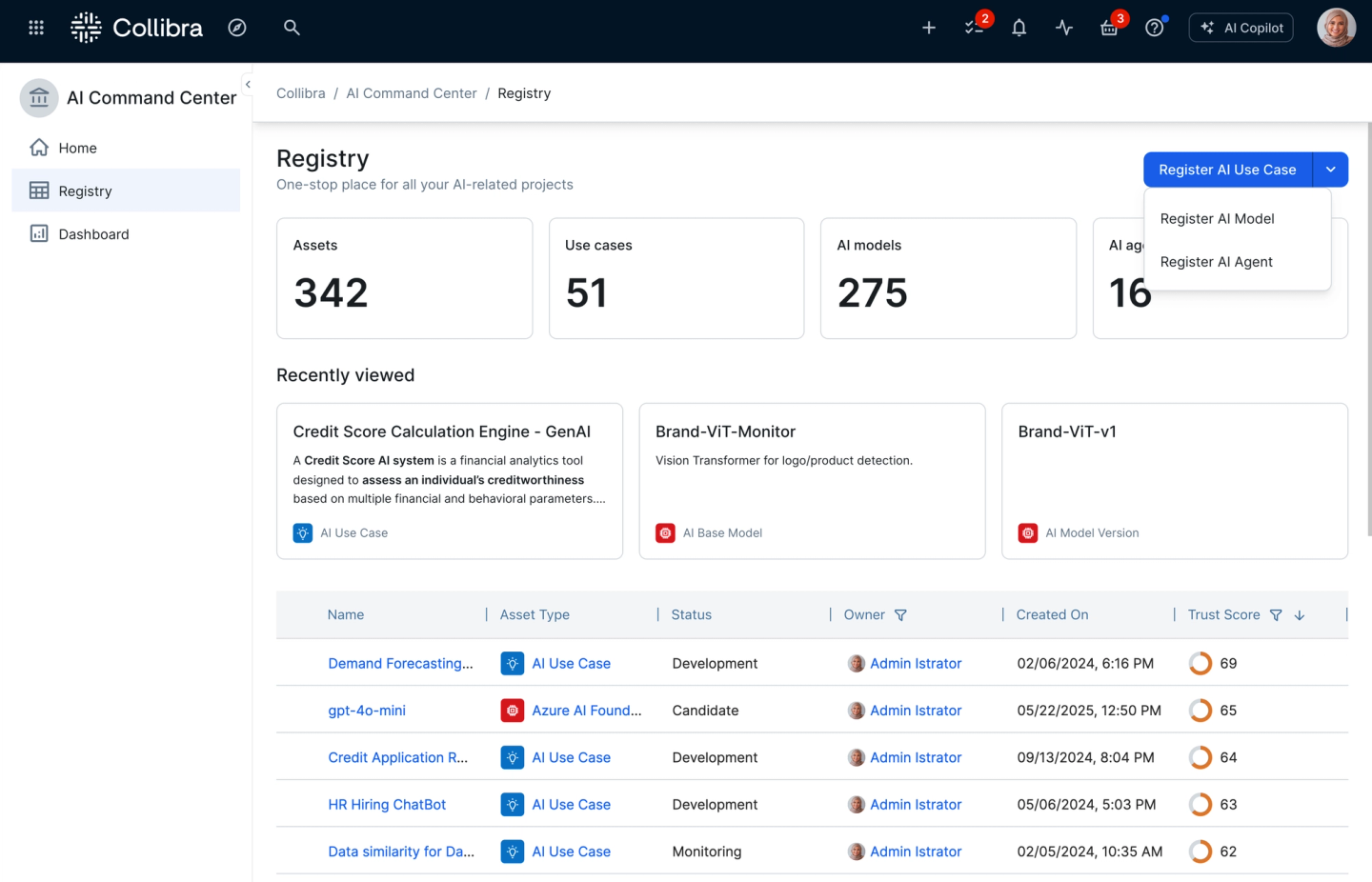
Unified AI Registry showing a centralized inventory of AI use cases, models, and agents with lifecycle status, ownership information and trust metrics.
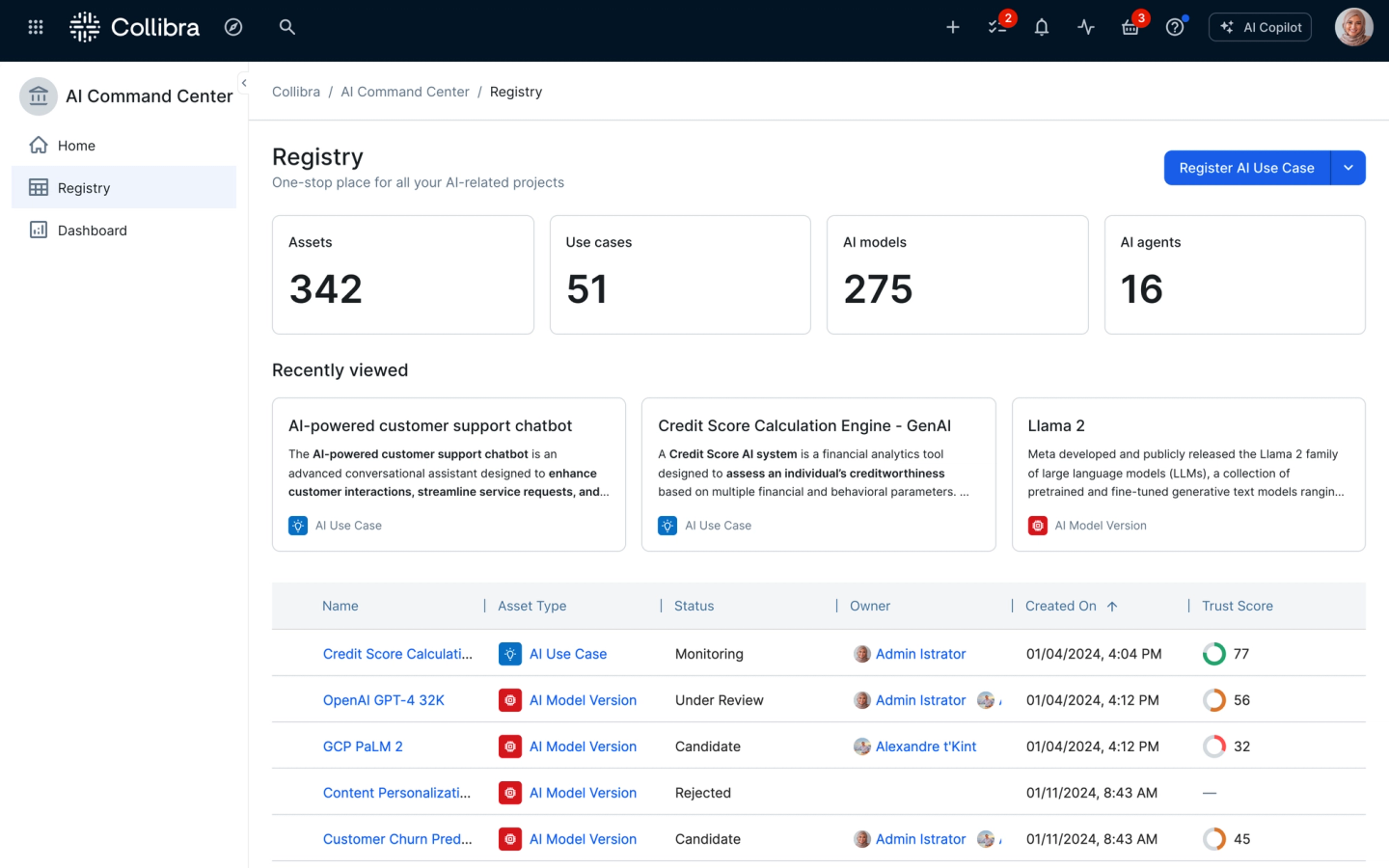
The registry provides real-time visibility into each AI asset’s trust score, enabling teams to quickly assess risk, monitor model health and prioritize governance actions.
The unified AI registry delivers significant value to a range of stakeholders across the enterprise, including:
- AI Governance Leaders: Gain visibility into the full portfolio of AI initiatives across the organization
- Data and AI Teams: Register and track AI use cases and models in a structured way as projects evolve
- Risk andCompliance Teams: Identify which AI systems require governance review or additional oversight
- Chief Data and AI Officers: Maintain an enterprise-wide view of AI adoption and governance coverage
These benefits are realized through several specific, detailed technical use cases:
• AI inventory management: Maintain a centralized list of AI use cases and models
• Governance onboarding: Register AI projects early in the lifecycle
• AI portfolio oversight: Monitor the scale and maturity of AI initiatives across teams
Key takeaways about unified registry
The unified registry helps organizations bring structure and visibility to their AI initiatives. By centralizing AI use cases, models and agents in a single inventory, teams gain the visibility needed to manage AI systems responsibly and at scale.
Join Collibra’s Spring Product Premiere to learn how unified registry provides:
• A central inventory for AI use cases, models and agents
• Structured governance from the beginning of the AI lifecycle
• Enterprise-wide visibility into AI initiatives
• Foundation for AI oversight
Where to learn more
To learn more about code-first AI registration and the broader Collibra AI Governance capabilities, explore the following resources:

Roeland Herrebosch
Roeland Herrebosch
Product Manager
Collibra

David Talaga
David Talaga
Product Marketing Director
Collibra

Pankuj Chachra
Pankuj Chachra
Senior Director of Engineering
Collibra
Share on:
Related articles

Data GovernanceFebruary 14, 2025
Why we are the data and AI leader for you

August 27, 2025
Why predictive modeling matters to higher education institutions

Data GovernanceJanuary 25, 2022
Gaining control of personal information ahead of CPRA

Data LineageJanuary 27, 2022
Accelerate IFRS-17 Compliance with Data Intelligence Platform
Keep up with the latest from Collibra
I would like to get updates about the latest Collibra content, events and more.
Thanks for signing up
You'll begin receiving educational materials and invitations to network with our community soon.