















Why data context and sovereignty are board-level concerns for pharma AI leaders
Share on:



Most pharma and life sciences organizations are sitting on a goldmine of proprietary data to better patient health and their own market positions — decades of clinical trials, real-world evidence, genomic research, pharmacovigilance signals, and operational records.
The Pharma and Life Sciences industries internal data is genuinely irreplaceable as they build a technology future intertwined with AI. The McKinsey Global Institute estimated that gen AI could unlock between $60 and $110 billion a year in economic value for Pharma and medical products industries, boosting productivity and innovation.
Science and lab data is the foundation upon which AI initiatives and agents in drug discovery, patient outcomes modeling, and precision medicine will either succeed or fail. The problem is few organizations actually know what they really have today. This is the first important step.
While agentic AI can be executed without the full value of internal data, making it an afterthought is a mistake that could have regulatory repercussions for global pharma operating across borders with data.
Knowing you have data to run agentic AI is not the same as understanding and assuring the outcomes — where it came from, what it represents, how it was collected and authorized, under what consent, and whether it has been transformed, merged, or derived along the way. The deeper layer of knowledge — data context — is what separates AI agents you can trust and defend from AI agents that expose your organization to regulatory, legal, and reputational risk. As AI adoption accelerates across the industry, the gap between organizations that have invested in that foundation and those that haven't is becoming impossible to ignore.
The hidden risk: Deploying AI on data you don't fully understand
Pharma and life sciences data is extraordinarily rich — and extraordinarily sensitive. Patient records, genomic sequences, clinical trial results, and real-world evidence are the raw material for AI-driven discovery and personalized medicine. But feeding that data into AI systems without a clear, documented understanding of its lineage, quality, and consent history is where organizations get into serious trouble.
Context determines consent. A patient who enrolled in a promotional offer or clinical trial agreed to a specific use of their data. Repurposing that data to train a predictive AI model knowingly or by accident — even for a medically beneficial purpose — may violate the terms under which it was originally collected. Without robust internal data cataloging, lineage tracking, and access governance, organizations often cannot answer the most basic questions a regulator will ask: What data trained this model? Who had access to it? Was it used appropriately? When AI systems ingest contextually mismatched or poorly governed internal data, the legal exposure compounds quickly — layered on top of model bias, flawed outputs, and ultimately, patient harm.
The regulatory web is tightening
Data sovereignty — the principle that data is subject to the laws of the jurisdiction in which it originates — is no longer a concern limited to multinational IT teams. It is a frontline AI governance issue.
HIPAA remains the foundational U.S. framework governing protected health information. While pharmaceutical manufacturers are not typically classified as covered entities, they routinely operate alongside and within healthcare ecosystems where HIPAA-regulated data flows freely. Inducing or facilitating misuse of protected health information carries significant liability, and AI pipelines that inadvertently ingest Protected Health Information (PHI) without proper safeguards amplify that risk considerably.
GDPR raised the stakes dramatically for any organization touching EU data subjects. The regulation requires that personal data be processed on a documented lawful basis, that consent be specific and freely given, and that individuals retain rights including the right to erasure. Enforcement has been substantial: penalties can reach €20 million or 4% of global annual turnover — whichever is higher. Several organizations have already faced nine-figure fines. For AI systems that train on patient or clinical data involving EU residents, GDPR compliance is not a legal checkbox — it is a design requirement.
The EU AI Act, now in force, introduces the first comprehensive legal framework specifically governing artificial intelligence. AI systems used in healthcare, clinical decision support, and drug development are likely to be classified as high-risk, triggering mandatory conformity assessments, transparency obligations, and human oversight requirements. Non-compliance can result in penalties up to €35 million or 7% of global turnover.
Frameworks that define the standard of care
Beyond regulations, three governance frameworks are rapidly becoming baseline expectations for AI in life sciences.
NIST AI RMF (Risk Management Framework) provides a structured approach to identifying, measuring, and managing AI risk across the AI lifecycle. For pharma AI directors, it offers a practical governance scaffold — mapping risk to organizational roles, ensuring transparency, and building accountability into AI deployment from the ground up.
ISO 42001, the international standard for AI management systems, is quickly emerging as the credentialing benchmark for responsible AI. Much like ISO 27001 did for information security, ISO 42001 establishes the policies, controls, and continuous improvement processes organizations need to demonstrate trustworthy AI governance. Certification signals to regulators, partners, and patients that AI is being managed with rigor.
MNIST AI RMF — the sector-specific adaptation being applied in regulated industries — extends these principles into the clinical and life sciences context, emphasizing traceability of AI decisions, validation of models against real-world data distributions, and clear documentation of intended use.
What this means for AI directors
The message for Directors of AI in pharma and life sciences is clear: governance is not a downstream concern. It must be engineered and embedded into data pipelines, model development and agent development, vendor contracts, and deployment architectures from day one.
In order to access the potential, the requirements first need to be satisfied. This means knowing exactly what data your models consume, where it originated, under what legal basis it was collected, and whether its use in an AI context was ever contemplated by the individuals it describes. It means building audit trails that can satisfy a regulator on three continents simultaneously. Treating frameworks like NIST AI RMF and ISO 42001 not as compliance burdens, but as competitive differentiators that protect your organization, your partners, and above all, your patients.
The regulatory and governance infrastructure surrounding AI in life sciences will only grow more complex. Organizations that build the right foundations now will lead. Those that don't will learn the hard way — and the penalties, as the industry has already seen, are not trivial.

Collibra
Collibra
Enterprise AI Control Plane
Share on:
Related articles
June 2, 2026
Trusted data, smarter AI: Unified governance for Snowflake
Data GovernanceJune 26, 2026
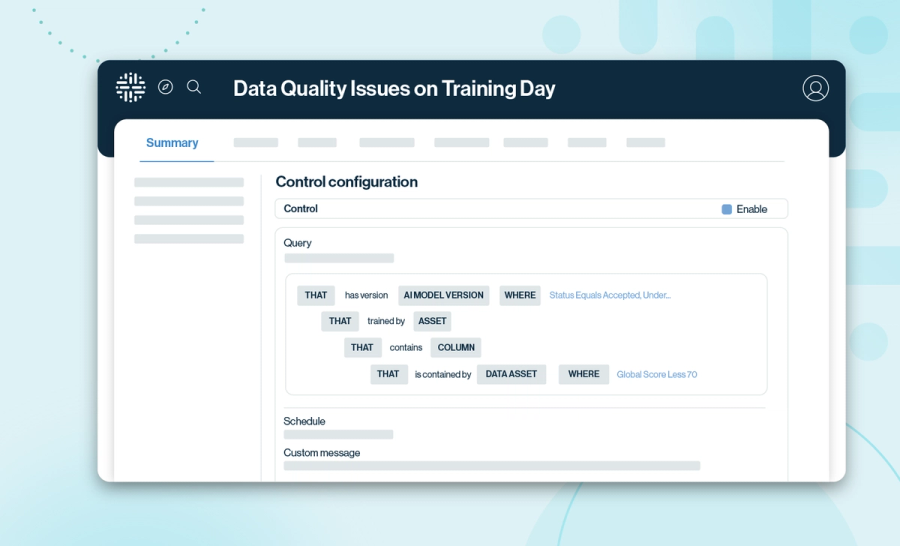
Control Tower: OOTB controls to govern AI by exception
Collibra PlatformMay 21, 2024
Collibra wins prestigious 2024 Communicator Award for AI Governance campaign
Data GovernanceMarch 31, 2026
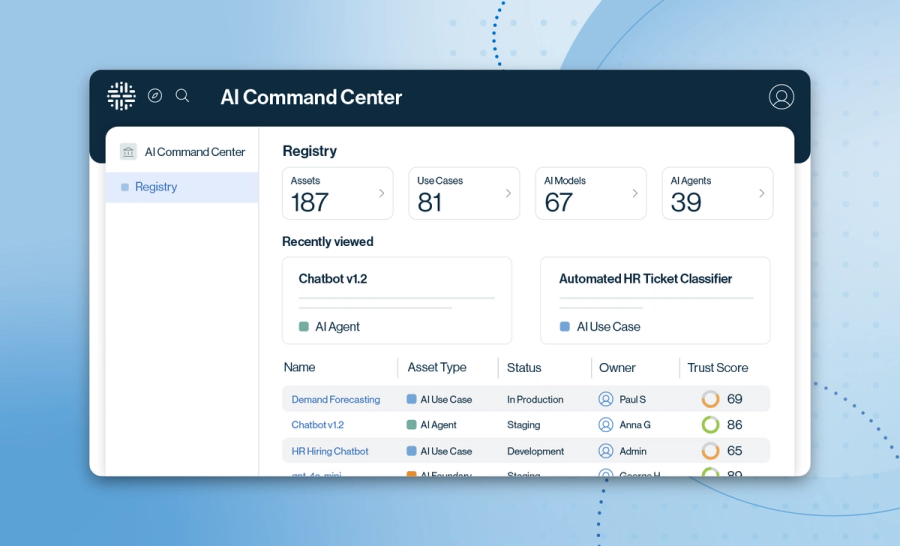
Unified AI registry: Your central inventory for AI use cases, models and agents
Keep up with the latest from Collibra
I would like to get updates about the latest Collibra content, events and more.
Thanks for signing up
You'll begin receiving educational materials and invitations to network with our community soon.