










The AI Trust Layer: Command-Center Architecture for Enterprise-Grade Models and Agents
Share on:


An AI trust layer is the architectural layer that sits between your AI systems and your business, enforcing context and control at runtime so every model and agent operates on data you trust, within limits you set.
It's where meaning, ownership, policy and oversight come together, so the AI reaching into your business is grounded, governed and accountable, rather than reaching into systems it doesn’t understand.
A trust layer isn't a safety setting on a model or a wrapper around a prompt. It's infrastructure. It's the place where the question "Should this AI be doing this, on this data, right now?" gets answered, every time, for every system. Build it once and trust becomes a property of your architecture instead of a hope you attach to each new project.
What is an AI trust layer?
An AI trust layer is a governing layer between AI and the systems it acts on, responsible for two things: giving AI the context it needs to be right, and exerting the control that keeps it accountable. Context is knowing what the data means, where it came from and whether it can be trusted. Control is defining who owns the AI, what data it can reach and what it's approved to do.
Context and control are the two halves, and they only work when they’re paired. Context without control is intelligence with no guardrails. Control without context is a locked door in front of an AI that doesn't understand what it's looking at. The trust layer holds both, and applies them while the AI runs.
Why do enterprises need an AI trust layer?
Organizations need a trust layer because AI now acts on the business directly, and the cost of it acting on wrong or ungoverned data has moved from embarrassing to material. A model that hallucinates produces a bad answer. An agent that acts on a hallucination produces a bad outcome: a wrong refund, a leaked record, a decision made on data nobody verified.
Without governed context, that risk is structural. In an independent test at KU Leuven, the same model on the same data answered correctly 92% of the time with a governed context layer in the loop and 62% of the time without it. The failure rate fell from 38.5% to 7.7%. The model didn't change, but the trust layer did.
The truth is that inference without grounded context is just guessing with confidence.
What does the AI trust layer sit between?
The trust layer sits between your AI estate, every model, use case and agent, and the data and systems that AI reaches into. Everything the AI wants to read flows up through it for context, and everything the AI tries to do flows down through it for control. Nothing reaches production data without passing the layer that knows the rules.
Picture three tiers. At the bottom, your data and platforms: the lakehouse, the warehouses, the operational systems. At the top, your AI: the models and agents doing the work. In between sits the trust layer, the single place where context is supplied and control is enforced. Put that layer inside any one cloud platform and you've tied your AI's trust to that vendor's engine. Put it in a vendor-neutral layer and it can govern your whole estate, because it has no engine of its own to favor.
What are the components of an AI trust layer?
A working trust layer has five components, working together: a unified registry, governed context, runtime policy enforcement, observability and a live trust signal. Drop any one and the layer leaks.
Component | What it does | Why it's non-negotiable |
|---|---|---|
Unified registry | One record of every model, use case and agent, with owner and risk tier | An asset you can't see is an asset you can’t govern |
Governed context | Definitions, relationships, lineage and quality delivered to the AI | Grounded AI is right far more often than ungrounded AI |
Runtime policy enforcement | Access, masking and retention enforced as code at the data layer | Policy in a document is policy nobody enforces |
Observability | Live behavior, drift and decision traces across models and agents | Trust you can't measure is trust you're assuming |
Trust signal | One score folding assessment, traceability, lifecycle, policy and monitoring | Leadership needs one figure, not ten dashboards |
| No sessions matching your filters are available. | ||
The registry and context cover knowing your AI and grounding it. Policy enforcement and observability cover controlling and watching it. The trust signal turns all of it into a number you can act on. Build context once, govern it everywhere, trust it always.
AI trust layer vs model guardrails: what's the difference?
Model guardrails constrain a single model's outputs. An AI trust layer governs the whole estate's behavior. Guardrails are useful and local; a trust layer is architectural and shared. Relying on guardrails alone means re-solving trust for every model, with no shared record, no estate-wide policy and no single view of risk.
Model guardrails | AI trust layer | |
|---|---|---|
Scope | One model or prompt | Every model, use case and agent |
What it governs | Output text | Context in, actions out, across the estate |
Policy | Per-model, re-implemented each time | Enforced once, applied everywhere |
Visibility | Local to the model | Portfolio-wide, with one trust signal |
Survives a new model? | No, rebuild it | Yes, the new model inherits the layer |
| No sessions matching your filters are available. | ||
Guardrails belong inside a trust layer. They're a feature of it, not a substitute for it.
How do you build an AI trust layer?
You build a trust layer by putting context and control in one place, outside any single execution engine, and enforcing both at runtime. The sequence: stand up a unified registry so you know what AI you run; connect governed context so models and agents reason from trusted meaning; enforce policy as code at the data layer; add observability across models and agents; and roll it all into one trust signal that gates what reaches production.
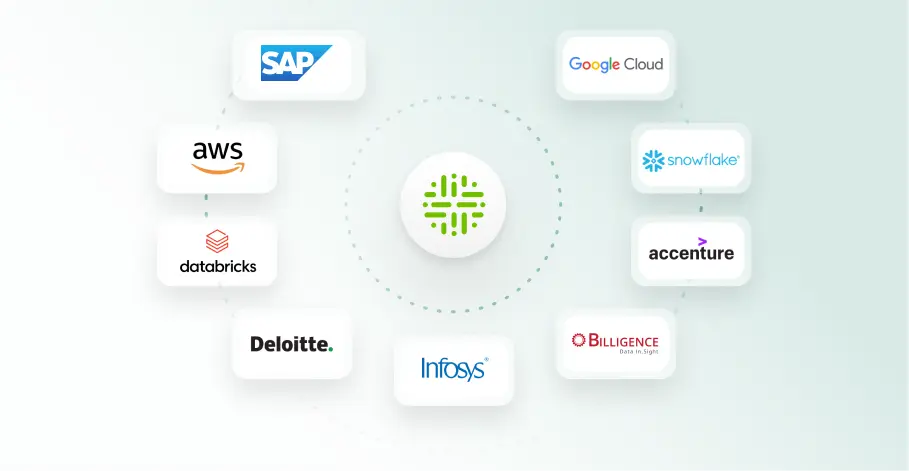
An AI Command Center is this architecture delivered as a product. It centralizes the registry, supplies governed context, enforces policy at runtime, observes behavior across the estate and scores every system for readiness and risk. Because it connects your platforms rather than replacing them, the trust layer governs Databricks, Snowflake and the rest from one neutral place, instead of locking your AI's trust to a single vendor's stack.
Frequently asked questions
What is an AI trust layer? An AI trust layer is the architectural layer between your AI and your business that supplies governed context and enforces control at runtime, so every model and agent operates on trusted data within limits you set.
How is an AI trust layer different from model guardrails? Guardrails constrain one model's outputs. A trust layer governs the whole estate, enforcing shared policy, supplying context and giving one view of risk across every model and agent, so trust isn't rebuilt for each new system.
What are the components of an AI trust layer? A unified registry of AI assets, governed context, runtime policy enforcement at the data layer, observability across models and agents, and a single trust signal that quantifies readiness and risk.
Why should the trust layer be vendor-neutral? Because a layer built inside one execution platform ties your AI's trust to that vendor's engine. A neutral layer can govern your entire estate, since it has no engine of its own to favor, and connects platforms rather than locking you into one.
Does an AI trust layer reduce hallucinations? It reduces the cost and frequency of wrong answers by grounding AI in governed context. In an independent KU Leuven test, governed context in the loop raised agent accuracy from 62% to 92% on the same model and data.
Where does an AI trust layer fit in the stack? Between your data and platforms at the bottom and your AI at the top. Context flows up to the AI through it; actions flow down through it for enforcement, so nothing reaches production data without passing it.

Collibra
Collibra
Enterprise AI Control Plane
Share on:
Related articles
Data GovernanceApril 10, 2026
Your semantic layer, automated: Meet Collibra's semantic agents

Context GovernanceApril 10, 2026
AI agents: Build or buy, governance becomes the differentiator

AI Command CenterJune 18, 2026
AI needs context: Why LLMs still don’t understand real-world systems

Data GovernanceApril 23, 2026
AI needs context: Why data alone is not enough
Keep up with the latest from Collibra
I would like to get updates about the latest Collibra content, events and more.
Thanks for signing up
You'll begin receiving educational materials and invitations to network with our community soon.