











Models are commodities, context is proprietary: Why context engineering is the new business standard
Share on:


The shift from model centrality to contextual determinism
The "model wars" are characterized by a persistent miscalculation: we treat the LLM as the destination when, architecturally, it is shifting toward a utility. It is becoming the "CPU" of the enterprise stack.
The real innovation is not in the engine, but in the engineering of the information supplied to it, the systematic architecture of how context is retrieved, filtered and ultimately fed to the model.
The anatomy of the reasoning engine
To understand why context is the only true differentiator, you must accept how these systems actually behave. An LLM is a non-deterministic processor. It possesses vast general knowledge but zero functional awareness of your specific business logic, customer history or real-time telemetry.
Consider the human analogues we already understand in high-functioning organizations:
- Support: A technician’s ability to resolve a critical bug isn't just a product of their IQ; it’s a function of having the specific environment specs and past ticket history in front of them.
- Sales Operations: A rep’s value isn't their ability to speak; it’s their grasp of a prospect's specific organizational hierarchy, tech stack, and business dynamics.
- Marketing: A marketer can only personalize a campaign if they have the specific customer intent signals, past purchase behavior and current lifecycle stage.
In these example cases, the "reasoning" is the commodity. The "context" is the edge.
Context engineering as a business process
While some context is external, the differentiating context resides inside your enterprise. Your organization’s explicit and tacit knowledge is your competitive advantage.
The "LLM CPU" is effectively interchangeable. You should be able to swap models for reasons of cost, performance or sovereignty without the system collapsing. But the strategic, organization-specific context that makes the LLM do work must be managed and protected as a core asset through a context lifecycle:
- Collection: Designing pipelines to harvest signals from various systems such as CRM, ERP, ECM, Collaboration tools and IoT sensors.
- Architecture: Determining where context lives, archival storage for history or vector databases for real-time delivery.
- Management: Organizing data into a functional memory hierarchy (short-term task data vs. long-term structural knowledge).
- Governance: Defining the rules of engagement. Which agent receives which piece of context? How is it shared across the system?
The end game is operational governance. In a non-deterministic environment, governance shifts from a bureaucratic checkbox to a functional necessity. Organizations must define context constraints at every layer: model, agent and orchestration. These are business rules executed through automation, with observability triggering human intervention the moment the system drifts outside its engineered parameters.
The paradox of context overload
The objective of context engineering is density, not volume. There is a persistent misconception that expanding the context window, the volume of tokens a model processes, linearly improves performance. In practice, the opposite is often true: as the window expands, we encounter context pollution.
A larger inference window does not create a smarter model; it frequently creates more noise. Flooding a model with irrelevant data leads to signal degradation (the "needle in a haystack" problem), economic inefficiency and increased latency.
You cannot give every model every piece of data. It is legally risky, technically impractical and economically wasteful. We must architect a system of surgical selection with business controls.Take a Sales Agent as an example. To be successful, it requires a specific hierarchy of context:
- Geography, market and industry: The foundational "common sense" encoded in the LLM’s weights, supplemented by real-time shifts in the customer’s competitive landscape.
- Regulatory and policy: The hard constraints. Which regulations apply here? Which internal standards guide execution?
- Domain and technology: The specific telemetry. What is the customer's tech stack? What internal data solves the pain point?
- Responsibility and process: The how of the system. Who owns the final decision? What specific steps, guidelines, and escalation paths define a successful task?
- Temporal and semantic: Is this a past, present, or future scenario? More importantly, are the concepts, like "ARR" or "Lead", semantically consistent across the entire context stack?
- Quality: The constraints that define whether an output is merely "generated" or actually "correct" according to business requirements.
In this architecture, success is a function of signal density. If context is inconsistent or noisy, the system fails, not because the model is weak, but because the instruction set was poorly engineered. The goal is to provide the minimum effective context required for a reliable result.
Why enterprise memory cannot be outsourced
As SaaS vendors attempt to lock context into their specific silos, remember that true enterprise context is horizontal. It spans proprietary IP, tacit employee knowledge and cross-functional workflows that no single application can fully capture.
If an organization tethers context to a specific model or a siloed vendor, it loses the ability to swap the underlying reasoning commodity as better or cheaper models emerge. By treating context as a sovereign, independent layer, the enterprise retains control over its most valuable asset.
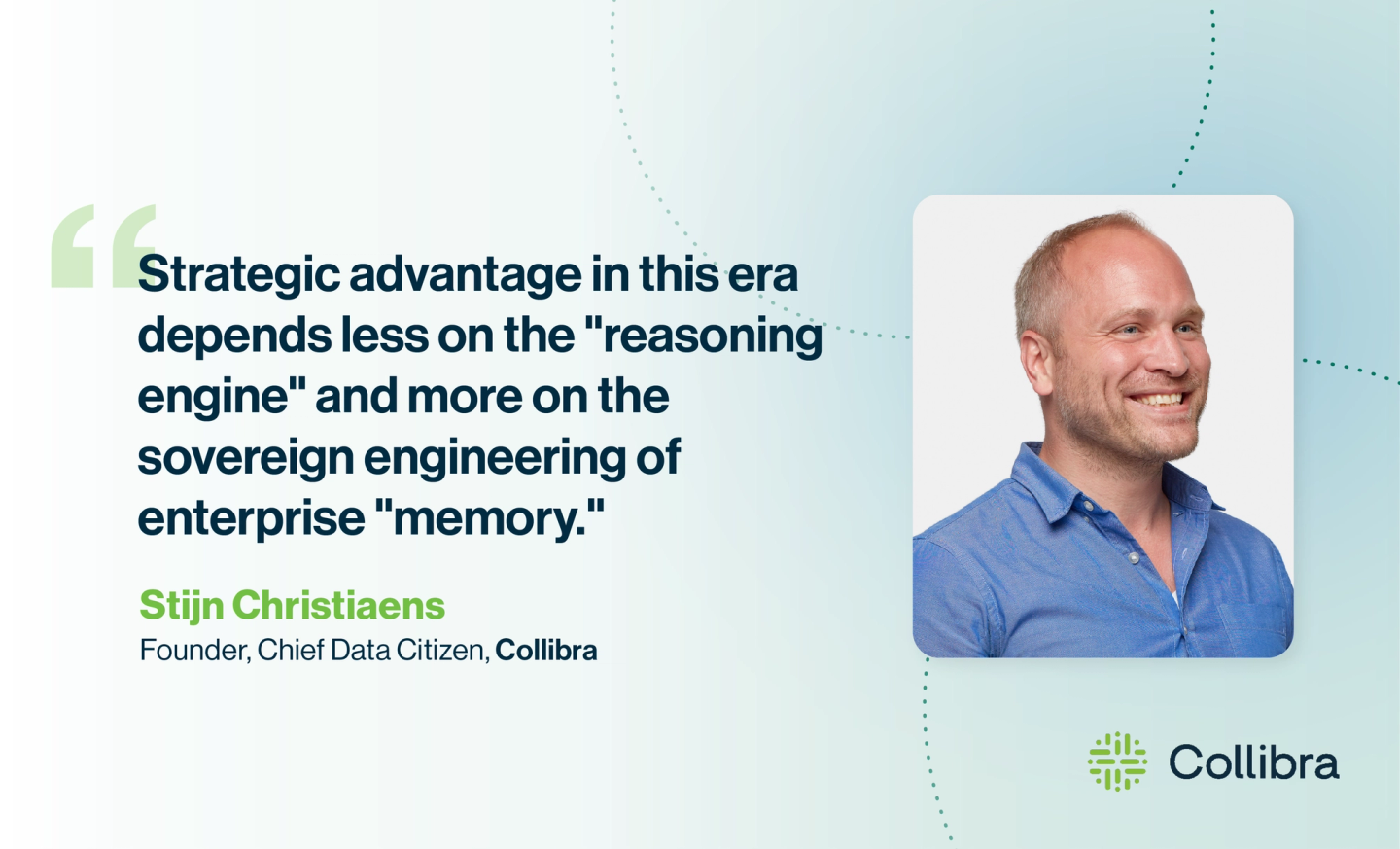
The model is interchangeable infrastructure. Your internal context is the only thing your competitors cannot buy, and it is the only data set the foundation models weren't trained on. Strategic advantage in this era depends less on the "reasoning engine" and more on the sovereign engineering of enterprise "memory."

Stijn Christiaens
Stijn Christiaens
Founder and Chief Data Citizen
Collibra
Share on:
Related articles
AI Command CenterJune 2, 2026
Trusted data, smarter AI: Unified governance for Snowflake
AI Command CenterJune 26, 2026
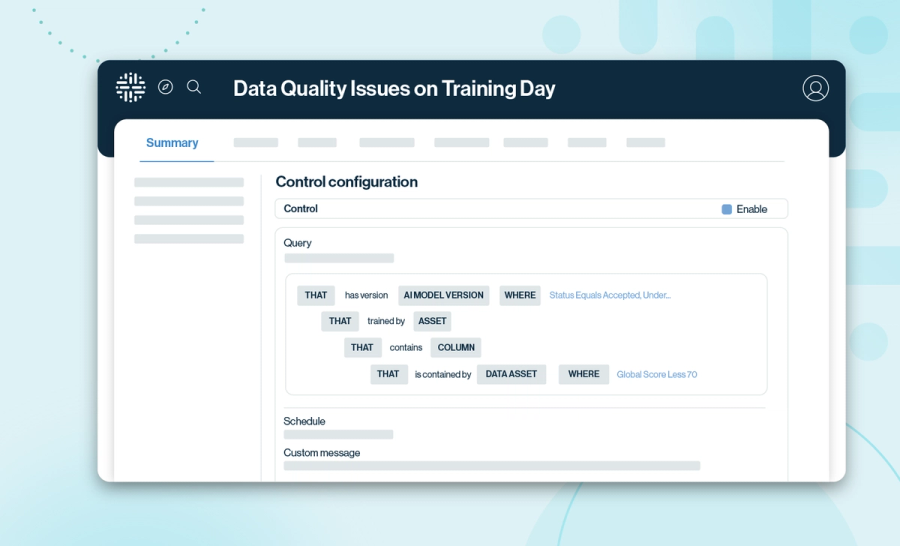
Control Tower: OOTB controls to govern AI by exception
Collibra PlatformMay 21, 2024
Collibra wins prestigious 2024 Communicator Award for AI Governance campaign
Data GovernanceMarch 31, 2026
Unified AI registry: Your central inventory for AI use cases, models and agents
Keep up with the latest from Collibra
I would like to get updates about the latest Collibra content, events and more.
Thanks for signing up
You'll begin receiving educational materials and invitations to network with our community soon.