










Govern every AI agent across its full lifecycle
Share on:


AI no longer just generates answers — it now acts. Agents read data, make decisions, call tools and trigger processes across systems, often without a human in the loop. That shift moves risk from “what a model said” to “what an agent did.” Gartner predicts that by 2028, 33% of enterprise software applications will include agentic AI, up from less than 1% in 2024, and that 15% of day-to-day work decisions will be made autonomously. Governance designed for static models can’t see, let alone steer, systems that operate on their own.
What’s new: Operating model evolution for agents
Collibra is extending its AI governance operating model to treat AI agents as first-class governed assets. The AI Agent extension introduces new asset types — AI Agent, AI Agent Tool, AI Agent Version, and AI Agent Deployment — while extending existing AI governance concepts such as AI Monitor and AI Endpoint to AI agents. It also connects agents to the use cases, base models, data, and policies that already live in the Collibra Platform. The result is a single, structured data model that captures how every agent is created, connected, deployed, and governed across the enterprise.
Rather than tracking agents in spreadsheets or scattered tools, organizations register each agent once and govern it everywhere. Agents can be linked to business outcomes, the services they orchestrate, the models they invoke, the tools they access, and the monitors watching them in production. This extended operating model provides the foundation for governing agentic AI consistently and at scale within AI Command Center.
How the operating model evolution helps
As teams move from pilots to production, agents multiply faster than oversight can keep up. They span data, roles and applications. Indeed, one call can ripple across many systems, making the impact continuous, rather than point-in-time. Most organizations have no shared inventory of existing agents, their scope of work, ownership or dependencies. This new operating model closes that gap by giving every agent a governed home — so oversight scales with the AI estate instead of falling behind it.
Problems it solves:
- Hidden dependencies between agents, models, tools and data that create operational blind spots
- Inconsistent, team-by-team governance with no shared standard for instructions, approved tools or lifecycle status
- Difficulty proving to auditors or leadership what an agent does, what it can access and how it has been controlled
How the operating model for agents works
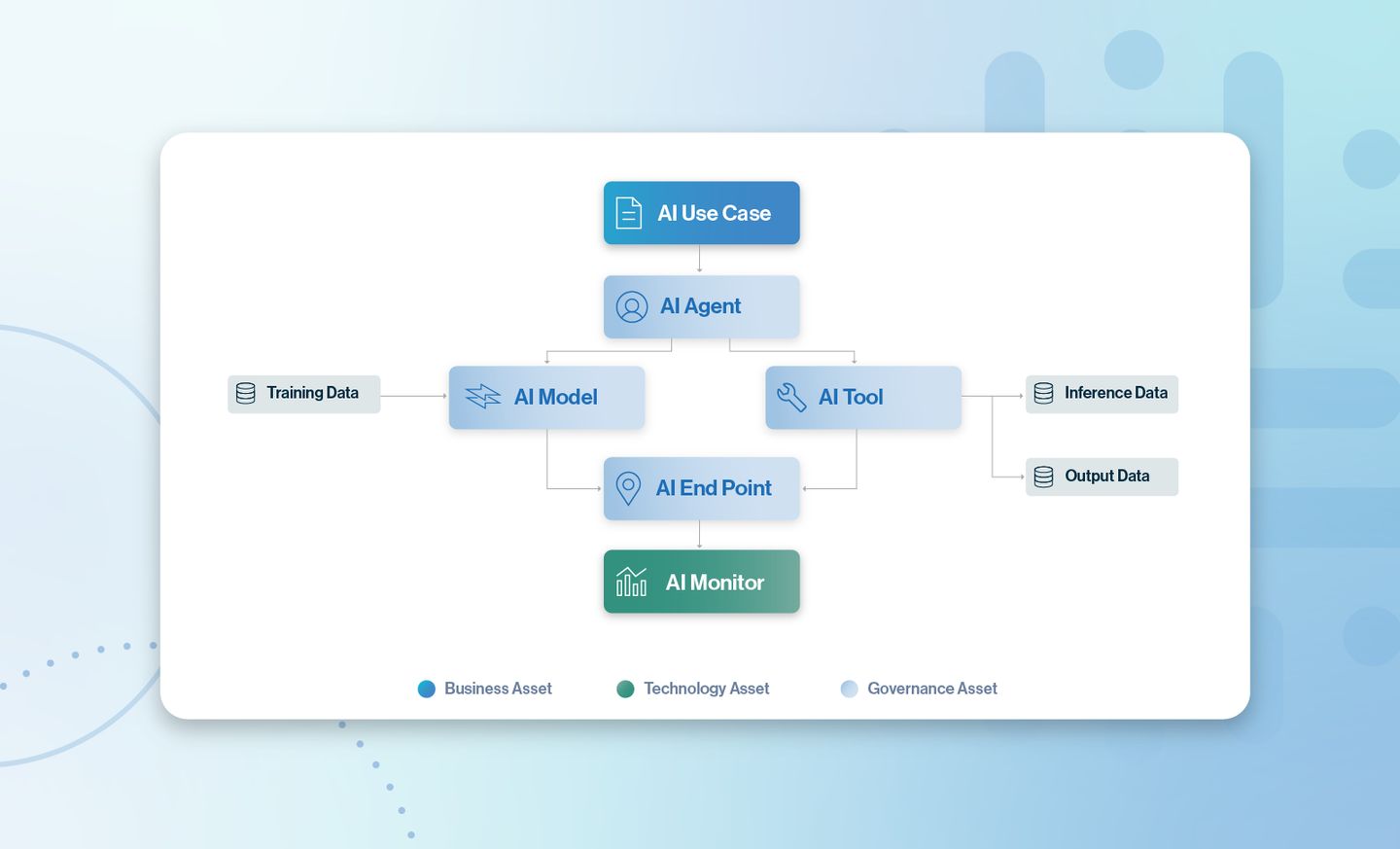
The operating model extends AI governance to agents by connecting every AI asset involved in delivering a business outcome. At the center is an AI use case, which defines the business objective and links together the AI agent, the AI model it relies on, the AI tools it is authorized to use, and the data and runtime services that support it.
The AI Agent orchestrates the workflow. It invokes AI models to perform reasoning and calls approved tools to execute actions, providing complete visibility into both the decisions the agent makes and the actions it takes.
The operating model also captures how AI systems move into production. AI models and AI agents are versioned and deployed, while AI endpoints provide the stable runtime interfaces through which AI capabilities are exposed and consumed. This enables organizations to govern AI consistently throughout its lifecycle, from development to production.
Data remains governed end to end. Training data is used to build AI models, while running systems consume, produce, and manipulate inference data and output data. Every AI interaction remains traceable back to governed data, ensuring agents are never treated as black boxes.
Finally, AI monitor provides continuous production oversight across deployed AI systems. Organizations can monitor AI models and agents using the same governance framework—including ownership, policies, lifecycle stages, risk assessments, AI Trust Scores, and operational signals. Rather than introducing a separate governance process for agents, AI Command Center extends the existing AI governance operating model to provide a unified control plane across AI use cases, models, agents, data, and runtime services.
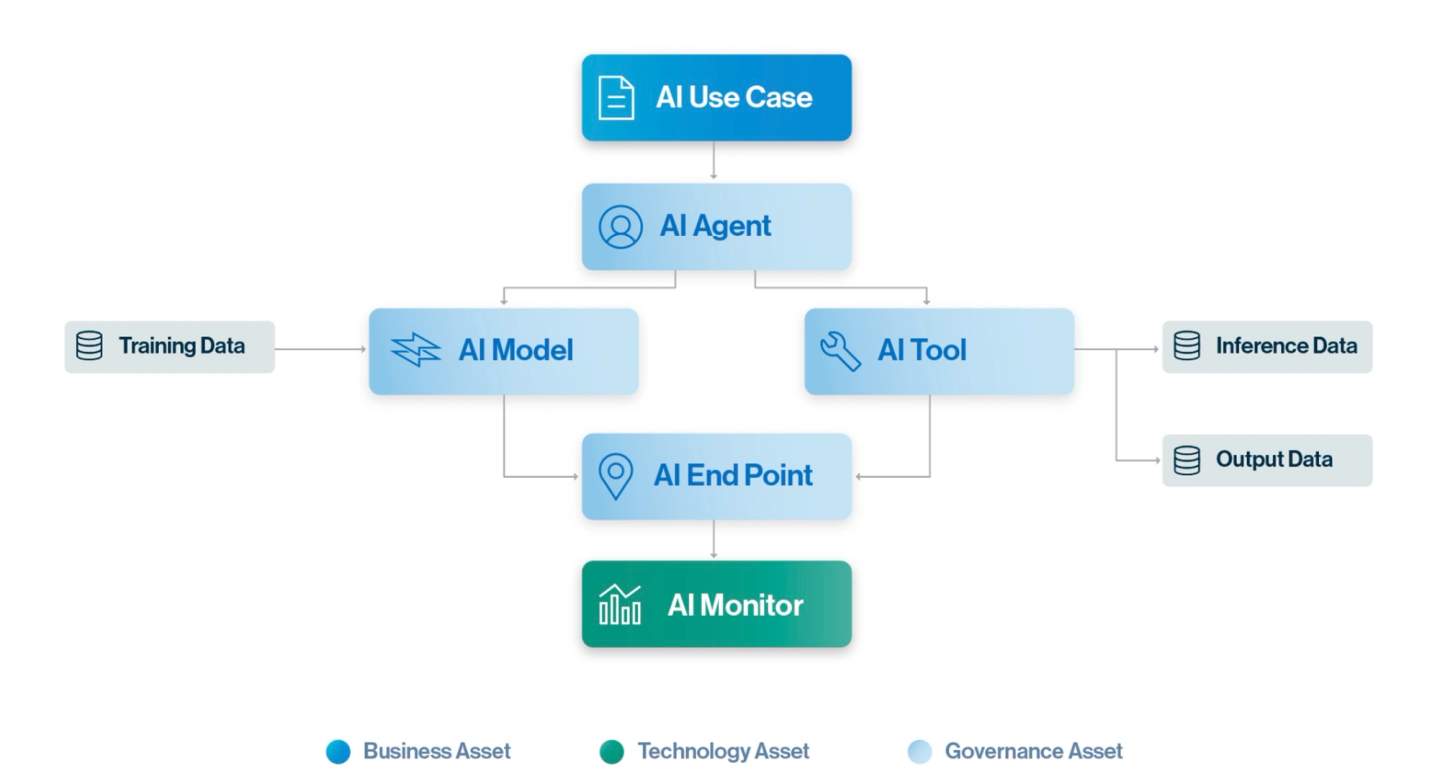
AI Command Center connects AI use cases, agents, models, tools, data, runtime endpoints, and production monitoring into a single operating model, providing end-to-end governance and traceability across the AI lifecycle.
Why you should be excited
Our new operating model empowers every stakeholder, including data leaders, engineers, and risk teams, to gain full visibility, clear accountability, and reliable control over their entire AI agent estate.
Chief Data / AI Officer
- One system of record for every agent, model and use case — see the full AI estate and prove it is under control
- Connect agents to business outcomes and owners, so investment and accountability are clear
Head of AI Engineering / ML engineers & AI product owners
- Register an agent once and govern it everywhere — versions, tools and deployments tracked without leaving your build workflow
- Visualized dependencies make it clear which models and tools an agent relies on before you ship a change
Risk, Compliance & CISO
- AI Monitor and traceability provide the evidence needed to show what an agent can do and how it has been controlled
Use cases
See how our integrated governance framework simplifies complex workflows, enabling teams to proactively map dependencies and generate audit-ready evidence for every agent.
- Mapping an agentic workflow: A customer-service agent calls a base model plus three approved tools and delegates to another agent. Teams visualize the full dependency chain to spot blind spots and single points-of-failure before production.
- Audit-ready agent evidence: When a regulator or internal auditor asks what an agent does, who owns it, which data it touched, and how it was approved, the connected model surfaces this information in one place.
Key takeaways about AI Agent governance
By making agents first-class governed assets connected to use cases, models, tools, data and monitors, AI Agent governance delivers a unifying structure, operation, and oversight in one place. From experimenting with agents to operating them at scale, AI Agent governance gives organizations the visibility, trust signals and control they need to act with confidence.
Three things you should take away:
- Agents are now first-class governed assets, connected to the business outcomes, owners, models, tools and data they depend on
- A single connected data model reveals agent dependencies and reduces operational blind spots across agentic workflows
- Built-in monitoring, lifecycle status, approved tools and trust metrics let you govern agents consistently at scale within the AI Command Center
Where to learn more about AI Agent governance

Roeland Herrebosch
Roeland Herrebosch
Product Manager
Collibra

David Talaga
David Talaga
Product Marketing Director
Collibra

Pankuj Chachra
Pankuj Chachra
Senior Director of Engineering
Collibra
Share on:
Related articles
Data GovernanceFebruary 14, 2025
Why we are the data and AI leader for you

August 27, 2025
Why predictive modeling matters to higher education institutions

Data GovernanceJanuary 25, 2022
Gaining control of personal information ahead of CPRA

Data LineageJanuary 27, 2022
Accelerate IFRS-17 Compliance with Data Intelligence Platform
Keep up with the latest from Collibra
I would like to get updates about the latest Collibra content, events and more.
Thanks for signing up
You'll begin receiving educational materials and invitations to network with our community soon.