










Data has gravity. Context does too.
Share on:


Make sure context pulls your enterprise together, not apart.
Data has gravity. Context does too. Make sure context pulls your enterprise together, not apart.
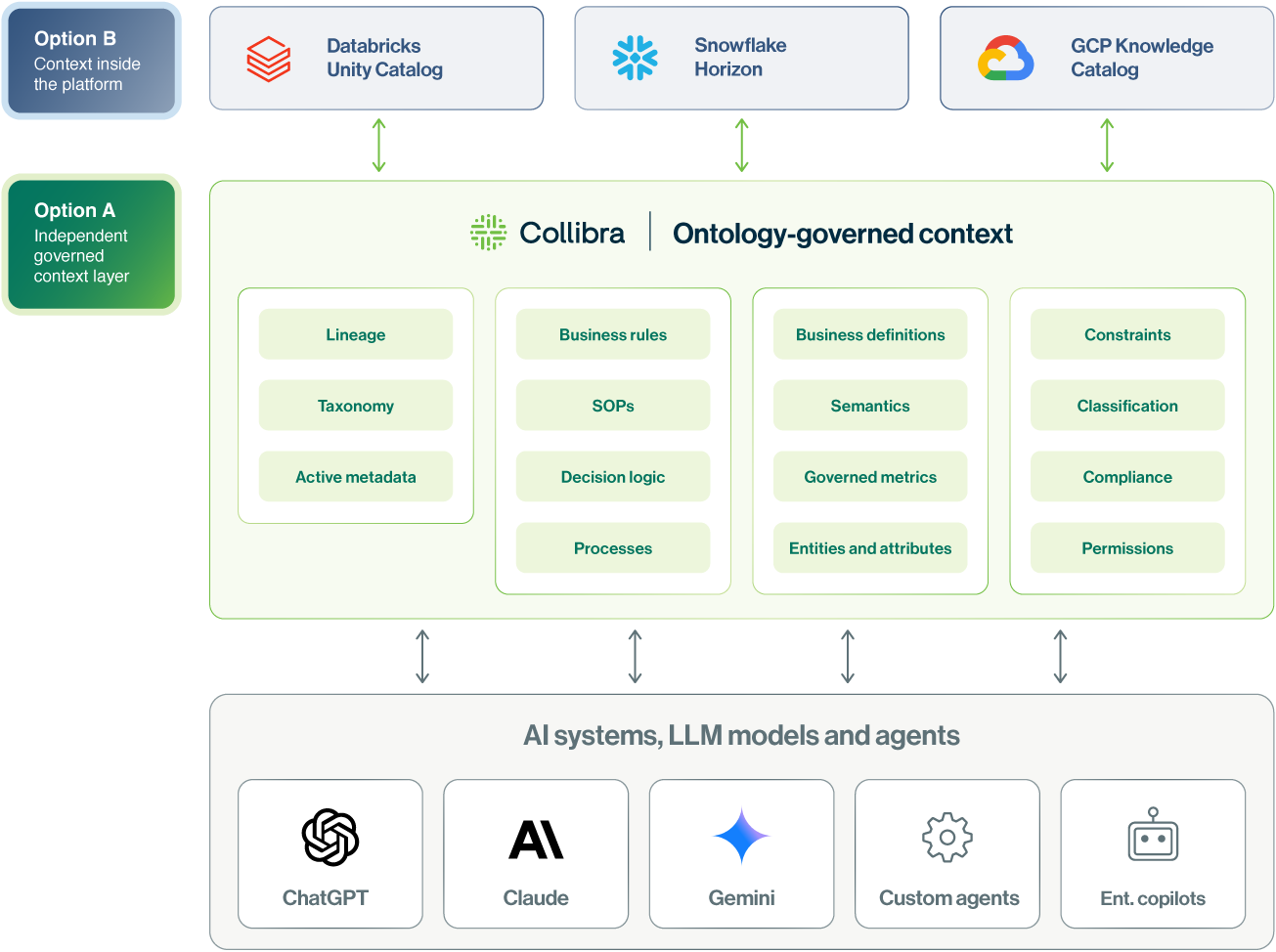
Every cloud platform is racing to build a context layer for AI. Databricks shipped Unity Catalog Business Semantics. Snowflake has Horizon. Google introduced the Cloud Knowledge Catalog. Each is good at what it was built for.
The question is not which catalog. The question is where your entire organization's ontology lives. That decision determines whether context pulls your enterprise together or apart, whether your agents reason on one truth or many.
The fragmentation problem
No enterprise runs on one platform. Customer records sit in Salesforce. Financials in SAP. Lakehouses in Databricks. Warehouses in Snowflake and BigQuery. Contracts and emails in SharePoint. Some are still running an on-prem database; they haven't retired in twenty years.
So what does "customer" actually mean? In the CRM, it's a person who signed a contract. In the data warehouse, it's an account with active billing. In the product analytics tool, it's anyone who logged in last quarter. Three definitions, three teams, three reasonable answers. A human analyst reconciles them in a meeting. An AI agent doesn't go to meetings.
Every cloud catalog quietly does the same thing. It encodes its own version of customer — and revenue, and active user, and every other business term that matters — inside its own walls. Each one is internally consistent. None of them agrees with the others. That's not one ontology. That's a federation of fragments. Every agent reaching across them inherits the contradiction and pays the hallucination tax — in wrong answers, wasted compute, and regulatory risk.
What we proved at KU Leuven
KU Leuven, founded in 1425, is Belgium's highest-ranked university and one of the oldest in Europe. It's where we ran the test.
We wanted to know how much governed context actually changes what an agent gets right. Not on a slide. On real data, with the answers known in advance. So we ran the test.
We took anonymized data from our preview program and put it on Databricks. Then we made it hard on purpose. We renamed the tables to look like a cryptic legacy ERP — the kind of system most large enterprises are actually running underneath everything else. We pointed a Claude agent at it. Thirteen questions, verified answers, two runs. One run had Collibra's governed context in the loop: definitions, lineage, and quality signals, retrieved at the moment of the question. The other run didn't. Same model. Same data. One variable.
The agent without context didn't refuse to answer. It guessed. Asked how many active testers a project had, it found a column called engagement status, added up the records marked "completed" and "viewed," and confidently returned three. The agent with governed context retrieved the actual definition of an active tester — someone who had filed at least three feedback tickets or finished at least two surveys — checked it against the data, and found that nobody qualified. The right answer was zero.And the wrong answer wasn't the only thing it cost. The agent without context worked harder to get there — more queries, more reasoning steps, more tokens spent chasing a definition it never had. Governed context hands it that definition up front, so it reaches the right answer in fewer moves and burns less compute doing it.
Across all thirteen questions, the agent with governed context got 92% right. Without it, 62%. The failure rate dropped fivefold.
But the average hides the finding that matters. On the easy questions, the ungoverned agent mostly got away with it. On the hard ones — the multi-step, definition-dependent questions a CFO actually asks — it went zero for four. Not one right. And it was confident every time.
That's the pattern. Governed context doesn't make a good agent a little better. It decides whether you get a right answer or a confident wrong one, exactly where the stakes are highest.
Context gravity cuts both ways
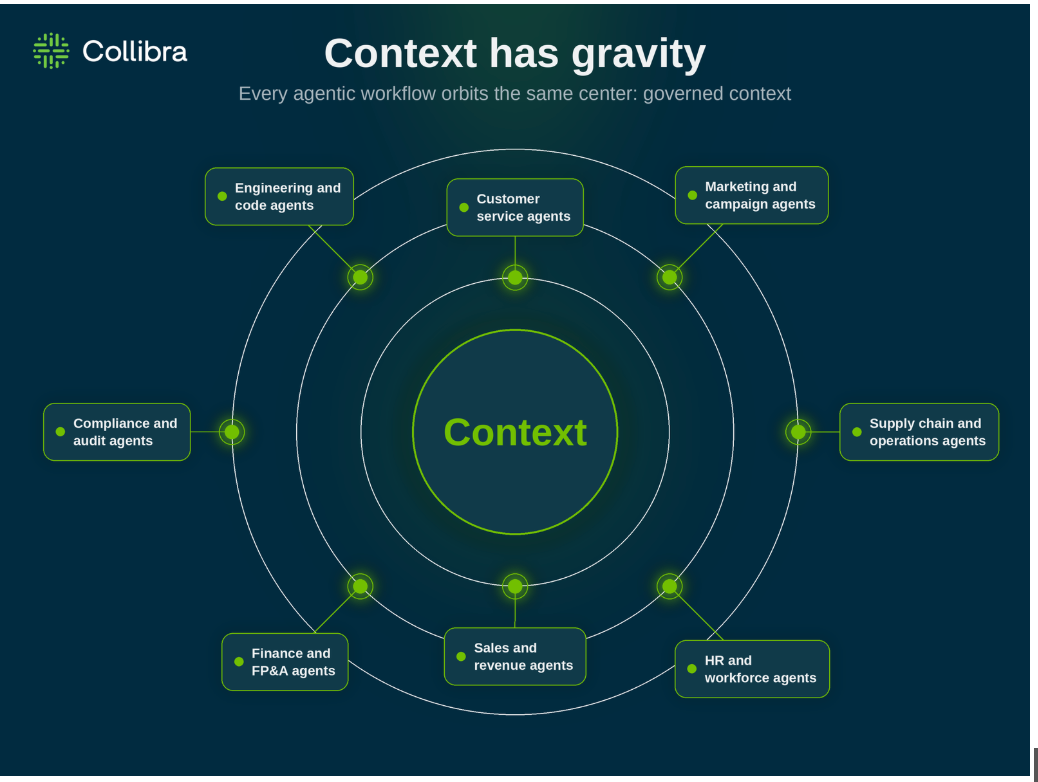
Here is the part most architects haven't priced in yet. Wherever your governed definitions, relationships, and policies pile up, your agents get pulled toward that place. They reason from it. They depend on it. Data gravity pulls workloads toward storage. Context gravity pulls reasoning toward meaning. Same mechanic, one layer up.
Put your context inside a single cloud catalog and you've built a new kind of lock-in. Not at the storage layer, where everyone is watching. At the intelligence layer, where almost no one is. Your definitions take that vendor's shape. Your agents reason from a context layer that only covers part of your estate. Everything outside that bubble is inference. And at agent scale, inference is just guessing with confidence.
Put your context in a neutral layer that every platform reads from and writes to, and the gravity flips. Now it pulls your enterprise toward one governed truth instead of fragmenting it across silos. Your agents draw from the same context whether they run on Databricks, Snowflake, BigQuery, or something you haven't bought yet.
Same force. Different vector. The vector is the part you control.
Why the layer has to be neutral
Cloud catalogs can't be neutral. A vendor that makes money from execution will optimize its catalog for its own execution engine first. That's not bad faith. That's economics. Third-party integrations exist, but they're additions to an ecosystem built around first-party services — not the foundation of a platform built to sit above all of them equally.
The layer that holds your context has to have no engine to favor and no compute to upsell. Otherwise the pull goes the wrong way.
There's a sharper way to say it. In the SaaS era you won by owning the system of record. In the agent era you win by owning the layer that decides which agents can act, on what data, with what limits — and can prove what happened afterward. The advantage is moving from the source of truth to the source of permission. No vendor that sells the platform can credibly be the neutral party that governs a rival's agents running on top of it.
The Collibra position
This is what Collibra was built for, eighteen years before agents made it urgent.
Collibra is the Enterprise AI Control Plane. Platform-agnostic by design. We govern context and control across any data, any model, any agent. Our ontology-powered approach gives AI leaders the certainty to move at the speed of AI.
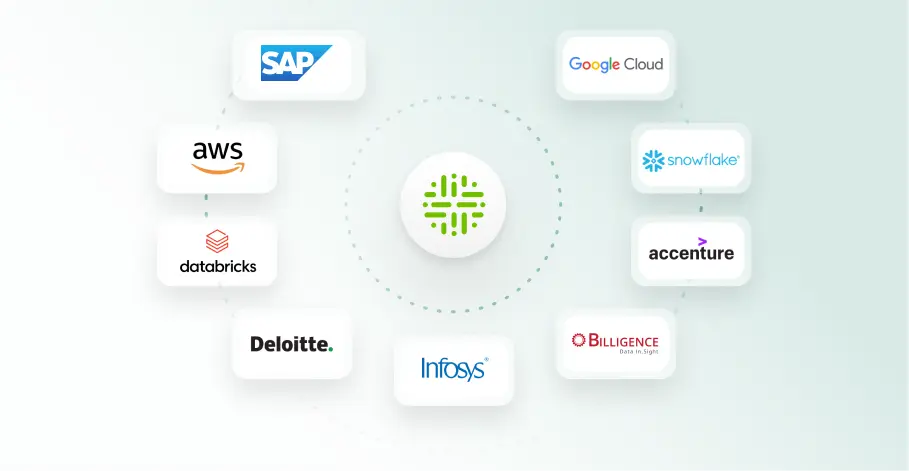
We sit above every platform you already run and send the same governed context to every system your agents reach. And most of that context never lived in a table. It's in the contracts, the call logs, the decks, the email threads — where the real definitions and the exceptions actually live. Cloud catalogs were built to read tables, not documents, so that context stays dark. Deasy Labs, now part of Collibra, reaches into it, pulls the meaning out, and governs it like everything else. Open standards push all of it outward — to Databricks, Snowflake, Google Cloud, and any agent framework that knows how to listen. Which is the whole point: your context stays yours. Built to travel, not to take our shape. No vendor owns it — not even us.
Databricks named Collibra its 2026 Governance Partner of the Year. Databricks customers run Collibra on top of Unity Catalog for exactly this reason. Unity Catalog governs the Lakehouse. Collibra governs the enterprise — including Databricks.
The window
The decision being made in boardrooms this quarter — which layer holds your context, which engine your agents are built to depend on — is not a software purchase. It's an architectural commitment. The cost of getting it wrong is not the cost of swapping a tool. It's the cost of unwinding everything built on top of it for the next ten years.
Data has gravity. Context does too. Make sure it pulls your enterprise together, not apart.

Tom Dejonghe
Tom Dejonghe
Vice President Product, Data Governance
Collibra
Share on:
Keep up with the latest from Collibra
I would like to get updates about the latest Collibra content, events and more.
Thanks for signing up
You'll begin receiving educational materials and invitations to network with our community soon.