










Customer zero: How Collibra built an org-wide AI analyst on its own governed context
Share on:


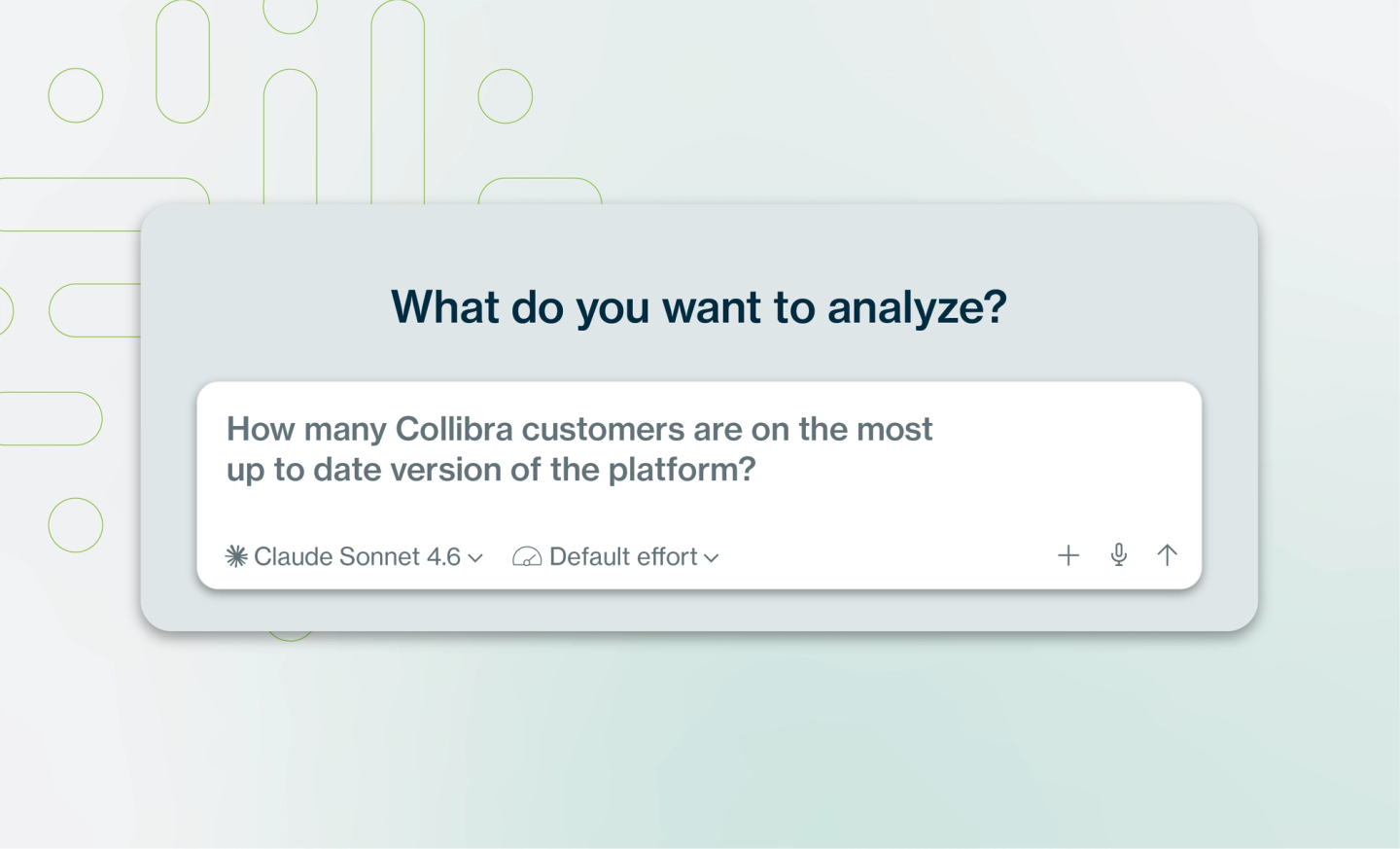
We built our own internal AI analyst, named it Dwight, and pointed it at our internal data. And no, before you ask, not that Dwight from The Office. Though ours is also weirdly obsessed with facts. This one's an agent we built ourselves. The real work was in the context: feeding Dwight the right slices of company data so its answers actually hold up. And we want to walk you through how we did it.
I grabbed some time with Dmytro Protsyk, Sr. Director of Strategy Operations at Collibra, to get into how Dwight came together, how we keep the context behind it honest and what it would take for you to build something similar.
– Meredith Bailey, Senior Product Marketing Manager at Collibra
Why we built Dwight
Meredith: So what is Dwight, plainly?
Dmytro: Dwight is Collibra’s internal agentic analyst: an AI analyst that queries data for you. You ask a question in plain language, and it figures out the answer the way a human analyst would. The intention was to provide the entire company insights at the speed of AI, grounded in context we actually trust and govern, instead of everyone waiting in a queue for one of a handful of analysts.
Meredith: What was the intent around building Dwight, and what problems were you trying to solve?
Dmytro: Two problems that pointed to the same solution. The first was scale. We were seeing employees across the organization ask harder questions than ever. They wanted insights, and we wanted to make sure they got answers faster. We needed self-service at the speed of AI. In 2026 you can build an AI system that approximates a skilled human analyst, so that's what we did.
The second problem was conviction. We've always tried to be ahead of where our customers are on managing data, and we wanted a first-hand opinion on what makes AI analytics succeed,because almost nobody had one yet. The directive had two parts. One was to build as much as you can and generate real learnings, so we can speak to customers from a place of confidence. The other was to give the org true self-service analytics, where anyone can ask a question and get an answer without learning a new tool, filing a ticket, or waiting on someone else.
The real work — governing context
Meredith: What can Dwight do that a generic LLM can't, precisely because it has Collibra's context?
Dmytro: An agentic analyst's accuracy depends almost entirely on the completeness and quality of the context provided. The analogy I use: hire an analyst who's written SQL but knows nothing about your company, connect them to a database, and don't let them talk to anyone. Ask "How's our revenue performance?" The answer will be poor. Start telling them where things live, how you measure things, and how you talk about them, and it improves dramatically. Collibra was the natural place to start. We govern our own data with it, so the organizational context was already there and well-tended: physical descriptions, business terminology, logical and semantic modeling and privacy controls. Injecting that into our agent was the easy part.
Meredith: How do you decide what context to give Dwight, and what to keep out?
Dmytro: Mostly empirically. Every time we change what's in Dwight's brain, we run evals. It's a simple loop, and I think Anthropic runs something similar: you give it a question plus a reference answer you trust, let Dwight take its own swing at it, then compare. Did it land the right number? How many tokens did it burn? Faster or slower? You come out of it with empirical evidence that tells you whether the change helped or hurt. So context has to earn its spot. Nothing goes in just because it happens to exist.
Meredith: A lot of people assume more context is always better, the same way they used to think more data was always better. How did you land on the right-sized context window?
Dmytro: Right, and past a point it's just wrong. There's a bell curve. More context helps until it doesn't, and then it hurts you. The more you pile in, the more tokens it costs, and the likelier Dwight (or any AI agent) is to grab the first halfway-decent thing it finds and rabbit-hole on it while the better answer sits somewhere else. The classic mistake is dumping ten thousand files into one folder and hoping. It'll grab whatever's on top and looks promising.
The fix isn't less context, it's better-organized, governed context. We think about it like a pyramid: the handful of lenses the business looks through at the top, then the playbooks under each, then the metrics, then the tables. So instead of wandering, Dwight walks a path that makes sense. That's what the physical, logical, and business layers are for when they're linked up right. They give Dwight a structure to reason.
There's also the "same word, different places" problem. "Customer" might show up in a dozen spots. We use the semantic model to build a logical view over everything, so Dwight reliably goes to the right one, and once those relationships are mapped it doesn't have to hop around to connect things. That's not just an accuracy win. It makes Dwight faster and cheaper to run, and we watched all three improve at once as the context got better.
Meredith: How does that governed context actually get from Collibra into Dwight's hands at the right moment?
Dmytro: That's where the Collibra governed context compiler comes in. We didn't want to write custom scripts every time Dwight needed to pull a metric definition, a semantic model, or a business term. The context compiler lets us define exactly what to extract from the Knowledge Graph, like semantic models, governed measures, approved synonyms, and ownership then delivers it in a structured format Dwight can actually use. So when someone asks Dwight a question, it's not guessing at what "monthly active users" means. It's pulling a governed, structured answer from a single source of truth. The pyramid I described? The context compiler is what makes it traversable for an AI agent, not just legible to a human.
Meredith: How do you ensure context doesn’t get stale or drift?
Dmytro: The fun part is that we run AI on the AI. It's very meta: Dwight logs its own conversations, so we literally ask Dwight how Dwight is being used. Periodically, someone on the team looks at what people asked, where it errored, where it got stuck in a loop and we have an agent read the context repository and propose fixes. We test those with evals, ship them and watch what happens.
That feedback loop is also pointing us toward a context engine, a layer that doesn't just serve governed context to Dwight, but continuously enriches the relationships between assets so the agent always has the freshest, most relevant slice.
We're automating more of that, the reflection, the proposed change, updating the context, but there's always a human giving the final approval, because whoever owns a piece of context should be the one to approve a change to it. And people underestimate how fast context goes stale. The physical and logical layers barely move. The business layer moves a lot, strategy shifts, priorities shift, the way leaders talk about things shifts. If nobody's maintaining it, it drifts, and every answer quietly gets a little worse. That's exactly the job a governance layer is supposed to do.
What this means inside Collibra
Meredith: Who's using it today, and for what?
Dmytro: We rolled it out like we'd roll out any new product at Collibra. A small internal preview first, then wider public preview across teams, and gradually opening access enterprise-wide. Usage spans the company: designers pulling live data to inform product decisions, teams prioritizing what to build next, people assembling narratives for executive decks, and analysts validating and auditing data. The pattern underneath all of it is the real story: analyzing quantitative and qualitative data together, fast.
Meredith: With this new agent, how has it changed how your team works?
Dmytro: It changes the job; it doesn't remove it. The work shifts from personally answering every question and building reports and dashboard to making the thing that answers them as sharp as it can be. Honestly, that's the more interesting job. It lets us move quicker and get the right answers into the right hands sooner.
If you want to build your own agent
Meredith: We hear this constantly: “leadership wants agents, but the team has no catalog, no marketplace, no governance”. If a customer wants to replicate Dwight, where do they start?
Dmytro: Philosophically, just start. Don't wait for the perfect plan. You'll learn more in two weeks of using something rough than in two months (or more) of designing something perfect on paper.
On scope, pick one use case and grow from there. Don't try to boil the ocean. Start where your data's already in decent shape so you get a win early. And start with the "why" and "how" questions, the research-y stuff, not the things that have to be right to the decimal. Don't make your first project the finance bot that has to nail every number. The magic is when it pulls numbers and text together at the same time, like connecting a spike in adoption to customer sentiment and feedback in NPS scores. That's the moment people go "oh."
Technically, start from a good data model. Garbage in, garbage out still applies, and if anything AI makes bad inputs worse, faster. If you've got nothing written down, don't spend six months documenting metrics by hand. Take whatever you already have that looks like code, SQL, dashboards, and let AI reverse-engineer how you actually do things. Then put that context somewhere it can be governed, so it doesn't rot.
Meredith: What's the next frontier for Dwight?
Dmytro: The thing Dwight taught us is that governed context at setup is table stakes. The harder problem is runtime: an agent that can retrieve precisely the right slice of context as it's reasoning, not one that was pre-loaded with everything you thought it might need. That's what we're working toward next, a new feature you'll be hearing about in the near future that links structured and unstructured knowledge through an ontology graph, so Dwight can navigate to the right answer the way a knowledgeable human would, following relationships, not just searching text. The agent gets faster. And the maintenance burden shifts from "curate everything upfront" to "govern the graph and let the engine do the retrieval."
Meredith: If you had to sum it up?
Dmytro: The model is the easy part. The durable advantage is context. Capturing it, structuring it into a pyramid the agent can navigate, governing it so it doesn't drift, and evaluating relentlessly. That's not a side project you bolt on afterward. It's the whole game. We learned that as customer zero, so hopefully the next person doesn't have to.
Dwight is our proof point, but the real story is context governance — the discipline of managing the context that makes AI go. If leadership is asking you to build agents and you're staring at a blank page, governed context is the place to start.

Meredith Bailey
Meredith Bailey
Product Marketing Director
Collibra

Dmytro Protsyk
Dmytro Protsyk
Senior Director, Strategy Operations
Collibra
In this post:
Share on:
Related articles
Collibra PlatformMay 21, 2024
Collibra wins prestigious 2024 Communicator Award for AI Governance campaign
AI Command CenterJuly 15, 2024
How to observe data quality for better, more reliable AI

Data GovernanceNovember 13, 2023
AI ethics and governance: responsibly managing innovation

Context GovernanceApril 10, 2026
AI agents: Build or buy, governance becomes the differentiator
Keep up with the latest from Collibra
I would like to get updates about the latest Collibra content, events and more.
Thanks for signing up
You'll begin receiving educational materials and invitations to network with our community soon.