For years, AI strategy has been built on a simple premise: either quality or quantity, preferably both, of data leads to better outcomes. That premise justified major investments in data platforms, pipelines, people, processes, and storage, enabling organizations to scale data access across the enterprise.
In many ways, that effort succeeded. Data is now abundant, accessible, and continuously generated. For many traditional AI applications, organizations have invested heavily in curating structured datasets.
Yet despite this progress, modern AI systems still struggle to deliver consistent, explainable, and trustworthy results in production environments. Outputs vary. Decisions are difficult to justify. Issues appear gradually rather than as clear failures. This suggests that the limiting factor is no longer access to data, but the ability to understand it. And as AI systems increasingly shift from sources of knowledge to sources of action — calling tools, triggering workflows, making decisions — the cost of that context gap only grows."
The gap between processing and understanding
AI systems are highly effective at processing inputs and identifying patterns. Progress has also been made in understanding the context of an individual user — their preferences, history, and intent. But organizational context is a far more complex problem. AI systems today lack awareness of the broader system in which their inputs exist. They do not inherently understand how datasets relate across domains, how definitions differ between teams, or how outputs are used in downstream decisions. They are not aware of dependencies between systems or the implications of change.
As a result, they operate with a partial view of reality. This becomes more pronounced as systems scale. An AI system that performs well in isolation can produce outputs that are misaligned once integrated into a broader environment of pipelines, dashboards, and operational workflows. The model continues to function, but the system becomes harder to interpret and coordinate.
This is not a limitation of the models themselves. It is a limitation of system-level understanding.
Context as the missing layer
Context provides the structure that allows data to be interpreted consistently. It connects technical elements — datasets, models, and processes — to their meaning and usage within the organization. It includes governance policies, ownership, lineage, quality rules, business definitions, and the relationships between all of them. It answers questions such as what data represents, where it is used, what depends on it, and what happens when it changes. Without this layer, AI systems can generate outputs but cannot fully assess their relevance or impact. This is why technically correct results can still lead to incorrect decisions. Context does not replace data. It enables it to be used reliably.
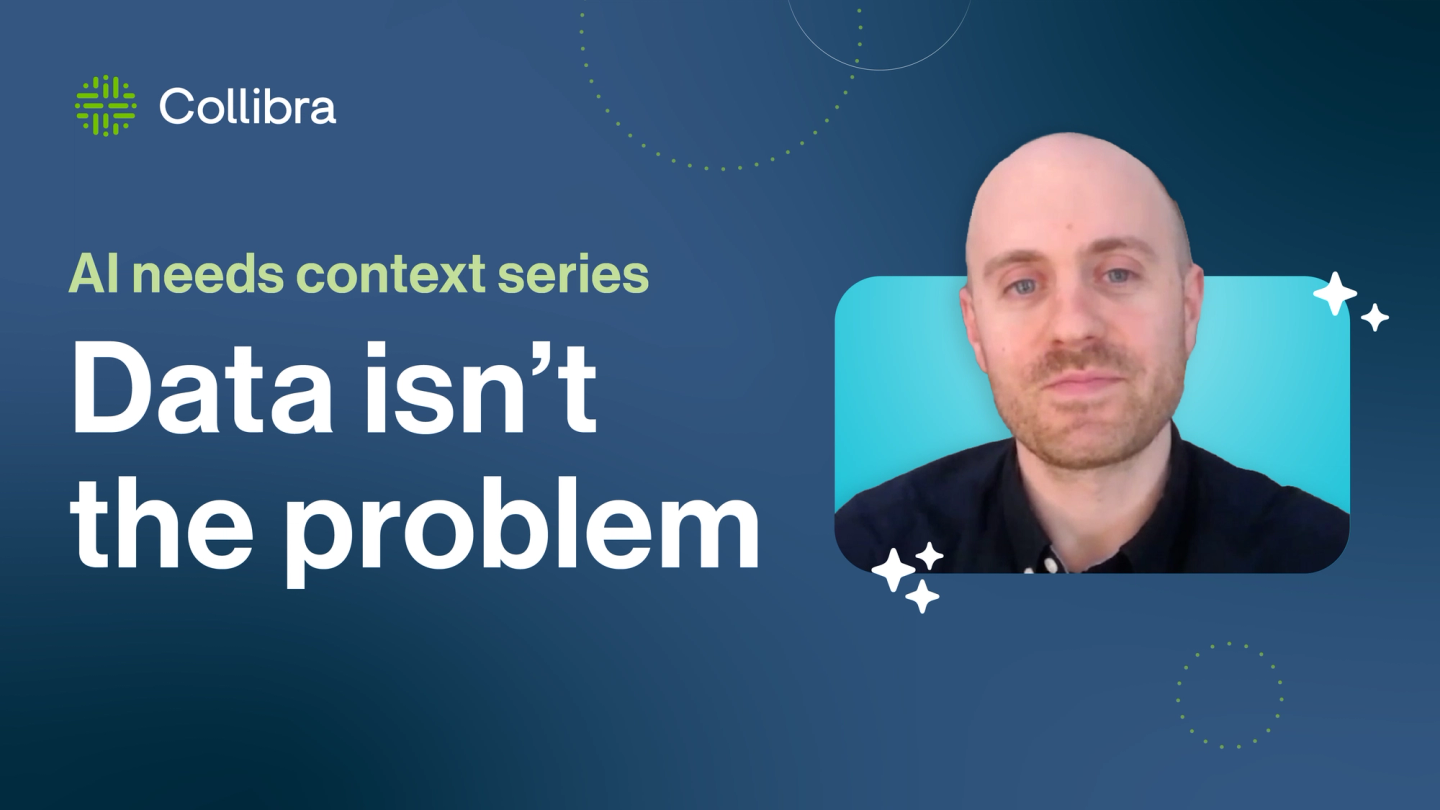
Video: AI needs context: Data isn't the problem
Share on:
Metadata as the foundation of context
Metadata is the mechanism through which context is captured and maintained. It describes the origin of data, its meaning, its ownership, and its relationships to other assets. It exposes how information flows across systems and makes dependencies visible.
Historically, metadata has been associated with governance—ensuring consistency in reporting and clarity in data usage.
In the context of AI, its role expands significantly.
AI systems depend on interconnected flows of information across platforms and teams. In such environments, metadata becomes the only scalable way to maintain coherence. It allows organizations to align definitions, trace dependencies, and establish a shared understanding of how systems operate.
In this sense, metadata is not just descriptive. It is structural.
When context fails, systems drift
The absence of context rarely results in immediate failure. Instead, it creates gradual misalignment. A data definition changes, but the structure remains the same. A model continues to run, producing outputs that appear valid.
Downstream systems continue to consume those outputs based on outdated assumptions. Nothing breaks, yet over time decisions become less reliable.
This is the nature of context failure. It does not interrupt systems. It erodes them.
Teams spend more time validating outputs, results vary across environments, and investigations require coordination across multiple systems with limited visibility. These are not isolated inefficiencies but indicators that context is not being captured effectively.
Toward a context-driven architecture
As AI systems scale, managing them as isolated components becomes increasingly difficult. Organizations operate interconnected ecosystems of models, pipelines, and applications.
In this environment, context must be treated as a first-class citizen. It is what provides AI systems with a foundation of truth — not just about data itself, but about how that data relates to the organization around it. This requires a layer that connects systems, provides visibility into relationships, and ensures alignment of core business concepts across teams. Such a layer enables organizations to understand interactions, anticipate change, and maintain consistency at scale. At its core, this is a context layer built on metadata and designed to operate across the AI lifecycle.
How Collibra helps: bringing context into the AI runtime
As AI evolves toward agent-based architectures, context must be available at the moment decisions are made. AI agents actively select tools, access datasets, and trigger actions. Without context at runtime, these decisions lack grounding. Collibra AI helps build and maintain this context — curating data quality, governance, and relationships — and the Collibra MCP server, available in the Databricks Marketplace, makes it consumable at runtime. Agents can dynamically query whether data is certified, assess quality, understand ownership, and evaluate policy constraints before acting. This enables a shift from passive to embedded governance, where context becomes part of decision-making itself. By making metadata accessible in real time, organizations reduce manual validation, limit risk, and create a more reliable foundation for scaling AI.
The first phase of AI focused on accumulation—collecting and processing data at scale. The next phase is defined by understanding. Understanding how systems connect, how meaning is established, and how decisions are shaped by the interaction of data, models, and processes. Data is no longer the primary constraint. Context is. And when structured through metadata and made accessible at runtime, context becomes the foundation for building AI systems that are coherent, reliable, and trustworthy, powering a competitive advantage through data.
What comes next
If context makes data usable, the next challenge is understanding how that context behaves across systems. Because even with structured data, AI still struggles to interpret workflows, dependencies, and operational constraints. In the next article, we explore why large language models still don’t understand systems and what that means for enterprise AI.