








SAP Signavio + Collibra: Where process meets governance
Share on:


When process and governance teams work in isolation, they can't reliably show where data originates or whether it's trustworthy, and closing that gap pays off. SAP Signavio reveals how your business actually operates; Collibra clarifies what your data means. Bring them together, and accountability becomes traceable all the way through, from a live business process down to the individual data asset behind it.
What’s new: SAP Signavio Integration
Collibra now offers a native integration that extracts metadata directly from SAP Signavio and brings it directly into the Collibra Platform. Process models, business dictionary entries and related objects that once lived only inside Signavio become governed, searchable and linkable assets alongside the rest of your data landscape, with no manual export, no copy-paste and no parallel maintenance. This is a purpose-built integration, designed specifically for Signavio's process-centric model. The first general availability release is built to do one thing exceptionally well: clean, reliable metadata extraction.
By pointing the integration at your Signavio instance, the relevant process and dictionary metadata flows into Collibra, ready to be governed. It's the foundation that finally lets process context and data governance live in one place.
How the SAP Signavio integration helps
For most organizations, process knowledge and data governance are two separate worlds. Business analysts document how invoicing, fulfillment or onboarding actually works inside Signavio, while stewards and architects govern the underlying data inside Collibra, and the two never meet. The result is duplicated effort, blind spots in impact analysis and a recurring inability to answer basic questions like: "Why does this field exist?" or "What process writes to it?" When regulators ask you to demonstrate accountability from a business operation down to a specific data element, that disconnect becomes a genuine risk. The SAP Signavio integration closes it.
Problems it solves
Our integration with SAP Signavio solves these problems:
- Process context is invisible to data teams: Data stewards and analysts can finally see which business process touches a given data asset, making impact analysis and data-quality root-cause investigation far faster.
- Duplicated governance effort: Teams maintain the same business terms in Signavio and Collibra with no synchronization. The integration lets Signavio act as the system of record for process-driven terminology and Collibra as the activation layer.
- Broken process-to-data lineage for compliance: Regulations such as DORA, BCBS 239 and GDPR increasingly require demonstrable accountability from business operation to data element, and this integration lays the groundwork for that chain.
- Slow, retrofitted SAP program governance: For S/4HANA and SAP Datasphere programs, the to-be process landscape is already in Signavio; pulling it into Collibra puts governance ahead of go-live instead of bolted on afterward.
How the SAP Signavio integration works
The integration connects directly to your SAP Signavio instance and moves metadata rather than the underlying transactional data. It synchronizes the names, descriptions and relationships between data concepts and business processes into Collibra, so you can analyze how data is used across different business processes. In practical terms, this means:
Signavio → Collibra: Business process context flows into Collibra, linking data assets to the processes that use them.
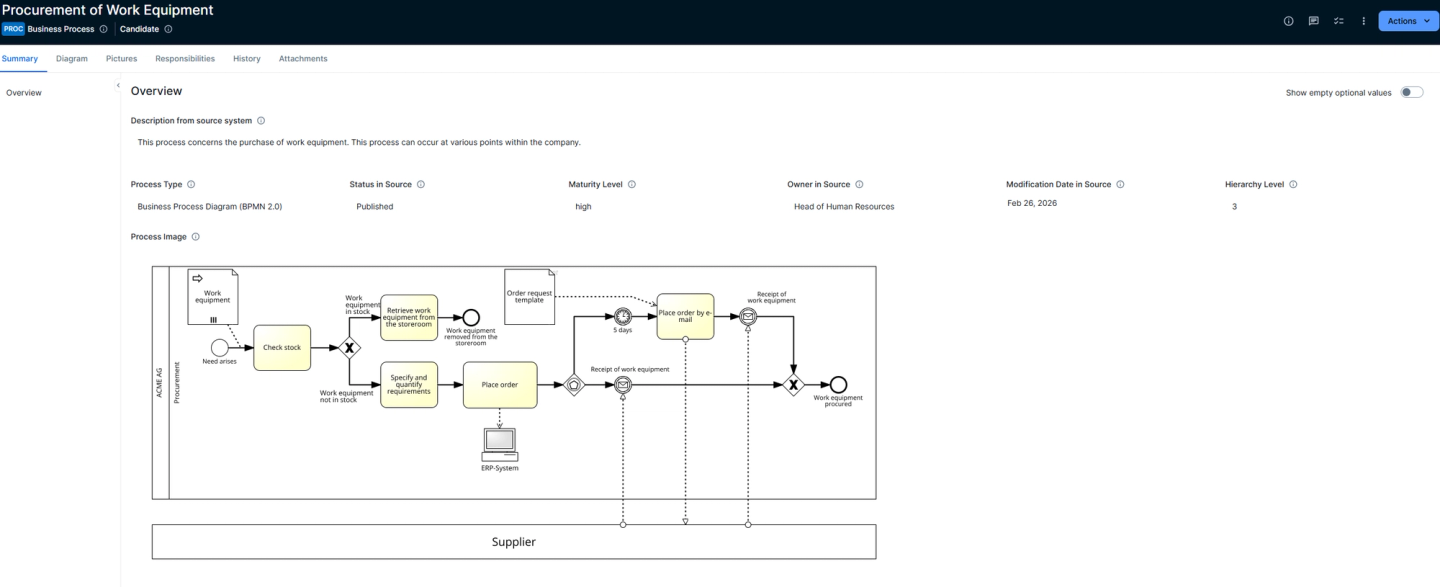
Procurement of Work Equipment' from SAP Signavio, now a governed asset in Collibra with its BPMN diagram and source metadata intact.
This is a purpose-built integration rather than a JDBC-driver connection, and that distinction matters. Signavio's model is process-centric, not table-centric, so a generic relational driver would miss the structure and relationships that give process metadata its value. This approach maps Signavio's objects into Collibra's asset model, so process knowledge arrives as first-class, connected metadata.
Once ingested, it behaves like any other asset in Collibra: Signavio's Business Dictionary entries, which capture the business's own definitions of concepts like "Invoice," "Customer," or "Delivery Date," surface in Collibra's Business Glossary as reusable, searchable governance artifacts that can be linked to data assets, policies and lineage.
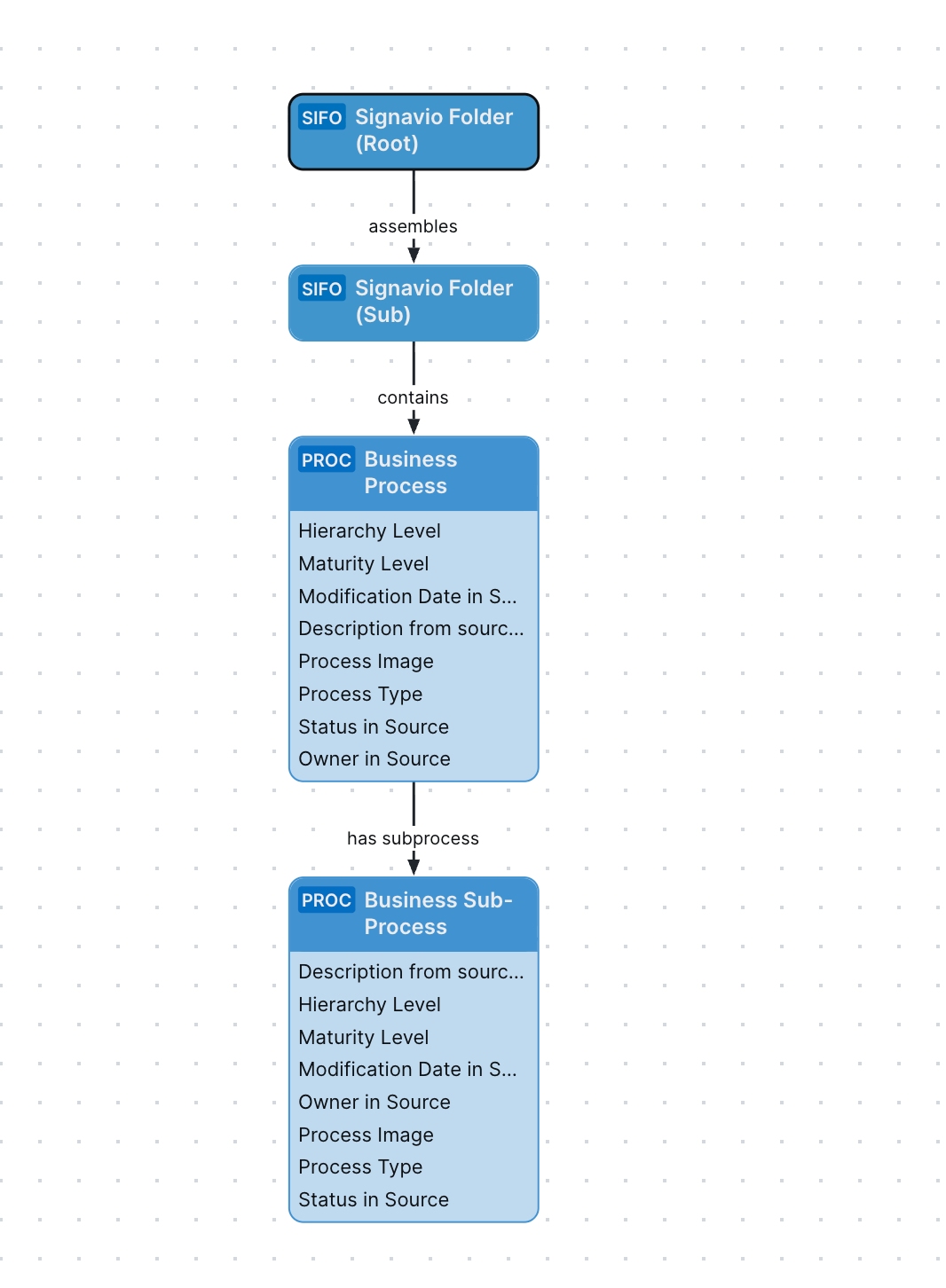
Shows the relationships between SAP Signavio asset types—Signavio Folders, Business Processes, and Business Sub-Processes—and the cardinality of the relation types in each asset's assignment
Why you should be excited
- Process-informed data governance: In Collibra, data stewards and analysts can map data domains and concepts to the business processes that use them, revealing how data flows across the organization and making regulatory and compliance requirements easier to meet.
- Connected process context: Process metadata arrives as structured, connected assets rather than ad-hoc documentation, so Data Architects and Engineers can trace how business operations relate to the data landscape they maintain.
- Regulatory and compliance confidence: Keeping business processes aligned with data domains and concepts is essential for any organization with obligations around data use and process transparency.
Use cases
- Align data mesh or data product initiatives: Keep process ownership and data ownership in sync as you stand up domains and products.
- Prove process-to-data accountability for regulators: Linking Signavio process objects to Collibra data assets and lineage lets compliance teams trace a DORA or BCBS 239 chain end-to-end, and show where AI-training data originated.
- Harmonize business terminology: Signavio's Business Dictionary becomes the system of record for process-driven terms, surfacing in Collibra's Business Glossary as governed terms linked to real data assets.
Key takeaways
Collibra gives you trusted data, Signavio gives you optimized processes, together they give you trusted processes built on trusted data, which is the foundation for reliable AI, compliant operations and confident decision-making.
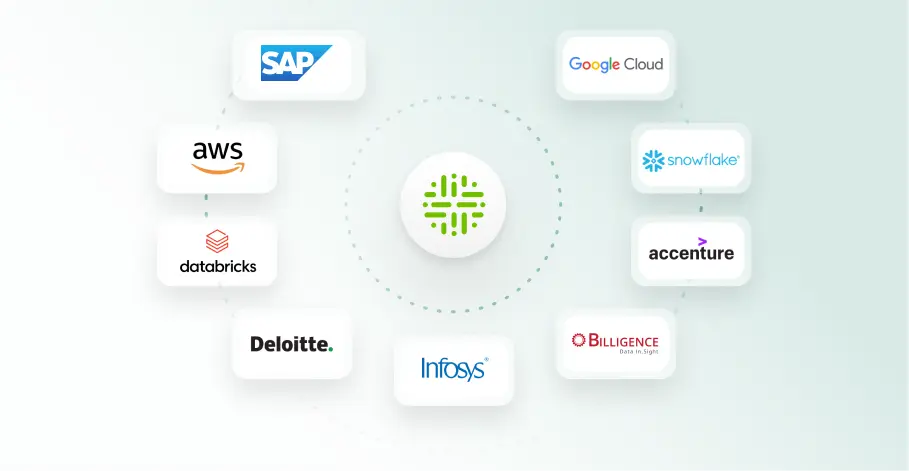
The SAP Signavio integration brings two halves of the enterprise together: the process intelligence that explains how your business runs, and the governance layer that explains what your data means. It's a differentiated capability, a purpose-built integration rather than a generic connector, and it strengthens Collibra's position within the SAP ecosystem alongside our broader SAP partnership. For the many organizations running S/4HANA and Datasphere programs, it's a way to make governance proactive rather than retrofitted, and to make AI initiatives auditable from the start.
Where to learn more about the SAP Signavio integration
For more details, please refer to Collibra Product Documentation.

Martin Ochotský
Martin Ochotský
Senior Product Manager
Collibra

Meredith Bailey
Meredith Bailey
Product Marketing Director
Collibra

Yuvraj Prashar
Yuvraj Prashar
Software Engineer
Collibra
Share on:
Keep up with the latest from Collibra
I would like to get updates about the latest Collibra content, events and more.
Thanks for signing up
You'll begin receiving educational materials and invitations to network with our community soon.