









Guardian Agents: Keep AI agents in control at runtime
Share on:


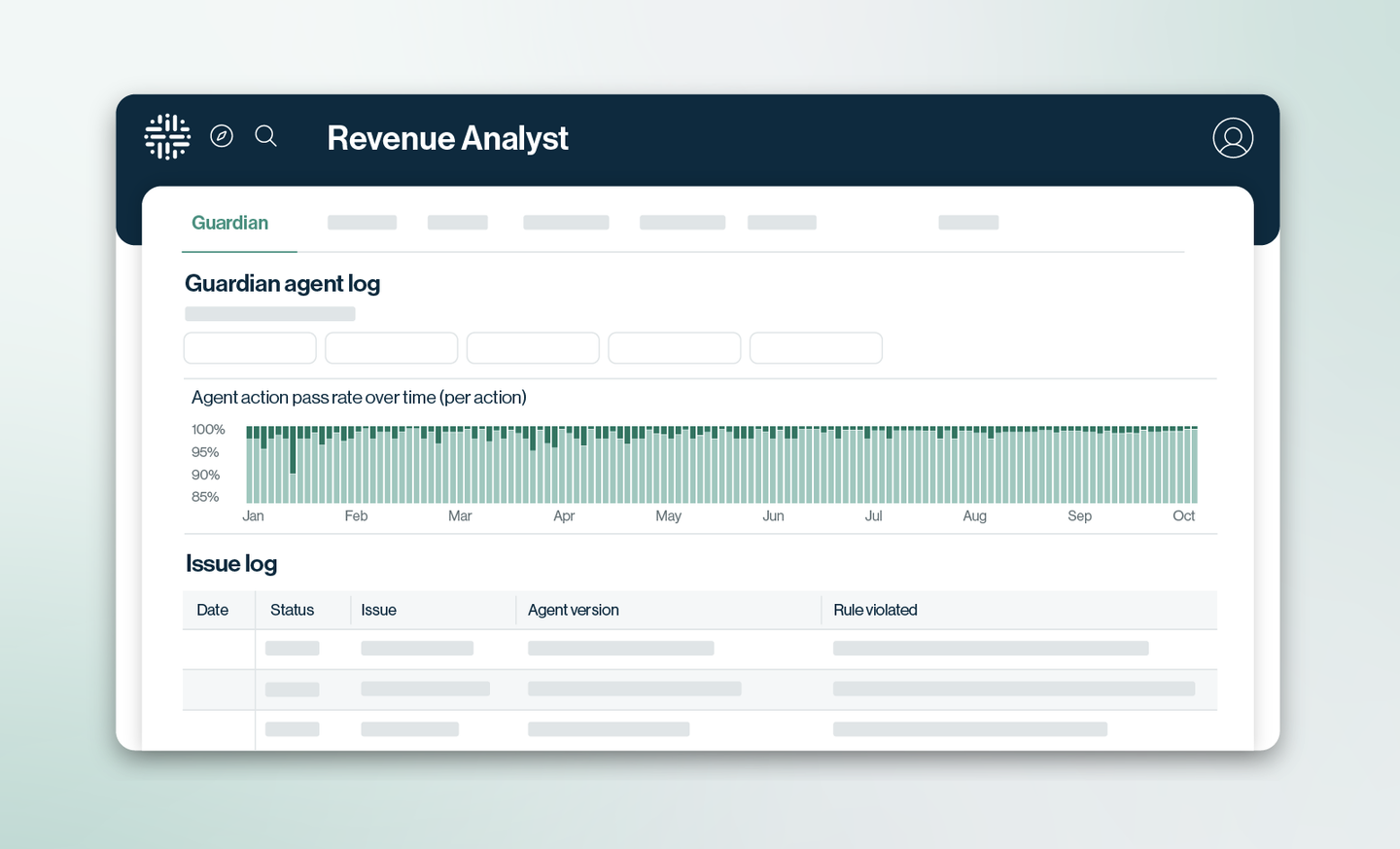
AI agents are moving from experimentation into production — and the stakes are rising fast. An agent can access sensitive data, call tools, interact with enterprise systems, and take actions autonomously. As agent fleets grow, organizations can no longer rely on policies written at deployment or periodic reviews to stay in control. They need to continuously supervise what agents are actually doing and intervene when they move outside established boundaries.
What's new: Guardian Agents
That’s where Guardian Agents come in. Guardian Agents are a new AI Command Center capability that extends control into runtime, continuously supervising how AI agents actually behave against the controls established for them. They help organizations identify when an agent moves outside its intended boundaries and take the appropriate response — from flagging and escalating an issue to redirecting behavior or blocking unauthorized actions.
Guardian Agents work together with Agent Contracts, which define the layered, machine-readable controls that establish how agents are expected to operate. Agent Contracts set the boundaries; Guardian Agents supervise whether those boundaries are respected at runtime. Together, they create a continuous approach to agentic control: define how agents should operate, supervise what they actually do, and intervene when they go off track.
How Guardian Agents help
Approving an agent for production doesn’t mean it will always behave as intended. Once deployed, an agent can use unauthorized tools, access data outside its approved scope, or take actions that fall outside its established boundaries. As agent fleets grow, manually reviewing those actions becomes impossible. Runtime telemetry can show what an agent did, but organizations also need to determine whether that behavior was acceptable based on the controls established for that agent. Guardian Agents close that gap by continuously supervising agent behavior and identifying when agents move outside their boundaries.
Problems it solves
- Point-in-time governance: An agent can be approved for production but later behave outside the boundaries established for it.
- Limited runtime oversight: Organizations struggle to connect what an agent is actually doing with the controls that define what it should be allowed to do.
- Controls that don’t scale: Manually supervising the actions of hundreds or thousands of agents becomes impossible as the agent fleet grows.
- Disconnected governance and runtime behavior: Policies and controls can remain separate from the systems where agents actually operate.
- Limited ability to respond: Detecting unexpected behavior is not enough — organizations need to identify violations and take the appropriate action when agents go off track.
How Guardian Agents works
Guardian Agents extend the controls defined for an agent into its runtime environment. The process starts with Agent Contracts, which establish layered, machine-readable controls based on factors such as an agent’s specialty, function, risk profile, and operating context.
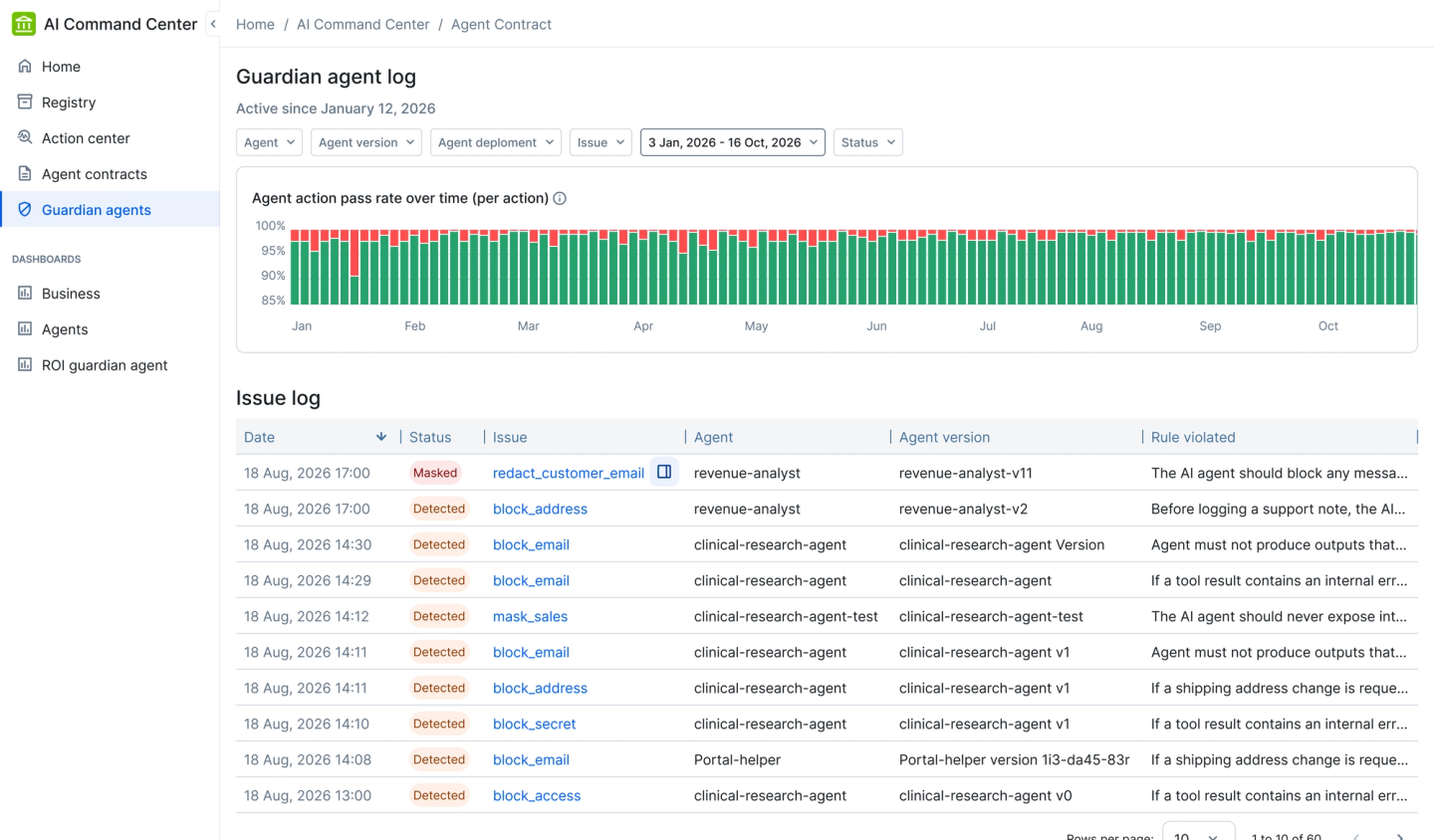
Once the agent is running, Guardian Agents continuously supervise its behavior against the controls that apply to it. Runtime activity provides the evidence needed to determine whether the agent remains within its intended boundaries including how it interacts with data, tools, systems, and other resources.
When behavior falls outside those boundaries, Guardian Agents identify the violation and provide the context needed to understand what happened and which control was breached. Organizations can then apply the appropriate response, ranging from visibility and escalation to redirecting behavior — or, when block mode is enabled, stopping unauthorized actions before they occur.
This creates a continuous control loop between what an agent is supposed to do and what it actually does, allowing organizations to maintain oversight as their agent fleet and level of autonomy grow.
Why you should be excited
Head of AI Governance
- Continuously understand which agents are operating outside established controls.
- Focus governance teams on exceptions instead of manually reviewing every agent action.
- Connect runtime behavior back to the governance requirements established for each agent.
- Maintain evidence of how agent behavior is being supervised over time.
CIO / CTO
- Maintain visibility and control as the organization moves from individual agents to an enterprise agent fleet.
- Understand whether agents stay within their intended operating boundaries after deployment.
- Progressively move from monitoring toward stronger runtime enforcement where needed.
- Scale agent adoption without relying on manual oversight to scale with it.
AI producer / Agent owner
- Understand when an agent’s actual behavior diverges from its intended operating boundaries.
- Identify whether the issue involves data access, tool usage, permissions, or another control.
- Get the context needed to correct the agent’s behavior rather than receiving a generic governance failure.
Use cases
Prevent unauthorized data access
A customer-support agent is authorized to access customer account information but not employee HR data. Its applicable controls establish those boundaries. If the agent attempts to access a salary dataset, Guardian Agents can identify that the behavior falls outside its established controls, flag the violation, and trigger the appropriate response before sensitive information is exposed.
Keep autonomous actions within approved boundaries
A procurement agent can search approved suppliers and prepare purchasing recommendations but isn’t authorized to execute transactions above a defined threshold. Guardian Agents supervise its runtime behavior against those controls and identify when an attempted action exceeds its authorized scope, enabling the organization to escalate or block the action.
Maintain control across a growing agent fleet
An enterprise operates agents with different responsibilities, data access, tools, and levels of autonomy. Rather than manually reviewing each agent, Guardian Agents continuously supervise runtime behavior against the controls that apply to them, allowing governance teams to focus on agents and actions that move outside established boundaries.
Key takeaways about Guardian Agents
Guardian Agents extend governance from defining how agents should operate to continuously supervising how they actually behave in production. Working with Agent Contracts, they help organizations identify when agents move outside established boundaries and take the appropriate response — from visibility and escalation to stronger enforcement where needed. This creates a scalable approach to maintaining control as organizations move from individual agents to growing agent fleets.
Three takeaways
- Agent Contracts define the boundaries; Guardian Agents supervise whether agents stay within them.
- Runtime supervision connects enterprise controls with actual agent behavior.
- Organizations can progressively move from visibility and escalation toward intervention and blocking unauthorized actions.
Where to learn more about Guardian Agents
Agentic AI changes the governance challenge from simply understanding what AI is being used to maintain control over what autonomous systems actually do. Agent Contracts establish the boundaries. Guardian Agents extend those controls into runtime, helping organizations continuously supervise agent behavior and intervene when agents go off track.
Learn more:
→ Explore AI Command Center
→ See Guardian Agents and Agent Contracts in action at the Collibra AI Summit

Shikhar Vaish
Shikhar Vaish
Senior Product Manager
Collibra

David Talaga
David Talaga
Product Marketing Director
Collibra

Michael Maes
Michael Maes
Senior Manager, Software Engineering
Collibra
Share on:
Keep up with the latest from Collibra
I would like to get updates about the latest Collibra content, events and more.
Thanks for signing up
You'll begin receiving educational materials and invitations to network with our community soon.