
















Governance by design: Automatically enforce standards with the AI-powered writing assistant, smart checks and lifecycle management
Share on:



As organizations accelerate AI adoption, deploying agents and automating decision workflows, the underlying assets those systems depend on will determine whether they succeed or fail. To ensure these initiatives succeed, organizations are moving away from passive documentation and embracing governance by design. This operational shift directly addresses Gartner's warning that 60% of AI projects will be abandoned due to poor data readiness, emphasizing that data governance must become deeply embedded in day-to-day data management. Instead of treating data oversight as a retroactive activity, this approach integrates active guardrails right into daily stewardship workflows, instantly validating and enforcing asset integrity the exact moment a steward creates or edits them.
What’s new: Governance by design tools — AI-powered writing assistant, smart checks and lifecycle management
Operationalizing governance by design means embedding asset verification directly into the daily stewardship experience. To support this approach, Collibra is introducing three new capabilities in Public Preview this June, designed to work together to help stewards maintain asset integrity as they work:
- The AI-powered writing assistant removes the blank-page barrier that keeps governance content incomplete. When a steward edits a text attribute, an AI button appears directly in the editor. One click generates a contextual draft using the full asset context (e.g., name, type, relations and existing attributes). Prompt configuration lets teams define tone, structure, length and output language, so generated content stays consistent across stewards and can be produced in multiple languages simultaneously. The steward reviews, refines if needed and accepts.
- Smart checks validate asset content automatically, right where stewards work. Configured in minutes, they evaluate attributes, relations and roles directly on the asset page. And when a steward edits a field, the relevant standard surfaces inline at the point of edit. No switching tabs, no guessing what "good" looks like. Standards are enforced where the work happens.
- Lifecycle management now extends beyond AI asset types to cover nearly all asset types in Collibra, including business glossary terms, critical data elements (CDEs), data products, custom asset types and more. Assets follow a defined path from creation to publication, with tailored activity gates (including smart checks) that must be cleared before an asset can advance stages.
How the governance by design tools help
Building a trusted data catalog is a significant achievement, but keeping that metadata accurate and up-to-date as the organization scales is a constant operational challenge. Even with dedicated stewards, manual documentation processes can struggle to keep pace with daily business changes, leading to incomplete descriptions, unmapped relations or unverified assets. The challenge isn't a lack of commitment; it's that traditional governance processes often rely on retroactive actions rather than real-time support. These three new capabilities work together to close that gap, transforming governance from an isolated, manual chore into a supportive, built-in part of a steward's daily routine.
Problems these capabilities solve
- No inline guidance: Stewards traditionally complete fields without knowing if they meet governance standards until a later review. Smart checks solve this by displaying instant, pass/fail feedback directly on the attribute the moment content is created or changed.
- Blank-page paralysis: Stewards frequently leave definitions incomplete simply because they do not have the time to draft descriptions from scratch or don’t know where to start. The AI-powered writing assistant removes this barrier, generating a contextual, standard-aligned draft in seconds to turn documentation into a quick review task.
- Informal publishing decisions: Without a defined process, determining whether an asset is truly "ready" for consumption often depends on informal, manual alignment. Lifecycle management makes the publication path explicit, trackable and structurally consistent across stages.
- Manual, reactive reviews: Periodic bulk reviews and spot-checks are slow and consistently ignored under time pressure. Smart checks make governance self-maintaining: the platform enforces standards automatically on every content change.
- Ungoverned data feeding AI: As AI agents and automated flows consume data products and business terms at scale, incomplete or unverified metadata directly undermines the integrity of AI outputs. Governance by design helps ensure that assets consumed by AI have passed defined standards before they are ever published.
How the governance by deign tools work
The three capabilities can be used separately but are most effective when used together: The AI writing assistant helps stewards quickly populate asset details, smart checks instantly validate that documented assets meet your standards and lifecycle management helps ensure assets do not reach data consumers until they have cleared every required gate.
- The AI writing assistant is activated per characteristic in the Collibra operating model. Administrators can draft a primary instructions prompt specifying the target audience, minimum length, structure and tone, and can test it against real assets before enabling it for stewards. To accelerate setup, Collibra ships a library of out-of-the-box template prompts covering common governance characteristics, so administrators have a tested starting point rather than building from scratch. When a steward opens the attribute in edit mode, an AI Assistant button appears in the editor toolbar. Clicking it reveals options to generate new content from scratch (using the full asset context and the configured prompt) or to improve existing content with actions such as Summarize, Make shorter, Make longer or Change tone. Upon review (and editing if needed) the steward can accept and save the output.
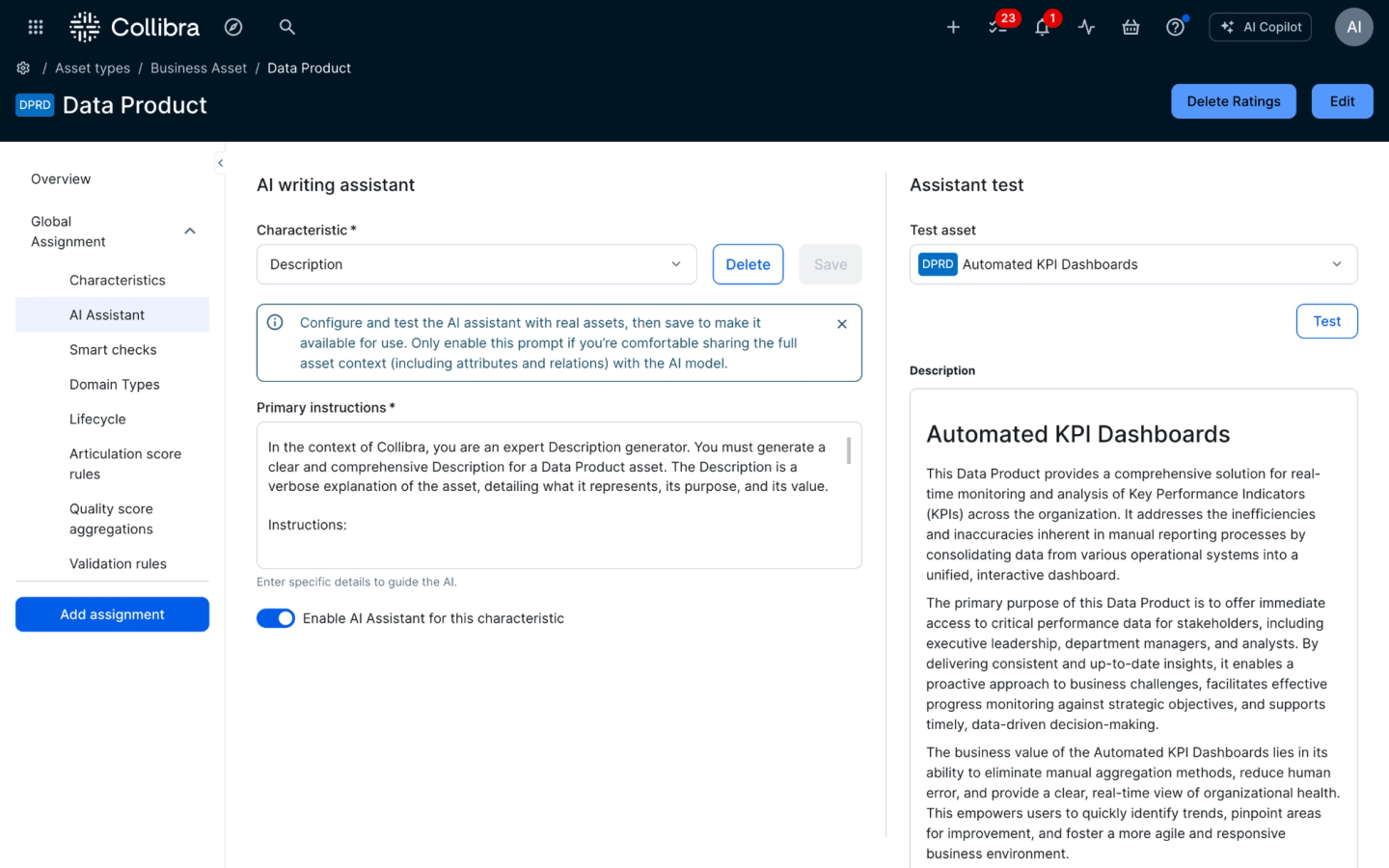
Teams can configure the AI writing assistant by setting up primary prompt guidelines, selecting target characteristics and testing text generation accuracy using actual assets before deployment.
- Smart checks are entirely no-code, meaning a first check can be created in under a minute. Each check governs a single parameter: one attribute type (string, numeric, date, boolean or selection) or one relation type, with one or more criteria that must be met. Checks evaluate automatically on every content change and results appear instantly on the asset page, directly next to the validated attribute. No manual trigger or page reload is necessary.
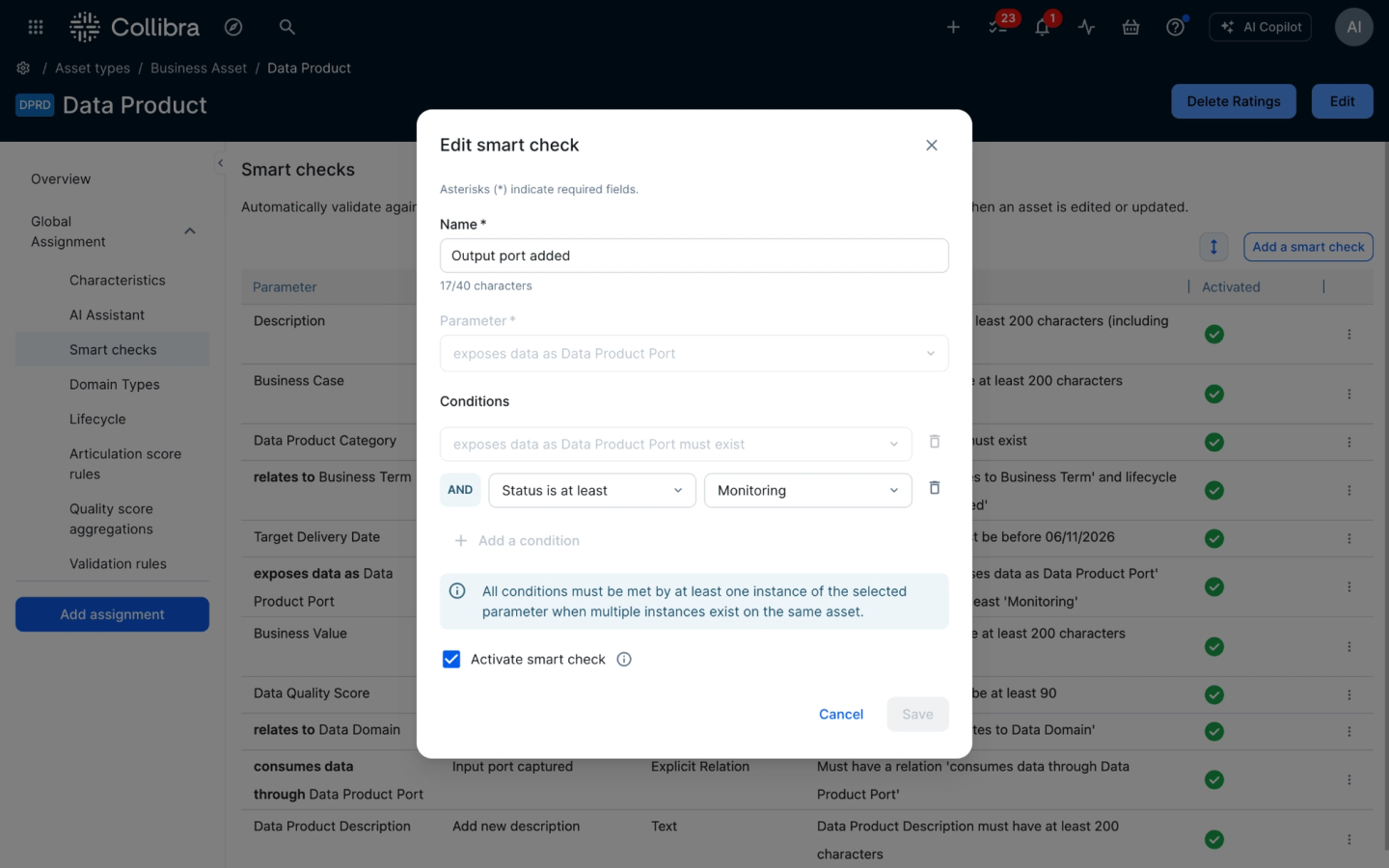
Users can establish no-code smart checks by matching asset parameters with precise validation conditions, like checking if a relation exists or if a status is active, to instantly enforce standards without manual reviews.
- Lifecycle management, previously available for specific AI assets in Collibra, now expands to cover nearly all asset types. It introduces two phases: a core phase for active assets moving through governance stages, and a retirement phase for assets that are no longer active such as archived or rejected assets. Within the core phase, flexible activities control how assets transition between stages. These activities can include form-based assessments, role-based sign-off approvals or automated smart checks.
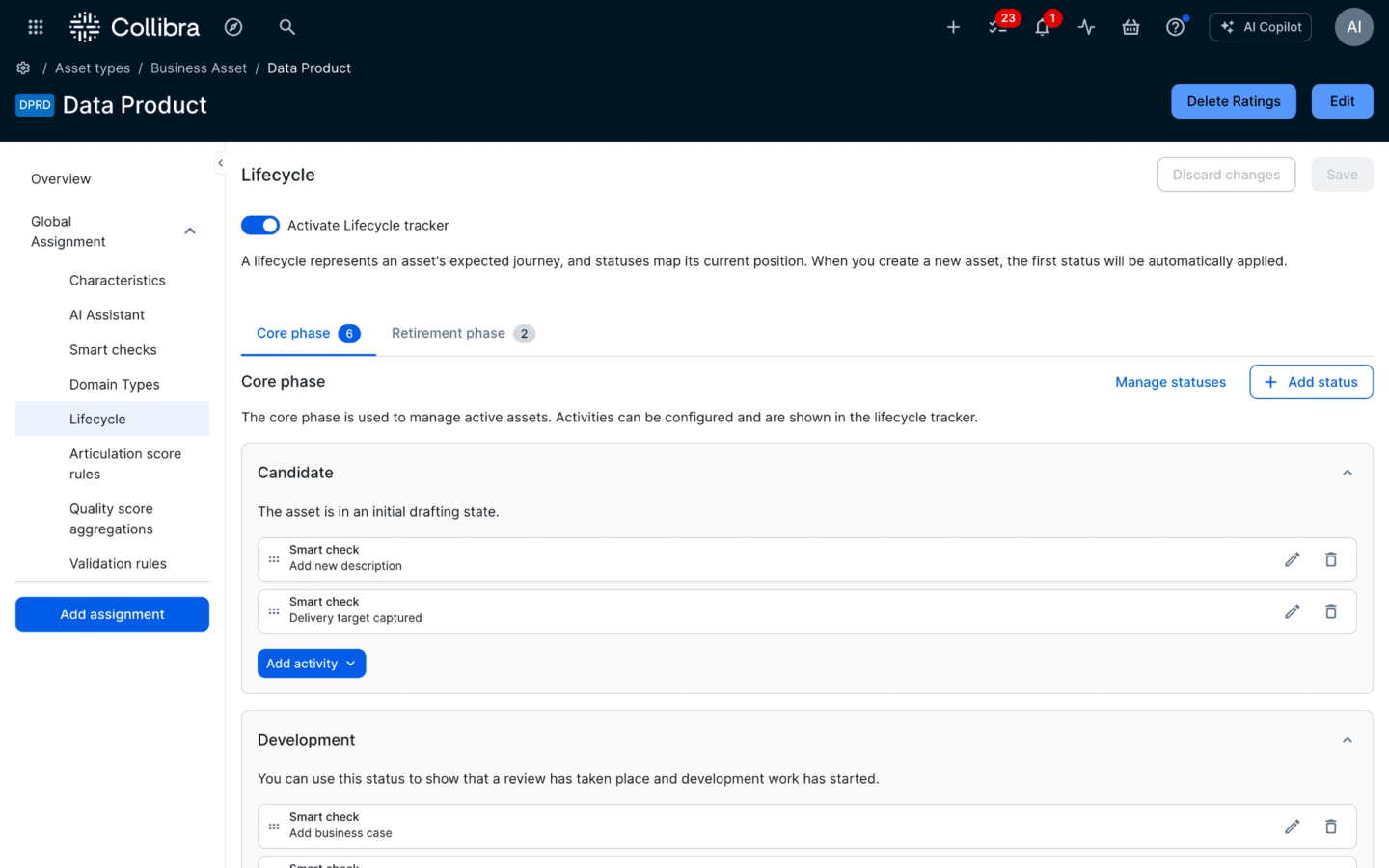
Administrators can track an asset's expected journey from creation to publication by defining core and retirement phases and configuring specific activities, like form assessments or smart checks, that must be cleared to advance.
Why you should be excited
By embedding intelligent automation directly into stewardship workflows, these features transform data governance from a manual challenge into a guided, high-efficiency experience for every member of your team.
- Data Governance Managers: Define your standards once (including smart check rules, lifecycle stages and AI prompt instructions) and enforce them automatically across every asset. Because every stage transition is backed by completed activities, the governance process becomes inherently traceable, verifiable and completely audit-ready without requiring manual oversight.
- Data Stewards: Real-time feedback instantly shows you what is missing, while the AI assistant helps you document asset details in seconds. With the lifecycle tracker mapping out exactly what is recommended to progress, governance transitions from a manual guesswork exercise into a guided, intelligent experience.
- Data Consumers: Gain absolute confidence that every published asset has cleared strict gates. Descriptions are complete, relations are mapped and ownership is verified, meaning integrity is built into assets, not just assumed.
- Data Leaders & AI Teams: Enable your downstream automation, analytics and AI models to be fueled by verified assets. By embedding validation at the point of creation, you eliminate the risk of unverified data products undermining AI outputs, creating a reliable foundation for enterprise-scale automation.
Use cases
Governance-by-design excels in high-friction areas where manual scaling is difficult. By replacing traditional oversight with automated validation, these features streamline complex processes from regulatory compliance and data product creation to responsible AI development. Below are some sample scenarios illustrating how AI-powered drafting, real-time smart checks and lifecycle management simplify day-to-day operations:
- Critical data element management for compliance: For organizations managing strict regulatory reporting requirements (such as BCBS 239 or DORA), Collibra will include out-of-the-box (OOTB) lifecycle configurations and a predefined CDE asset type tailored specifically for compliance use cases. Rather than building frameworks from scratch, teams will be able to deploy a predefined framework right away. The preconfigured lifecycle guides CDEs from initial identification through formal review to publication. Concurrently, smart checks automatically enforce that every CDE has a verified risk classification, a linked regulation and an assigned data owner before it can ever be used in reporting. This helps ensure full traceability and auditability for regulatory submissions, structurally enforced by the Collibra platform rather than assembled manually via spreadsheets.
- Governed data product publication: Organizations can establish tailored progression paths for publishing data products, preventing assets from going live without documentation and verified relationships. The process begins as the AI writing assistant pulls from the asset's existing context (such as output ports, domain and related assets) to draft a comprehensive description in seconds, which the steward then reviews and accepts. Next, automated smart checks instantly evaluate the asset against your specific parameters, verifying, for example, that the description meets your required minimum length and that the necessary data contract relation is mapped. Once these automated checks pass and the assigned data owner signs off, the data product clears its final gate and publishes automatically, bypassing the need for slow, manual administrative reviews.
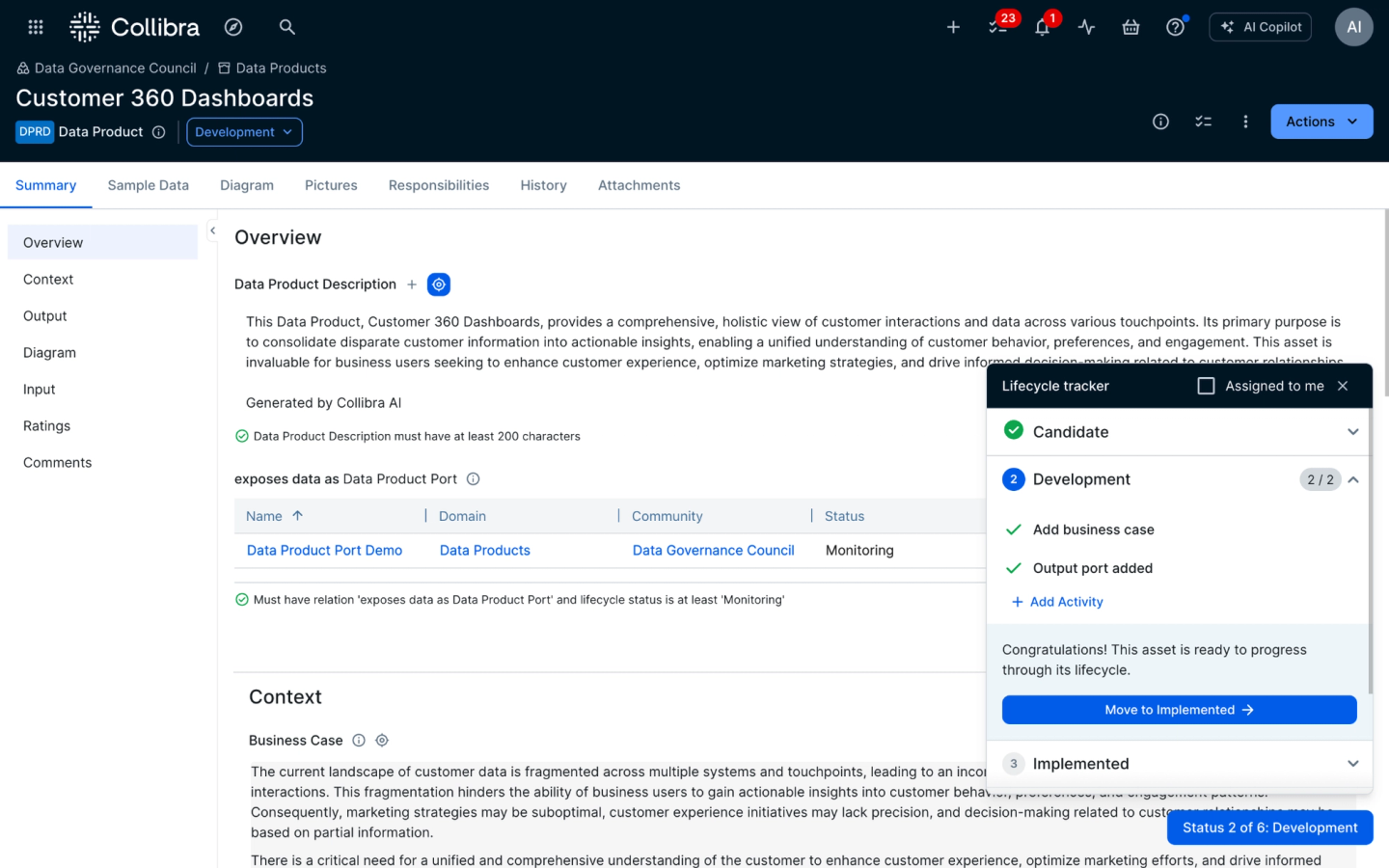
Governance by design in action on a live data product asset page ("Customer 360 Dashboards"). This unified experience showcases an AI-generated description, passing inline smart check badges and a sidebar lifecycle tracker guiding the steward to the next stage.
- Responsible AI governance: Deploying AI models at scale requires verifiable compliance, but manual tracking often stalls development. Organizations can address this by embedding tailored accountability checks directly into the AI development lifecycle. When a team proposes a new AI Use Case, the AI writing assistant can accelerate the initial paperwork by translating the underlying technical asset context into a clear, business-friendly purpose and audience description. Rather than relying on retroactive compliance audits, the platform enforces guardrails in real time. Smart checks automatically evaluate the asset to confirm that mandatory parameters (such as risk classifications) are fully populated. Organizations can configure the lifecycle to surface these automated criteria as recommended guidance and prompt for the designated AI owner's sign-off before advancing to an approved deployment status, establishing a clear, traceable history from initial proposal to production.
Key takeaways
These new governance by design capabilities further unify the stewardship experience, evolving Collibra's structured approach to data governance by further embedding automated validation directly into daily routines. The AI writing assistant dramatically accelerates context creation, reducing the time and effort required to document assets at scale so stewards can focus on review and judgment rather than drafting from scratch. And automated smart checks independently and instantly validate the assets against organizational standards. By embedding these checks and sign-offs directly into tailored lifecycles, organizations can systematically prevent unverified assets from reaching consumers. The result is a more continuous approach to data governance where asset integrity and compliance with standards are maintained at every stage.
Where to learn more:
- Product documentation: Governance by design tools
- Blog: The new standard for metadata documentation: Meet your new AI writing assistant

Zuzana Zatrochova
Zuzana Zatrochova
Senior Product Manager
Collibra

Melanie Henry
Melanie Henry
Product Marketing Director
Collibra

Volodymyr Iliushchenko
Volodymyr Iliushchenko
Software Engineer
Collibra
Share on:
Keep up with the latest from Collibra
I would like to get updates about the latest Collibra content, events and more.
Thanks for signing up
You'll begin receiving educational materials and invitations to network with our community soon.