












Delivering operational trust for AI agents
Share on:


AI agents are moving into production faster than organizations can govern them. According to Deloitte's 2026 State of AI in the Enterprise survey, 74% of organizations expect to be using AI agents at least moderately by 2027, up from 23% today. Yet only 21% have a mature governance model in place for agentic AI — meaning roughly 80% lack capabilities like clear agent decision boundaries, real-time monitoring and audit trails. Closing the gap between agent adoption and agent trust requires trust you can measure continuously — not assess once.
What’s new: Operational Trust for AI Agents
Collibra AI Command Center now continuously measures operational trust across every AI agent using evaluation signals generated throughout the AI lifecycle—from pre-production validation to production runtime. Available now in preview alongside the new Databricks Agent Bricks integration, this capability transforms LLM judge evaluation results into a dynamic AI Trust Score for every deployed agent, while surfacing additional operational insights such as AIUC-1 certification status and token consumption trends.
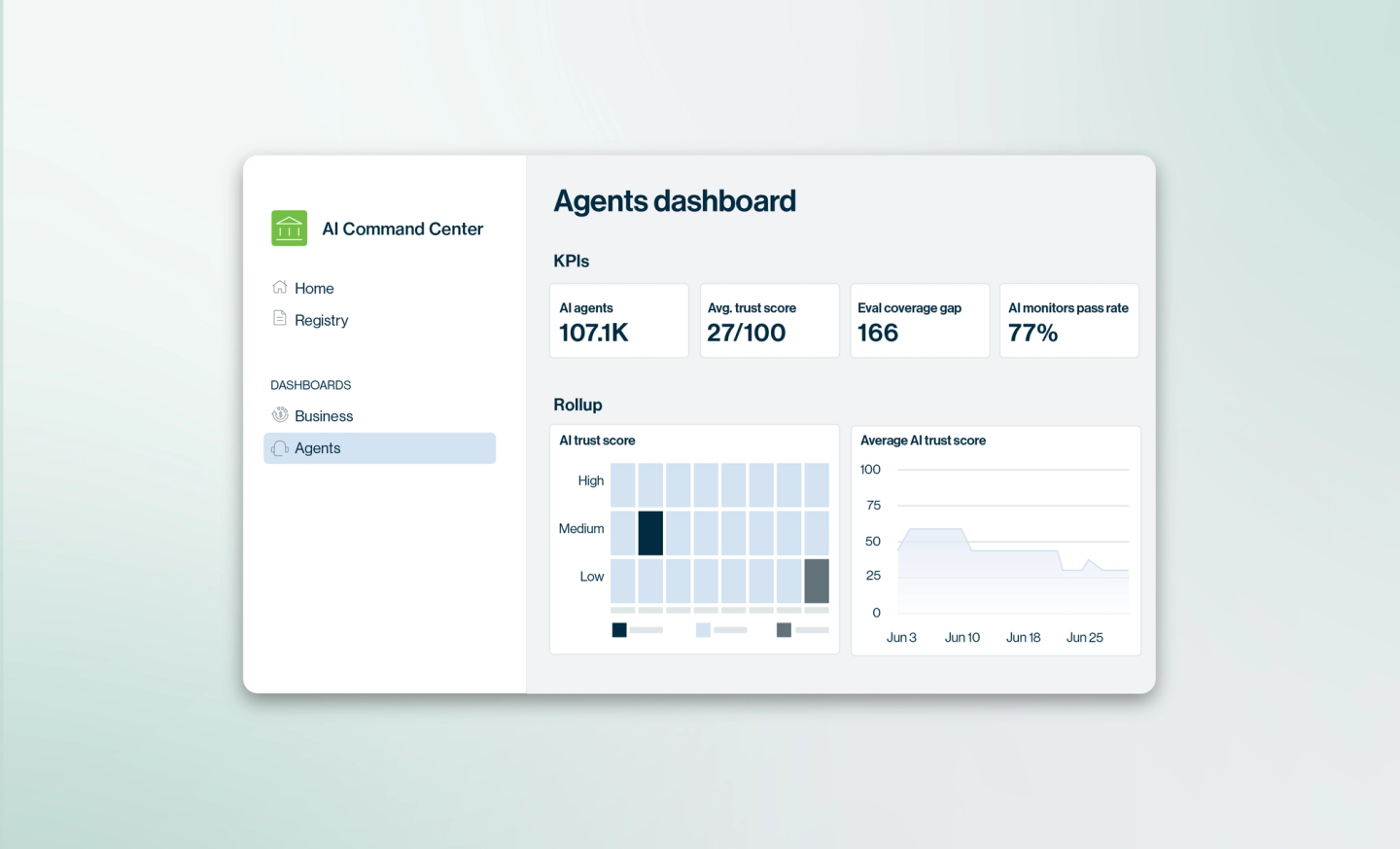
The new Agents dashboard rolls these signals up across your entire AI fleet. At a glance you can see how many agents are running, the average Trust Score across the fleet, your evaluation coverage gap, and the pass rate across all AI monitors, with a 30-day rolling trend that makes degradation visible the moment it starts. Trust is no longer a point-in-time judgment made at approval — it’s a living measure that evolves with each agent’s real-world behavior.
How Operational Trust for AI Agents helps
Most organizations approve AI agents once — at deployment — and then lose sight of them. Runtime behavior drifts as models are updated, prompts change and usage grows, but governance teams have no continuous signal telling them whether an agent still deserves the trust it was granted. Evaluations run ad hoc, monitoring agents sits in engineering tools that governance can’t see, and by the time quality or safety issues surface they’ve already reached users. As agent fleets grow into the hundreds or thousands, manual spot-checking simply can’t keep up.
Problems it solves
- Point-in-time approvals go stale: trust assessed at deployment doesn’t reflect how an agent behaves in production today.
- No shared, objective measure of agent trustworthiness that governance, engineering and business teams can align on.
- Agent Quality and safety degradation is discovered too late — after users are impacted — instead of at the first sign of drift.
- Evaluation blind spots: no visibility into which agents in the fleet lack adequate eval coverage.
- Fragmented monitoring: runtime signals from platforms like Databricks stay disconnected from AI governance and the agent registry.
How Operational Trust for AI Agents works
At the core is the AI Trust Score, a dynamic 0–100 rating computed for every deployed agent registered in AI Command Center. Rather than relying on documentation or one-off assessments, the score is derived from LLM judge evaluation results that continuously assess key aspects of agent behavior, such as groundedness, faithfulness, relevance, correctness, retrieval quality, and safety, across pre-production and production. AIUC-1 compliance status and token consumption trends are surfaced alongside the Trust Score as complementary operational signals, providing a more complete view of each agent’s operational health. As new evaluation results arrive, each agent’s Trust Score updates continuously—so a score of 27/100 tells you immediately that trust has eroded and why.
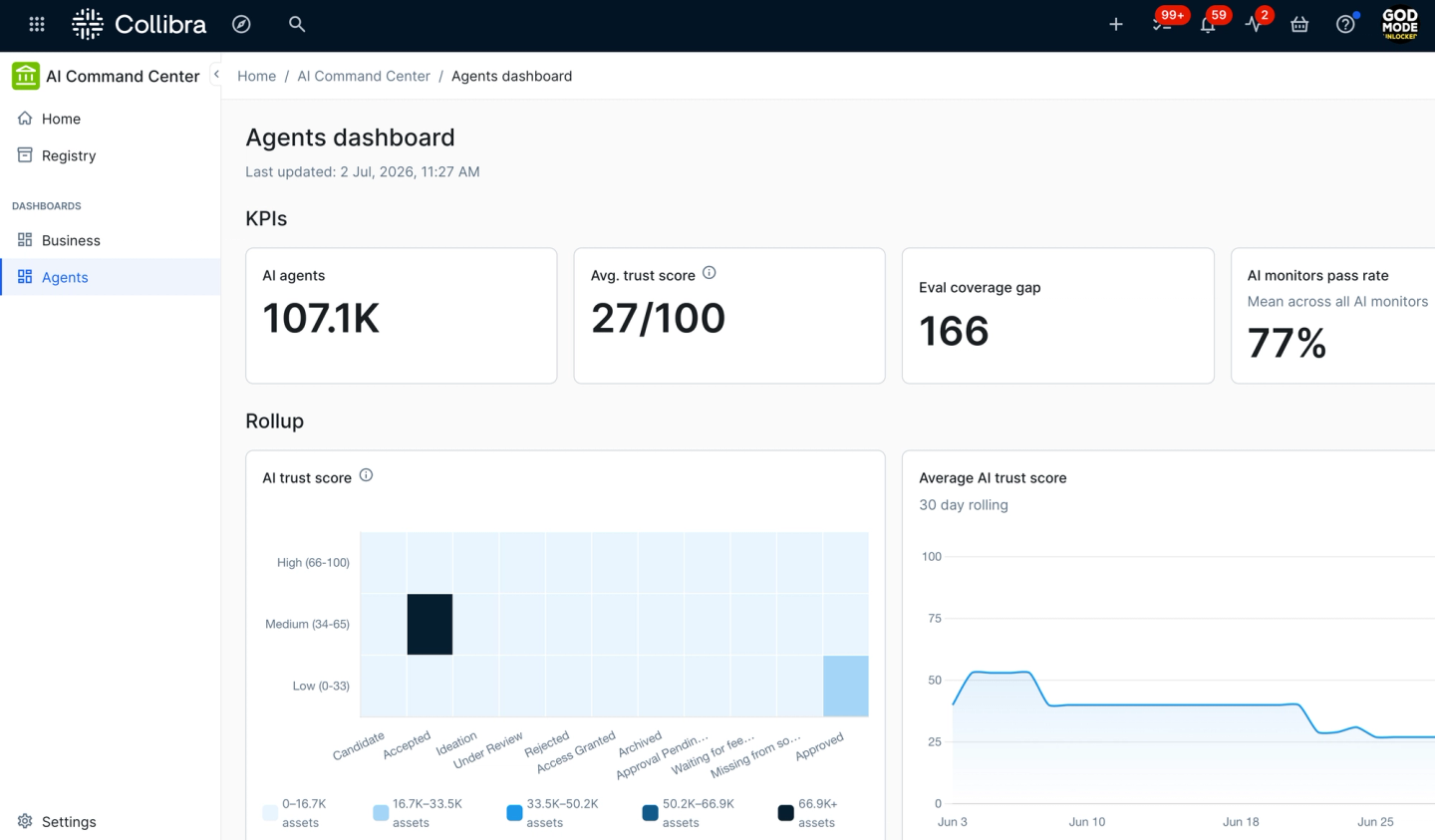
Track the health of your AI agent ecosystem through unified KPIs, AI Trust Scores, evaluation coverage, and operational trends—all from a single dashboard.
With the new Databricks Agent Bricks integration (preview, available now), agents built and served in Agent Bricks are connected directly to the AI Command Center. Their runtime telemetry — evaluations, judge verdicts and usage metrics — flows into Collibra automatically, so agents running on Databricks are registered, scored and monitored alongside the rest of your AI estate without custom pipelines.
Everything rolls up in the Agents dashboard inside the AI Command Center. KPI tiles summarize the fleet: total AI agents, average Trust Score, evaluation coverage gap (agents lacking sufficient evals) and the mean pass rate across all AI monitors. A rollup heatmap distributes agents across configurable thresholds High Medium and Low trust bands by lifecycle stage — from candidate through approval — so you can spot concentrations of low-trust agents instantly. A 30-day rolling chart of the average AI Trust Score reveals fleet-wide trends in degradation before they become incidents.
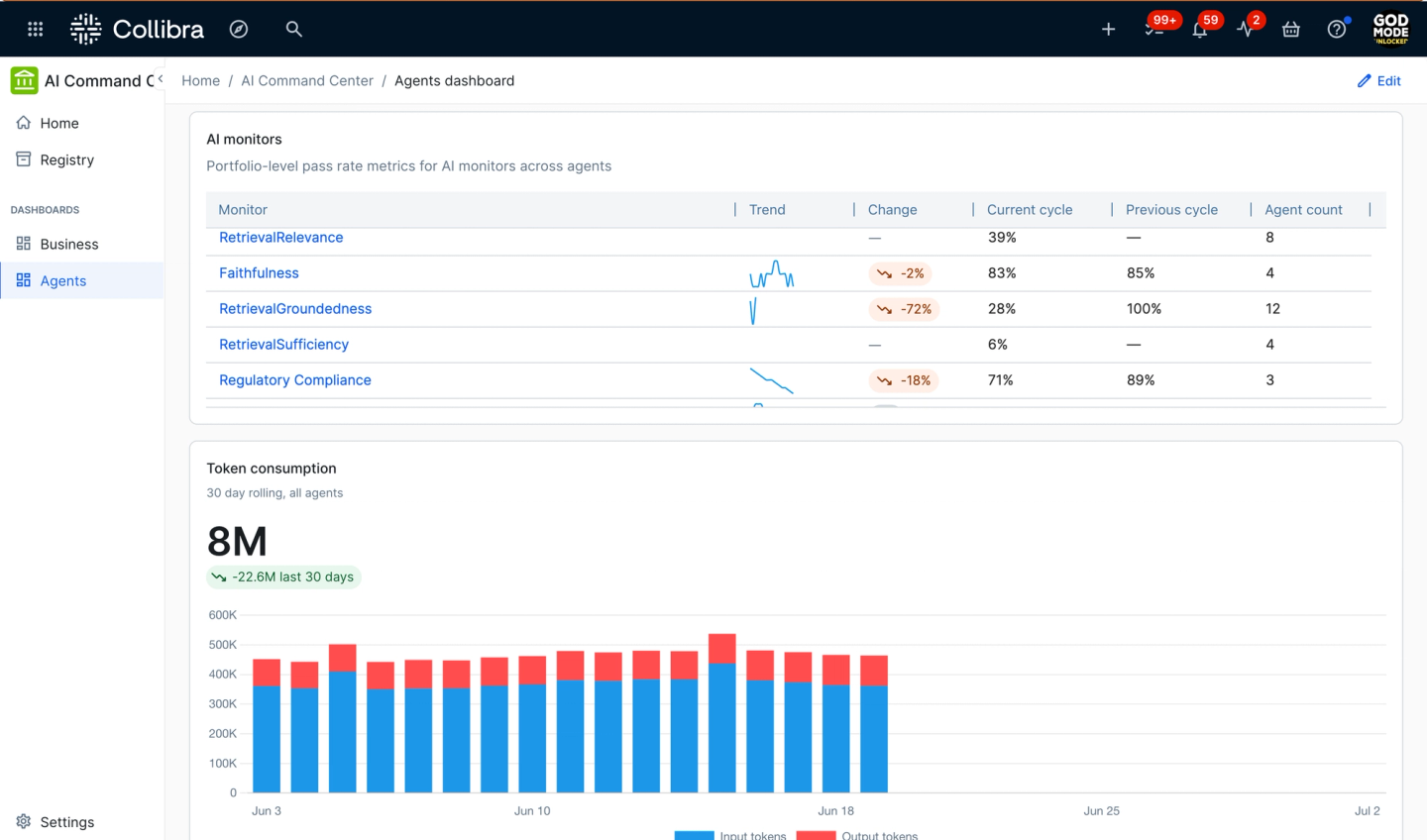
Continuously monitor the health of your AI agents with real-time quality, compliance, and consumption metrics—turning operational signals into enterprise-wide AI trust.
Because this runs on the Collibra Platform, every score is anchored to the governed agent record in the AI registry: its owner, use case, policies, underlying models and connected data assets. Falling trust isn’t just a metric — it can trigger governance workflows, review tasks and status changes in the same platform where the agent was approved.

Shikhar Vaish
Shikhar Vaish
Senior Product Manager
Collibra

David Talaga
David Talaga
Product Marketing Director
Collibra

Pankuj Chachra
Pankuj Chachra
Senior Director of Engineering
Collibra
Share on:
Keep up with the latest from Collibra
I would like to get updates about the latest Collibra content, events and more.
Thanks for signing up
You'll begin receiving educational materials and invitations to network with our community soon.