










Data sharing agreements vs. Data contracts: Two different promises around data
Share on:



They sound interchangeable and get confused constantly, both are "agreements about data." But a data sharing agreement and a data contract solve different problems, sit in different parts of the organization and are owned by different people. As enterprises push toward data products and AI-ready data, the distinction has become an operational requirement.
What is a data contract?
A data contract is a formal, machine-readable agreement, set between the producer and the data product owner and exposed to consumers, that defines exactly what a data product delivers and how it will behave. Think of it as a data delivery agreement: which data is delivered, to whom and with what SLAs.
A typical data contract specifies:
- Schema and semantics: Field names, data types, formats and what each field actually means in business terms.
- Service-level objectives (SLOs/SLAs): Freshness, availability, latency and update frequency.
- Data quality rules: Thresholds for completeness, accuracy, validity and consistency.
- Versioning and change management: How breaking changes are handled and communicated.
- Ownership: Who produces the data and who to contact when something breaks.
- Terms of use: How the data may be consumed, including masking or anonymization rules.
The key word is enforceable. Unlike informal documentation, a data contract can be validated automatically, checked in CI/CD pipelines and used to reject a breaking change before it reaches production and silently corrupts a dashboard or model. Many implementations follow the Open Data Contract Standard (ODCS) so contracts are portable across tools.
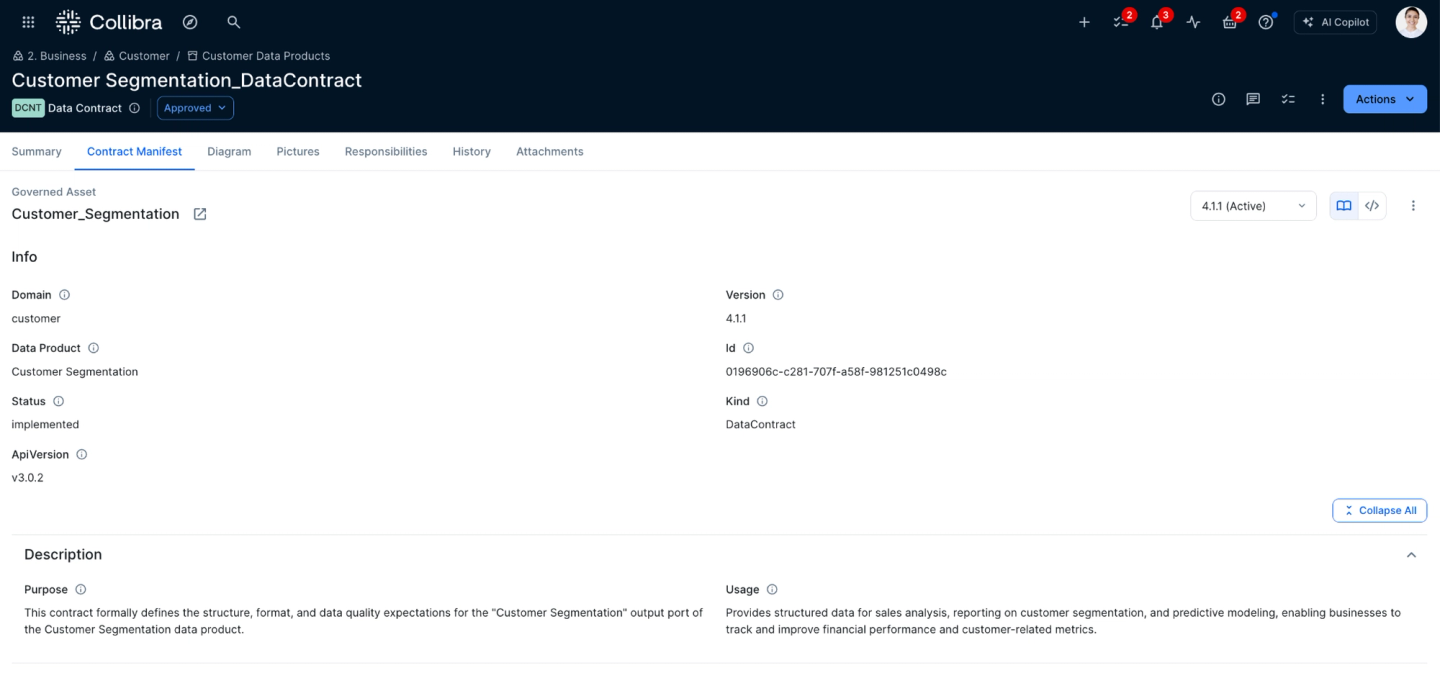
The data contract as a governed asset in Collibra, showing its domain, version, status and the purpose and usage it commits to.
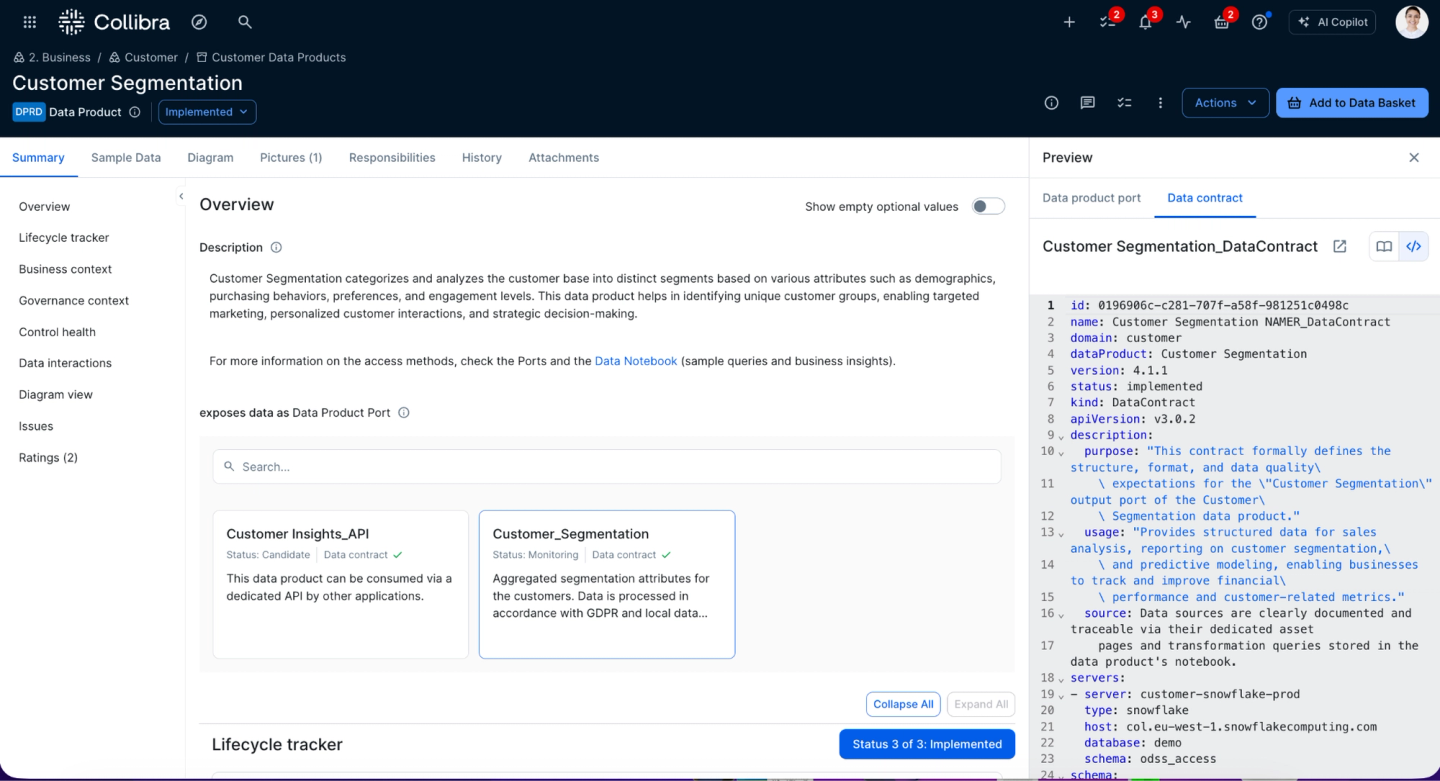
Example of a machine-readable data contract governed as a first-class asset in Collibra.
What is a data sharing agreement?
A data sharing agreement (DSA) is a legally binding document between two or more parties that governs how data is shared and for what purpose. It is the governance layer for the relationship between the parties exchanging data, not the technical shape of the data itself.
A data sharing agreement typically covers:
- Purpose: What data is being shared and why.
- Roles and responsibilities: Who is the data controller and who is the processor.
- Legal basis and compliance: Obligations under regulations such as GDPR, CCPA or HIPAA.
- Permitted use and restrictions: How the recipient may and may not use the data.
- Security and privacy obligations: How the data must be protected.
- Liability and indemnity: Who is accountable if something goes wrong.
DSAs are most common when data crosses organizational boundaries: between companies, between a company and a vendor or between research institutions.
Data contracts vs. data sharing agreements: the key differences
The cleanest framing is this: a data contract is a technical promise between systems; a data sharing agreement is a legal promise between organizations.
Dimension | Data sharing agreement | Data contract |
|---|---|---|
Purpose | Govern the legal terms of sharing data between parties | Define and enforce technical expectations between producers and consumers |
Nature | Legal, human-readable document | Declarative, machine-readable spec (often YAML) |
Scope | Inter-organizational / external | Often internal, between data producers and data product owners, exposed to consumers |
Defines | Purpose, legal basis, roles, compliance obligations, permitted use | Schema, semantics, SLOs/SLAs, quality metrics, versioning |
Enforced by | Law and contractual liability | Automated validation, schema registries, pipeline checks |
Driver | Compliance and risk allocation | Reliability, data quality, trust at scale, AI-readiness |
Audience | Legal, privacy, compliance | Data engineers, data product owners, platform teams |
| No sessions matching your filters are available. | ||
Crucially, they are complementary, not competing. A data sharing agreement may establish that two organizations can exchange a dataset; the data contract specifies what that data product looks like and what the consumer can rely on.
Who is responsible for each?
Data sharing agreements are owned by legal, privacy and compliance functions. The data controller or business owner is accountable for the terms, the data protection officer shapes the obligations and procurement gets involved when sharing crosses organizational lines. The defining responsibility is accountability under the law.
Data contracts are owned much closer to the data itself. The data producer—typically a data engineer or the data product owner—is the one who authors and maintains the contract, because they're the party actually committing to schema, quality, and SLAs. That contract is then exposed to data consumers—analysts and data scientists—who depend on it to know exactly what they're getting. Data governance managers or data stewards oversee the review and approval process. Ultimately, the defining responsibility here is reliability. This is the 'shift-left' philosophy in action: expectations are defined at the source by the producers themselves, not retrofitted downstream.

Meredith Bailey
Meredith Bailey
Product Marketing Director
Collibra
Share on:
Related articles

Data MarketplaceJune 16, 2026
What are data products and why do they matter for AI, analytics and ROI?

Data MarketplaceOctober 4, 2023
Data mesh: The key to innovation in government

Data GovernanceMay 11, 2022
Data Mesh 101: A straightforward overview of the hottest topic in enterprise data

Collibra PlatformAugust 17, 2023
Accenture + Collibra: 2023 data mesh reading list
Keep up with the latest from Collibra
I would like to get updates about the latest Collibra content, events and more.
Thanks for signing up
You'll begin receiving educational materials and invitations to network with our community soon.