













Related resources
Data Product Lifecycle Manager: Guided governance for every data product
Share on:
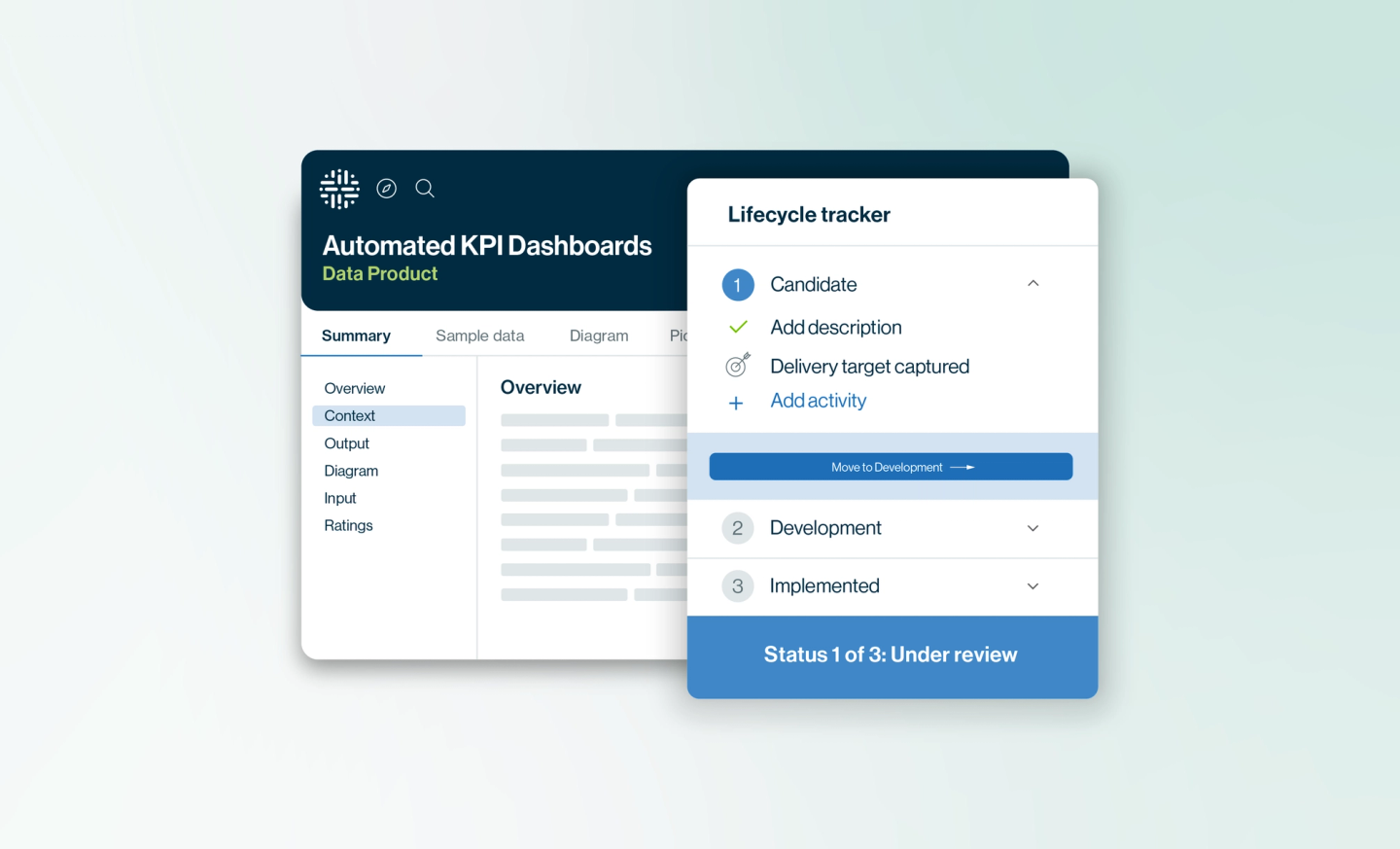
What separates a real data product from a relabeled table is the process behind it: a repeatable, consistent way of building that holds every product to the same standard, no matter who creates it or which team it comes from.
What’s new: Data Product Lifecycle Manager
The core idea is simple: governance shouldn't be something teams remember to do at the end. It should be built into the path itself.
With the Data Product Lifecycle Manager, smart checks validate a product's attributes, relationships and responsibilities at every stage of its life. Before a product can move forward, the platform confirms that the right context is in place, the right connections to business terms and domains exist, and the right people are accountable. Nothing advances on trust alone — it advances because it has met the bar. That means every product in your data marketplace has cleared the same requirements, so consistency becomes the default state.
How the Data Product Lifecycle Manager helps
Turning raw data into trusted, reusable products is rarely blocked by the data itself, it's blocked by the process around it. When every team builds data products their own way, with their own idea of "done," the marketplace fills with assets that look alike but can't be trusted alike. Documentation is uneven, checks get skipped, ownership is unclear, and consumers have no way to know which products actually passed review and can be trusted for use. The Data Product Lifecycle Manager removes that inconsistency by making governance a standardized, guided part of how every product is built, giving teams one repeatable path from idea to publication.
Problems it solves
- Inconsistent build processes that vary from team to team and produce uneven, unpredictable quality
- Governance treated as a final step, or skipped entirely, rather than enforced at each stage
- Unclear ownership and accountability across a data product's lifecycle
- Poor visibility into where a data product stands and which checks and assessments it has passed
How the Data Product Lifecycle Manager works
Governance by default. Rather than relying on individual discipline, the lifecycle manager enforces governance through smart checks that validate a product's attributes, relationships and responsibilities at every stage. Before a product can move forward, the platform confirms the required business context is in place, the right connections to business terms and domains exist, and the correct people are accountable. Nothing advances on trust alone — it advances because it has met the defined bar, so consistency becomes the default state rather than a hope.
Guided, gated transitions. Every data product follows a defined progression, with each transition gated. Progression isn't a manual judgment call; it's controlled by automated checks, built-in assessment and required sign-offs. A candidate can't enter development without meeting entry criteria, and a product can't reach published status until its assessments pass and the right owners approve. Because the flow is identical for every product, a status genuinely means what it says: "published" is earned, not applied.
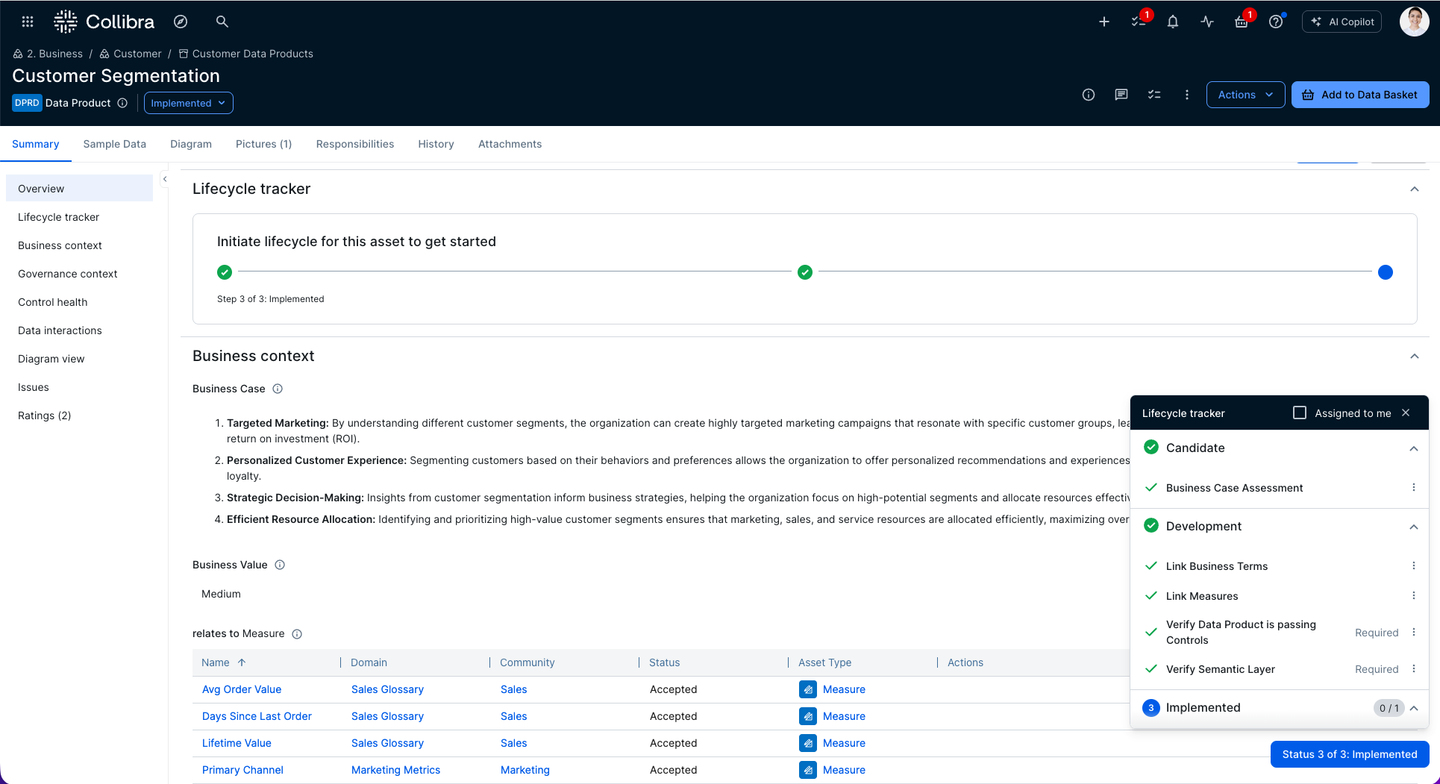
Standardized build process. Teams define the activities tied to each stage, encoding the organization's expectations directly into the tool. Once configured, every team building a data product works from the same playbook — new members inherit the standard automatically, audits get simpler because every product was built the same way, and quality stays consistent because consistency is enforced, not requested.
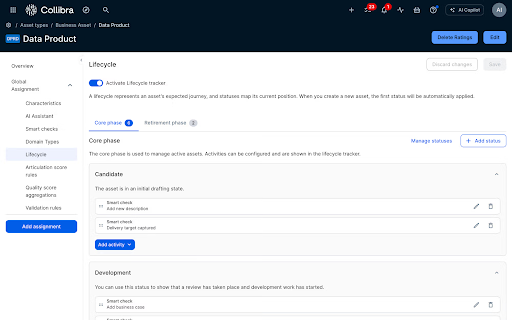
Configurable and collaborative. No two organizations govern data the same way, so the lifecycle isn't fixed. You can configure the stages themselves, define the assessments that gate each transition, and assign responsibilities to the right roles to match your organization's policies and structure. Throughout, teams build and manage products together with a shared, real-time view of lifecycle progress, replacing status meetings and guesswork with transparency that's always current.
Why you should be excited
Data product owners: Move through the full lifecycle on a guided path, with tailored stages and built-in assessments that keep every product developed and published with consistency, context and accountability.
Data governance managers: Configure the lifecycle stages, assessments, and responsibilities every product must follow, then trust the standard is enforced automatically. Get portfolio-wide consistency without policing it by hand, quality doesn't drift from team to team and track where every product sits and whether it's cleared its gates, all from a single view.
Data product consumers: Shop the data marketplace with confidence, knowing every product listed has passed the required governance processes and meets company quality standards.
Use cases
- Launching a new data product. Each contributes at the right stage: business context, validation checks, automated approval and publishing, while gated transitions ensure the product only advances when it's genuinely ready, and the shared tracker keeps everyone aligned.
- Vetting data products before usage. Lifecycle status and passed assessments provide immediate evidence that the product went through proper, standardized review and is safe to reuse.
Key takeaways
Trusted data products depend on a trusted, consistent process for building them. The Data Product Lifecycle Manager makes governance the default, guides every product through the same gated stages and lets you standardize exactly how your organization builds, all with the collaboration and visibility teams need to move quickly. From proposal to production, every data product is held to the same standard, so "trusted" means the same thing every time.
Where to learn more about the data product integrations
Get started with our product documentation.

Zuzana Zatrochova
Zuzana Zatrochova
Senior Product Manager
Collibra

Meredith Bailey
Meredith Bailey
Product Marketing Director
Collibra

Volodymyr Iliushchenko
Volodymyr Iliushchenko
Software Engineer
Collibra
Share on:
Related articles

Data ProductsJune 16, 2026
What are data products and why do they matter for AI, analytics and ROI?

Data CatalogMay 13, 2026
Enterprise data catalog: How to discover, understand, and trust your data assets

Data MarketplaceApril 17, 2025
Strengthening data reliability at WGU through smarter governance

Data MarketplaceOctober 4, 2023
Data mesh: The key to innovation in government
Keep up with the latest from Collibra
I would like to get updates about the latest Collibra content, events and more.
Thanks for signing up
You'll begin receiving educational materials and invitations to network with our community soon.