












Data Product Agent: Turn a cataloged table into a governed data product
Share on:


Today, building a Data Product means opening three asset pages and filling each by hand. The Data Product, its Ports and the Data Contract get created separately, in whatever order the producer remembers, with no shared draft connecting them. Every attribute, from description to business case to ownership to SLAs, gets typed from scratch even when the underlying table already answers most of it. Ports get wired to tables and columns one relation at a time. And with no way to check first, teams routinely rebuild a product that already exists under another name.
What’s new: Data Product Agent
The Data Product Agent collapses all of that into a single guided conversation that turns a producer's intent into a fully governed data product, complete with one or more Ports and a Data Contract. It's built on Collibra Maestro and available as a skill through MCP Server.
Point it at a physical table in your catalog and the agent pulls the context Collibra already holds, including columns, descriptions, data types, business and technical lineage, semantic layer and sample data, and drafts the whole package from it: name, domain, owner, description, business case, business value, access method, sensitivity and SLAs. Along the way it checks whether the table is already published or already belongs to an existing data set or data product, so producers reuse rather than recreate. Then it stops and shows you the full proposal before anything is written to Collibra.
How the Data Product Agent helps
Our new Data Product Agent removes the manual assembly. There's no opening three asset pages and filling each one by hand, and no wiring Ports to tables and columns one relation at a time. Attributes arrive drafted from the table's own context, ready for you to edit rather than type from scratch. Duplicate checks happen at the moment you ask, not after two teams have shipped competing versions. And because nothing is written until you approve the proposal, review comes before creation instead of cleanup after it. Work that used to take days now takes a single conversation.
Problems it solves
- Multi-asset sprawl. Data Products, Ports and Data Contracts are assembled together in one flow, in the correct metamodel shape, instead of one asset page at a time.
- Manual attribute entry. Descriptions, business case, business value, ownership and SLAs are drafted from the table's own context, then edited by you, not typed from scratch.
- Manual wiring to physical data. The agent resolves the relations between Ports and the underlying tables and columns for you.
- Duplicate data products. Matching datasets and existing products are surfaced at design time, not discovered after launch.
Inside the Data Product Agent
You reach the Data Product Agent from wherever you already work. If you're a data engineer living in an MCP client, you call the same skill the way you'd call any other tool in that session; the agent reads that skill and works through the same steps. Or if you're a data product owner or steward working in Collibra, you reach it through Collibra Maestro, where the skill is surfaced as a Maestro agent.
From table to governed product. The agent takes an existing physical table in your catalog and turns it into a fully governed Data Product draft with starting values for you: a description, a business case, SLAs. It checks whether that table has already been published so you don't end up with duplicates. Everything a person would otherwise assemble by hand, choosing a domain, naming the product, setting an owner, picking an access method, defining SLAs, wiring the relationships, writing the contract, arrives as a draft you review rather than a form you fill.
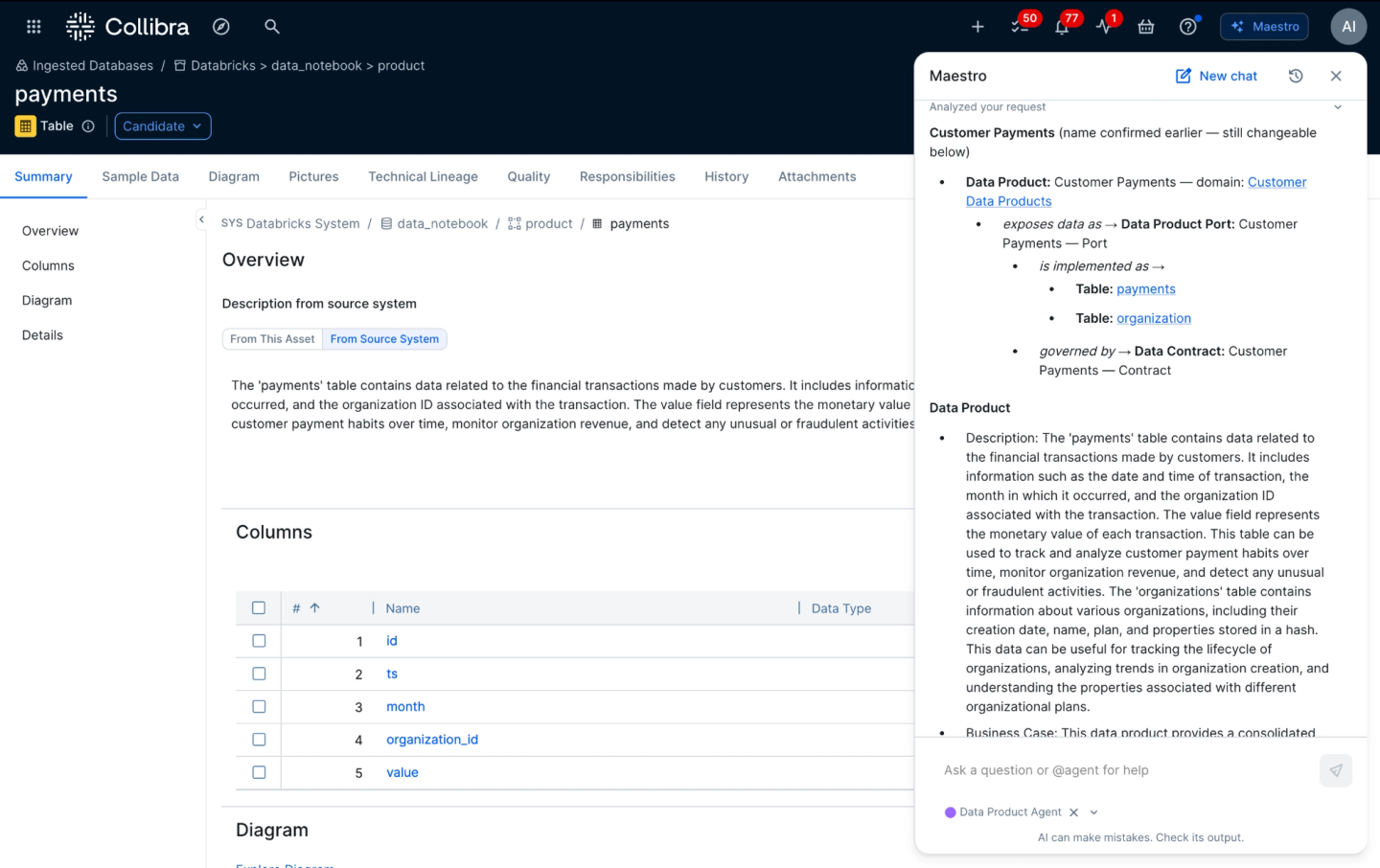
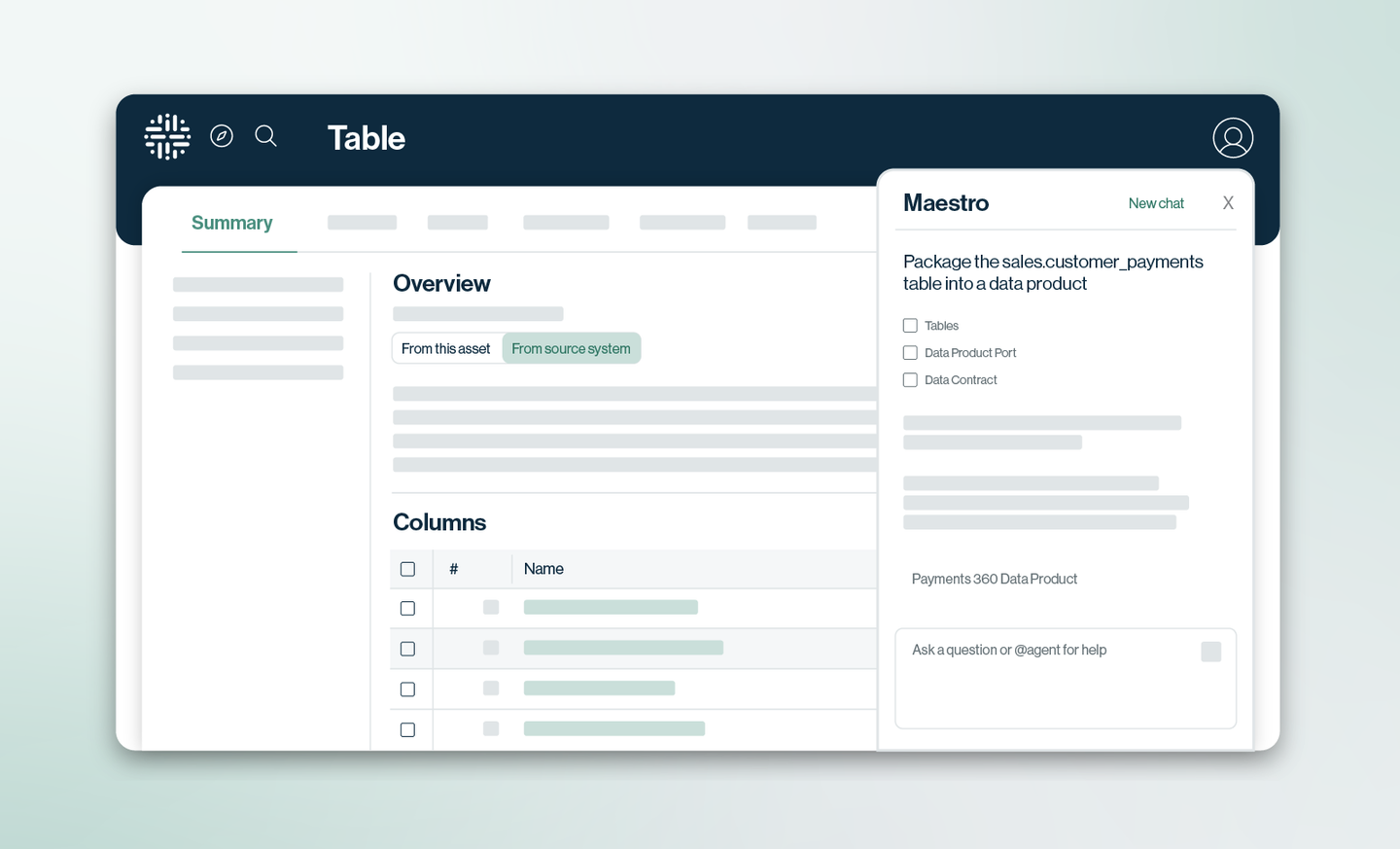
Maestro builds the Customer Payments Data Product from a natural-language request, complete with domain, port, source tables and a data contract.
A conversation with checkpoints. The flow is deliberate and pauses for input at every decision point: find and confirm the table; check whether it's already published as a data product or included in a data set; optionally suggest related tables in the same schema to bundle into one product; propose governance setup (name, domain, owner, access method, category, sensitivity); handle SLAs (define your own, accept standard defaults, or skip); present the complete proposed Data Product, Port, and Data Contract for review; and only then create. Any value can be adjusted or renamed along the way.
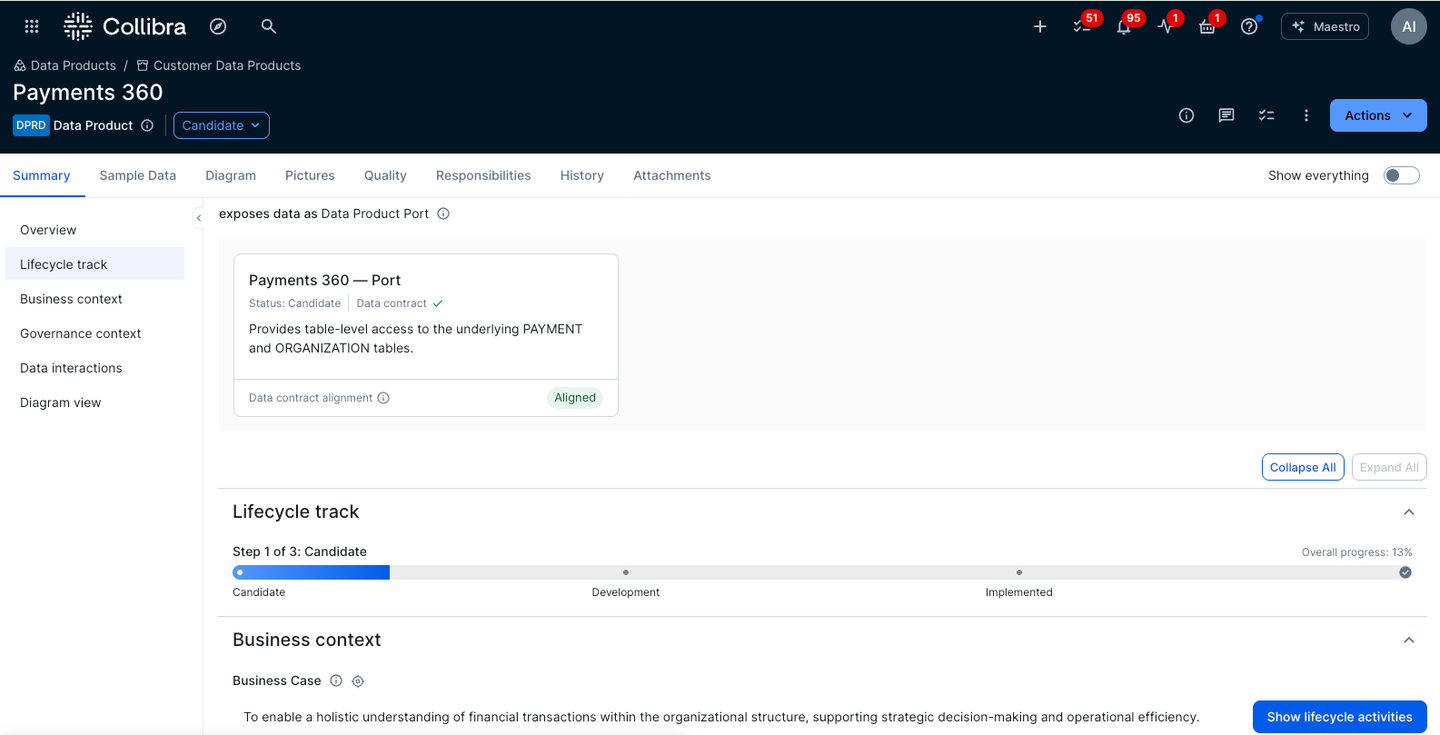
A final Payments 360 Data Product created using the Data Product Agent in Maestro.
On confirmation, real assets. The agent creates the Data Product, its Ports, the Data Contract, every attribute and every relation in the correct Collibra metamodel shape, then reports back with clickable links to everything it made. It also generates an ODCS YAML and uploads it to the Data Contract asset.
Why you should be excited
- Data Product Owner: You're accountable for the Data Product end to end, but today that means owning four separate asset pages and depending on someone else to finish wiring the ports. The data product agent gives you one proposal to review instead of three assets to assemble: the data product, its ports and its contract all drafted together, with the wiring to physical tables and columns already resolved. You spend your time approving and refining, not filling in the first version by hand.
- Data Engineer: You work in an MCP client, Claude, Databricks, wherever your pipeline work already lives, and publishing a data product means stopping to context-switch into a governance UI you touch once a quarter. This new agent is callable as a tool in the session you're already in: point it at the table you just landed, and it returns a data product, its ports, and a contract drafted from the lineage and schema Collibra already holds.
Use cases
- Turning a cataloged table into a governed product: Point the agent at a table that's already documented in Collibra. It reads the columns, lineage and semantic layer, and returns a complete Data Product, Port, and Contract proposal, with no separate asset pages and no manual wiring.
- Catching duplicates before they get built: Before drafting anything, the agent checks whether a matching Data Product already exists. Instead of discovering a duplicate after two teams have built competing versions, you find out at the point you ask.
Key takeaways
The Data Product Agent is an AI assistant built on Collibra's Maestro that takes a physical table already sitting in your catalog and turns it into a fully governed Data Product, complete with a Data Product Port and a Data Contract, through a short guided conversation. What used to take days of manual documentation, stakeholder back and forth, and contract drafting now happens in a single guided conversation.
Where to learn more
The Data Product Agent is available now in Private Preview. To get access or see it in action, reach out to your Collibra representative.

Dylan Greenfield
Dylan Greenfield
Senior Product Manager
Collibra

Meredith Bailey
Meredith Bailey
Product Marketing Director
Collibra

Antonin Krotky
Antonin Krotky
Software Engineer
Collibra
Share on:
Keep up with the latest from Collibra
I would like to get updates about the latest Collibra content, events and more.
Thanks for signing up
You'll begin receiving educational materials and invitations to network with our community soon.