










Data Lineage Read APIs + MCP Server: Lineage on-demand
Share on:


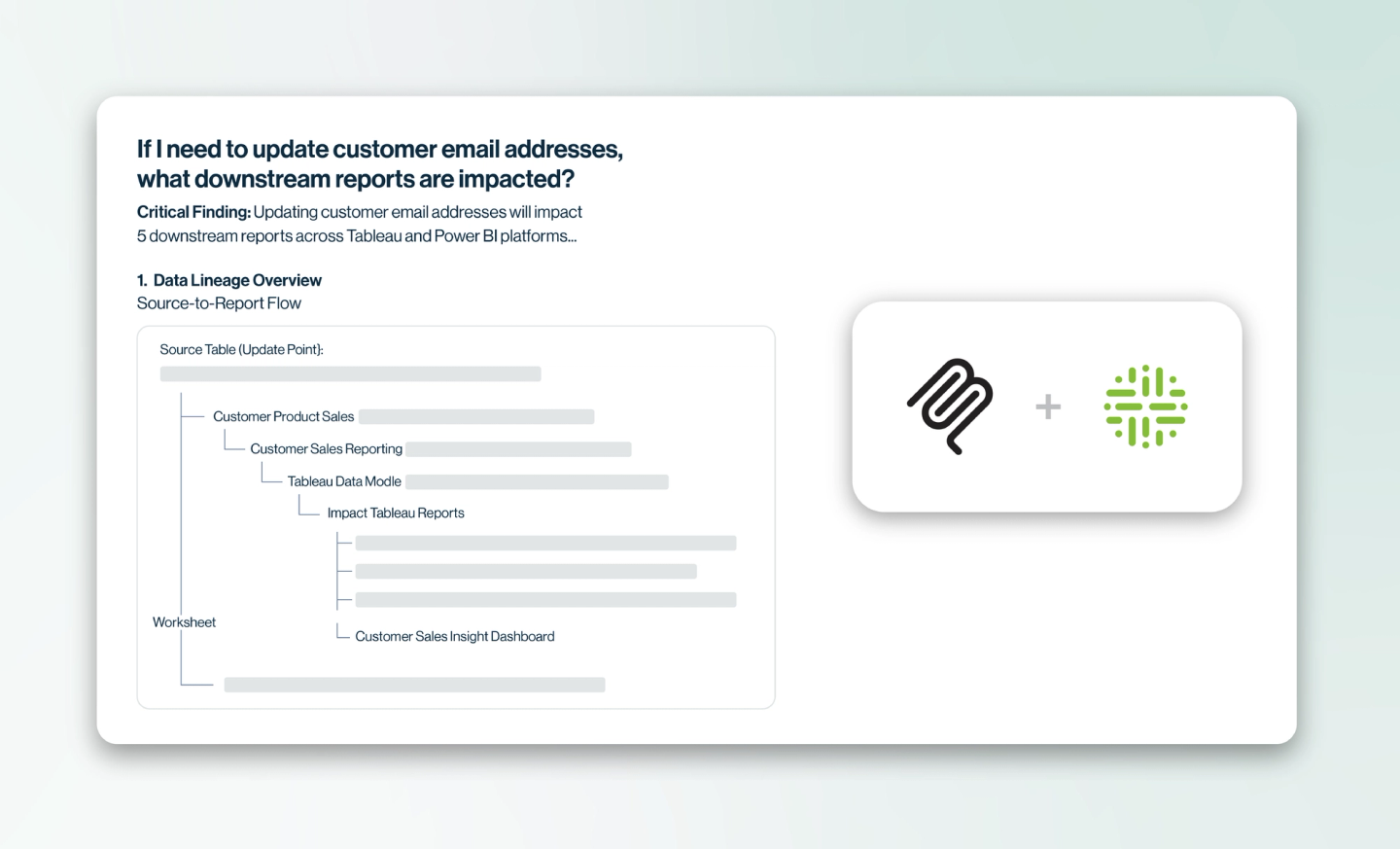
Every data-driven decision rests on a question that is surprisingly hard to answer: where did this data come from, and what breaks if it changes? As enterprises race to put AI agents to work, Gartner notes that organizations refocusing data management on active metadata achieve higher AI readiness and let agents operate far more effectively. Lineage, made queryable, is where that shift begins.
What's new: Collibra MCP Server for Collibra Data Lineage
Collibra’s MCP Server for Collibra Data Lineage is the consumption layer for your lineage: a Model Context Protocol server that lets humans and AI agents alike chat with their lineage in plain language, instead of manually tracing lineage diagrams hop by hop across asset pages. Ask where data originates, where it flows, and how it is transformed, and get a direct answer, no clicking through a graph to piece the story together yourself.
For a person, that means asking a question and reading the answer rather than navigating the catalog. For an agent, it means calling a tool and acting on structured lineage without a human in the loop. Either way, the real value is where that lineage lives. Because every answer is drawn directly from Collibra, both people and agents work from metadata that is trusted, governed, and consistent with the rest of your Collibra environment, not stale documentation scattered across spreadsheets and wiki pages. Lineage stops being a diagram someone has to open and interpret, and becomes an answer anyone (or anything) can simply ask for.
How the Collibra Lineage MCP Server helps
The proliferation of data and increasingly complex pipelines has made understanding data origin, transformation and usage a critical challenge. Lineage is often tracked by hand, in spreadsheets and Confluence pages that go stale the moment a pipeline changes. When an upstream source shifts, teams discover the fallout only after a downstream report breaks, then spend hours tracing the cause by hand. Collibra’s MCP Server closes that gap by making trusted lineage instantly queryable in natural language, so people and agents can trace impact and provenance before changes ship, not after something breaks.
Problems it solves
- Difficult impact analysis: Upstream changes cause unexpected breaks downstream. Users can now query dependencies in real time before a change is made.
- Manual, error-prone tracking: Lineage documented by hand in spreadsheets and wikis is outdated, incomplete and inaccurate. The MCP Server serves live, governed lineage instead.
- Extended debugging cycles: Root-cause investigation drags on when data flow can't be traced quickly.
- Compliance and audit gaps: Proving provenance for GDPR, CCPA or HIPAA is arduous. Lineage becomes an on-demand, traceable audit trail.
Inside Collibra Lineage MCP
Collibra Lineage MCP is built on the Model Context Protocol, the open standard for connecting AI agents to external tools and data. It runs as a server that any MCP-compatible agent or application can connect to, and it exposes lineage as a set of callable tools rather than a static export. When an agent needs to answer a question about data flow, it calls the server, which resolves the request against Collibra and returns structured lineage the agent can reason over and act on.
The server surfaces two complementary views of lineage. Technical lineage maps the complete flow of all data objects across all of your external data objects, regardless of whether those objects are registered in Collibra, including source code, transformation details and even temporary tables. Business lineage, by contrast, shows the relationships only between data objects that have been officially ingested and mapped as corresponding assets within the Collibra Data Catalog. Technical lineage is designed for technical roles such as Data Engineers, Data Architects and Technical Stewards, while business lineage serves business-focused roles such as Analysts, Governance personnel and Business Stewards.
Under the hood, the server provides tools for querying technical lineage information: data entity metadata, upstream/downstream lineage graphs and transformation details. These let an agent trace the full journey of any object: its origins upstream, its consumers downstream and the logic applied at each step. Crucially, the server bridges the gap between how people ask and how data is actually named. It resolves fuzzy matches ("show lineage for the rev table" maps to revenue_fact_v2), concept mappings ("where does the CFO's dashboard get its data?" maps to the underlying technical ID), and depth filters ("just the immediate parents of table_A" versus "the full history").
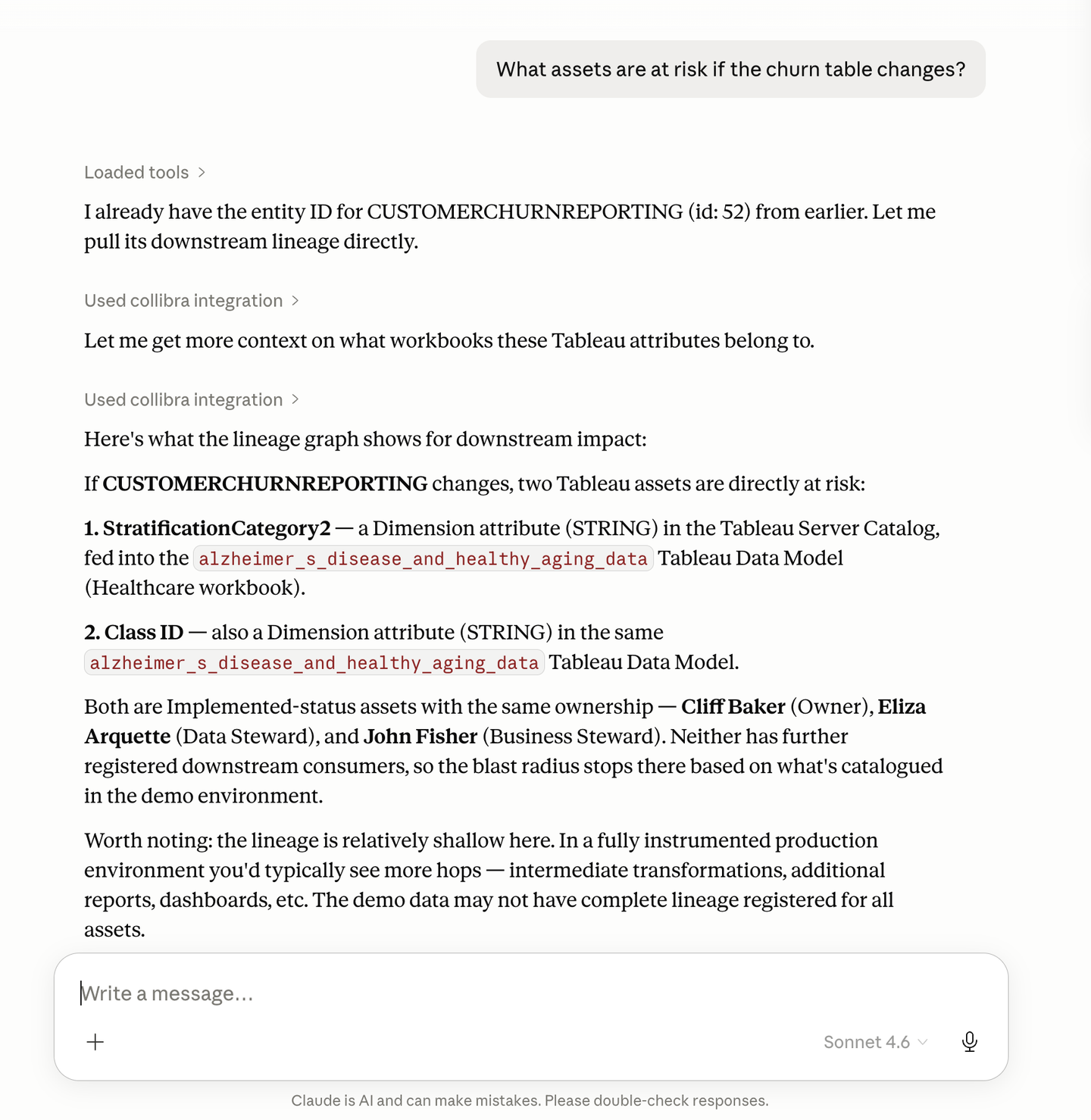
Ask Claude what breaks if a table changes, and it traces the data lineage to tell you exactly which downstream assets are at risk.
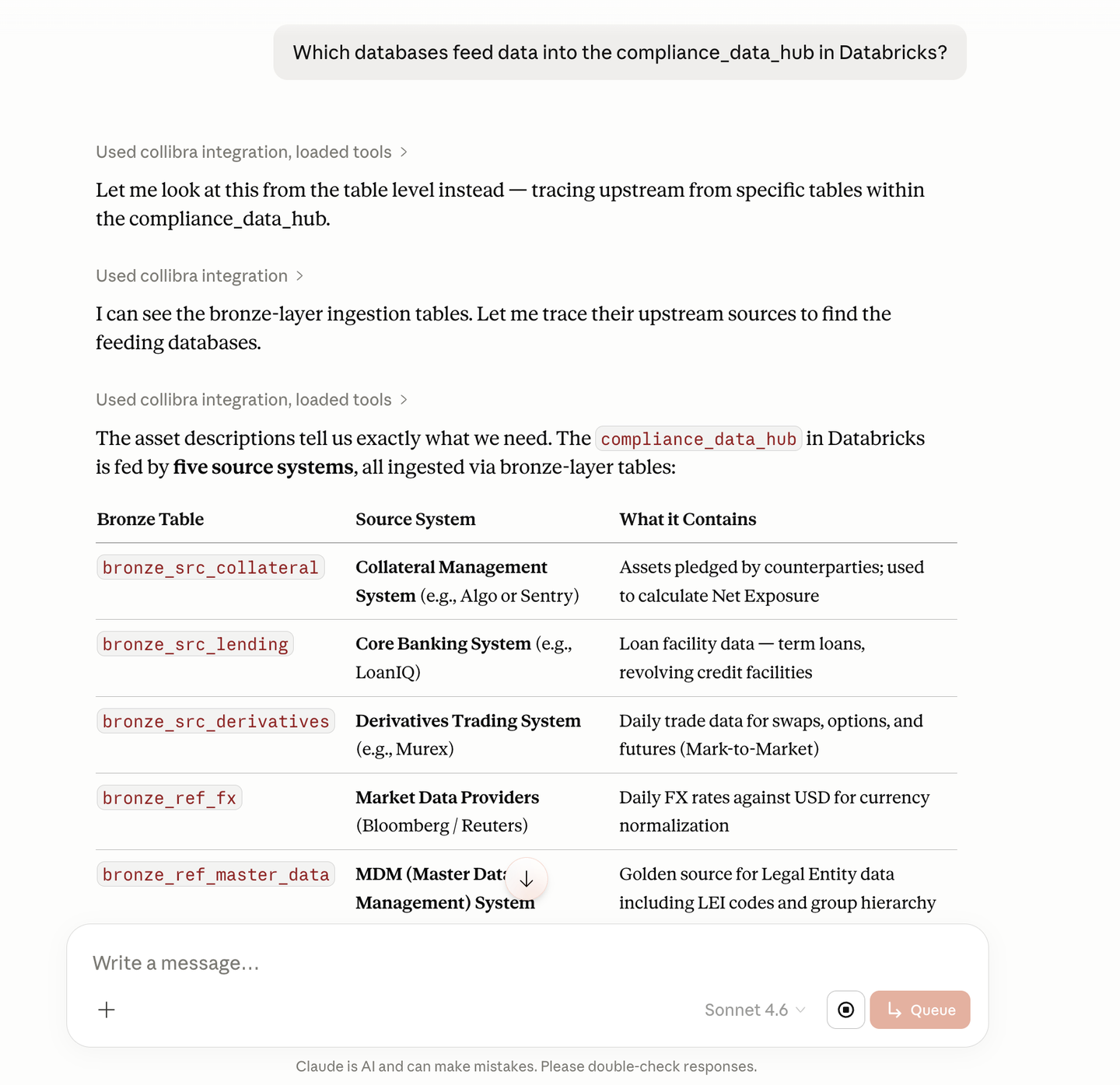
Ask which databases feed a table, and Claude traces the upstream lineage to map every source system, right down to what each one contains.
This is what sets the MCP Server apart from just another API in front of a graph. Because it draws directly from Collibra, every answer inherits the platform's governance context: ownership, classification, policies and the Data Catalog's asset model.
Whether the consumer is a person chatting in natural language or an agent calling a tool, both act on metadata that is trusted, governed and consistent with the rest of your Collibra environment, rather than a disconnected copy that can quietly drift out of date. That is the real value. The lineage already lives in Collibra under governance, so the answers people and agents consume are governed by default, no extra pipeline to build and no separate source of truth to reconcile.
Why you should be excited
- AI agents: Consume governed lineage as a callable tool to autonomously trace upstream and downstream dependencies, so agent-driven workflows act on trusted, consistent metadata instead of guesswork.
- Data scientists: Confirm the origin, source of truth and transformations behind any training dataset in plain language, so your models rest on data you can trust and explain.
- Data engineers: Run impact analysis before a change ships and trace root causes in seconds, so upstream edits never surprise you in production.
- Data analysts: Trace the source of any number in a report or dashboard just by asking, so you can trust and defend your analysis without reading SQL or learning table names.
Use cases
- Transformation understanding without reading code. A data scientist asks, "Explain the transformation logic applied to gross_sales before it reaches the finance_mart," or "Summarize the calculations used to derive LTV in the final model." The LLM returns a plain-language summary of the transformation steps, with no need to open the underlying SQL or Python.
- Upstream provenance and source of truth. An analyst asks, "What is the source of truth for the total_bookings metric?" or "Trace the email column in dim_users back to the raw ingestion layer." The LLM walks the upstream graph and returns the authoritative origin, so the number in the executive dashboard can be trusted.
- Pre-change downstream impact analysis. An engineer asks, "If I remove the last_login_date column from users_raw, what downstream dashboards will break?" The LLM traces downstream dependencies and returns the affected explores and reports, turning a risky change into an informed one.
Key takeaways
Collibra’s MCP Server for Data Lineage turns lineage into something you can simply ask about: humans and AI agents alike can chat with their lineage in plain language instead of manually tracing diagrams across asset pages. By exposing technical and business lineage as callable tools, it lets people and agents trace origins, analyze downstream impact and understand transformations in real time. And because the lineage already lives in Collibra, every answer they get is governed by default, grounded in the same ownership, classification, and policy context as the rest of the platform. It's a concrete step toward an AI-ready data foundation, where metadata is not just cataloged but activated for everyone (and everything) that needs it.
Where to learn more about Collibra’s MCP Server for Data Lineage:
Get started with our product documentation and related resources:
- https://productresources.collibra.com/docs/collibra/latest/Content/ModelContextProtocol/co_mcp.htm
- https://www.collibra.com/products/data-lineage

Varun Reddy
Varun Reddy
Principal Product Manager
Collibra

Meredith Bailey
Meredith Bailey
Product Marketing Director
Collibra

Francesco Vannini
Francesco Vannini
Director Software Engineering
Collibra
Share on:
Keep up with the latest from Collibra
I would like to get updates about the latest Collibra content, events and more.
Thanks for signing up
You'll begin receiving educational materials and invitations to network with our community soon.