










Contextual gravity: Why enterprise AI will standardize on the layer that can't be replicated
Share on:



When it comes to building, deploying and running technology, data has always had gravity.We can observe this in the way workloads get pulled toward whatever platform holds the storage.
Contextual gravity is the pull that draws AI agents toward wherever an enterprise's governed meaning, trust, and policy live. Wherever the definitions, the lineage, and the policies accumulate, agents get pulled toward reasoning from that place. In other words, context drives the same pull as data, one layer up.
Every enterprise deploying AI in 2026 is making a decision about where that gravity lands, whether it's making that decision deliberately or by default.Today, context is the layer enterprise AI will standardize on. Not the model. Today, the model is becoming the easy part. More than ever, context is what will determine operational effectiveness in the age of AI.
The last mile just disappeared
Enterprise software has always assumed a human would read the output. The analyst caught the bad number. The steward reconciled two conflicting definitions of "customer." Data never had to be perfect, because a person supplied the judgment the data itself lacked.
Agents remove that person.
They don't interpret. They predict. Handed an ambiguous definition, an agent doesn't pause. It picks whichever meaning scores highest in its context window and proceeds. A confused dashboard used to cost an analyst a morning. A confused agent reroutes a customer escalation, approves a transaction or files a regulatory disclosure. Same ambiguity. But completely different costs; the fact is agent errors can cause downstream challenges at orders of magnitude larger than a single human error.
That's why more than half of generative AI projects were abandoned after proof of concept last year, and why Gartner expects more than 40% of agentic AI projects to be cancelled by the end of 2027. The reason cited isn't model failure. It's the escalation costs, unclear business value, and inadequate risk controls.
Why the model stopped being the moat
In June 2026, Z.ai released an open-weight model that led open-model rankings at roughly a sixth of frontier API pricing. Epoch AI measures the gap between open and frontier capability at about three months, and holding. Models are converging. That trajectory isn't going to reverse.
What doesn't commoditize is what a model can't be handed off the shelf:
- What your data means?
- Whether it can be trusted right now?
- Who is allowed to act on it?
That's context. Whoever holds the deepest governed version of it wins, regardless of which model happens to be running underneath.
Anthropic's own engineering team published the sharpest illustration of this to date. Agents querying a raw, ungoverned data warehouse answered correctly on roughly 21% of questions. Wrapped in governed definitions and a semantic layer, accuracy rose above 95%. The implication is difficult to read as anything other than confirmation that the constraint has moved off the model entirely.
What’s more: In the Anthropic research, a month after governance stopped being actively maintained, accuracy fell back to roughly 65%. Context isn't a setup cost. It decays the moment nobody's watching it. Governed once, it drifts. Governed continuously, it holds.
The two gaps deciding whether your agents actually work
Every enterprise running agents in production hits two distinct failures. Most governance conversations only address one of them.
The context gap: what happens before an agent acts
Three questions have to be answered before any agent touches enterprise data:
- What does this data actually mean? "Customer" in wealth management is the household. In institutional banking, it's the counterparty. Same word, but different meaning. Without governed context, the agent picks one and moves on.
- Is this data trustworthy right now? Is the definition current? Has the source refreshed? Did the quality check pass? Without governed context, stale data gets treated as authoritative.
- What am I allowed to do with it? Which policies apply, which jurisdictions restrict the action, who owns the definition? Without governed context, the agent acts inside the data and outside the policy.
These aren't metadata problems. They're an ontology problem. A semantic layer tells an agent what a word means. An ontology (or the grammar connecting meaning, trust and permission) tells it how those things relate: Customer owns account, account has position, position is governed by policy. Without the grammar, an agent reasons about isolated terms. With it, an agent reasons about the enterprise.
The control gap: What happens after an agent is already running
Once an agent is live, the questions change. Who deployed it, and what was it authorized to do? What did it actually touch, and what did it produce? If it causes harm, can you prove exactly which boundary it crossed?
Five agents in production is manageable. Twenty is a budget line. However, fifty is a program-level risk, because manual review collapses well before you get there, and spreadsheet-driven oversight can't keep pace with agents acting in real time.
Both gaps produce the same hidden expense: a hallucination tax paid in retries, wrong answers, manual review and exposure that only surfaces after the damage is done. In fact, Harris Poll research found 91% of technology decision-makers are building or deploying agentic AI, 86% expect it to drive ROI. And only 48% have the governance in place to deliver it. That 38-point gap is the tax.
Why the layer has to sit above the stack, not inside it
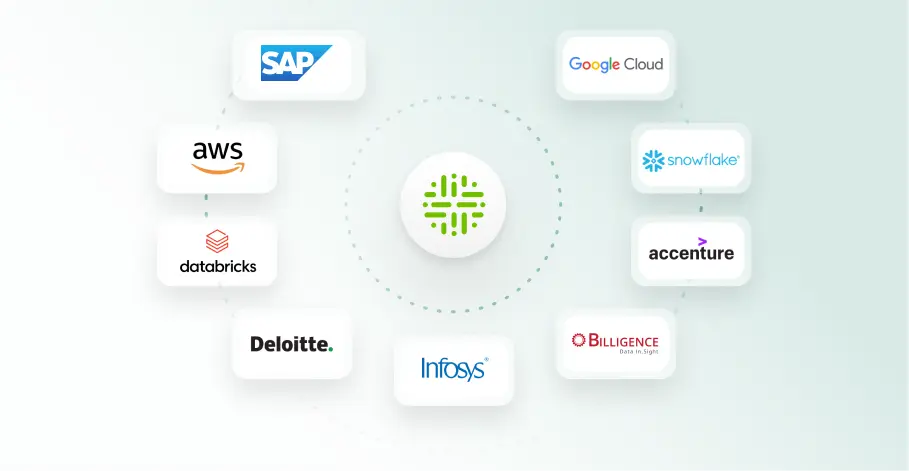
No Fortune 500 company runs on one platform. Six to ten major systems is normal, plus SAP, Salesforce, mainframes and whatever's still running on-premise after twenty years. An agent answering one question for a CFO might need to cross three clouds and four SaaS applications, each with its own definitions, its own lineage, its own version of "revenue."
Every cloud governs itself well. Databricks governs Databricks. Snowflake governs Snowflake. That's exactly what they should do. They own the execution engine, so they govern the execution engine. But a definition of "customer" or "revenue" isn't owned by any of them. It's owned by the enterprise, and it has to travel across every platform the data touches, every model that retrieves it, every agent that acts on it.
A vendor that also sells the compute has a structural reason to shape its context around its own engine first. It's also exactly why the context layer can't live inside any single platform's catalog. The advantage in the agent era isn't only about owning the system of record anymore. It's about owning the layer that decides which agents can act, on what data, with what limits. And can prove afterward what happened. That layer has to sit above the platforms, reading from and writing to all of them, or the gravity pulls the wrong way.
What changes when governed context enters the stack
We ran a controlled test at KU Leuven to see how much this actually moves the number, rather than just the argument. We took anonymized data, renamed the tables to resemble a cryptic legacy ERP (in other words, the kind of system most large enterprises still run underneath everything else) and pointed an agent at it twice. Same model, same data, thirteen questions with verified answers. One run had governed context in the loop. One didn't.
Asked how many active testers a project had, the ungoverned agent found a column called "engagement status," added up rows marked "completed" and "viewed," and confidently returned three. The governed agent retrieved the actual definition of an active tester, checked it against the data and found nobody qualified. The right answer was zero.
Across all thirteen questions: 92% correct with governed context, 62% without. The gap widened sharply on the hardest, multi-step questions, which are the kind a CFO actually asks. The ungoverned agent went zero for four on those. Not one right. Confident every time. It's a single test, not a universal benchmark, but it shows the mechanism plainly: Governed context doesn't make a good agent marginally better. It decides whether you get a right answer or a confident wrong one, exactly where the stakes are highest.
That mechanism shows up as real economics in three places:
- Fewer escalations, first try. Governed context means the agent retrieves trusted definitions, current data and applicable policy up front. Support agents resolve cases without escalating; analytics agents produce numbers leaders actually trust.
- A fraction of the token spend. An LLM left to make sense of unstructured data alone burns five to ten times the tokens it would need if that data had already been prepared into the slice it actually requires.
- Agents that clear the pilot. The most common way an AI initiative dies isn't a bad model; it's a good agent that never leaves the pilot stage because nobody can prove it's safe. Real-time visibility into what's deployed and how it's behaving is what lets a leader ship an agent instead of guarding it.
The Weir Group is already running this in production, using AI Command Center to scale agent-led innovation across its global engineering operations.
Why this is a boardroom decision, not a tooling decision
Two things are converging on the same timeline. Governance has become the top stated priority for data and AI leaders for the first time. And the AI mandate itself is now the fastest-expanding function in the C-suite. In fact, 76% of organizations have a Chief AI Officer today, up from 26% a year ago. Whoever holds that mandate is accountable for both the value AI is supposed to create and the risk it introduces when it doesn't.
That's what makes this a boardroom decision rather than a tooling decision. Swapping a model is a project measured in weeks. Unwinding the context layer everything else was built on top of is a decade of rework. The choice being made in enterprises right now isn't which model to run next quarter. It's which layer gets to hold the gravity: The one every future model, every future platform and every future agent will have to reason from.
The names will keep changing. The model this quarter is one thing; the platform is another; the title on the org chart shifts from CDO to CAIO and back.
None of that changes the underlying requirement: Govern what your data means, control what your agents do with it. That requirement is the layer contextual gravity pulls toward. The decision worth making deliberately is where it lands.
Frequently asked questions
What is contextual gravity? Contextual gravity is the tendency of AI agents and AI workloads to reason from wherever an enterprise's governed context (in other words: meaning, trust and policy) actually lives. Just as data gravity pulls compute toward storage, contextual gravity pulls agent reasoning toward whichever platform holds the enterprise's governed definitions.
What is the "hallucination tax"? The hallucination tax is the hidden enterprise cost of running AI agents without governed context. It’s the manual oversight, rework, retries and risk exposure that grows with every new agent put into production. It compounds at the rate an enterprise deploys agents: manageable at five, a budget item at twenty, a program-level risk at fifty.
Why can't a single cloud platform govern enterprise context? Because no enterprise runs on a single platform. Most run six to ten major systems plus legacy and on-premise infrastructure. A definition like "customer" or "revenue" belongs to the enterprise, not to any one cloud, so it has to travel across every platform the data touches, which requires a context layer that sits above the stack rather than inside any one part of it.
Does a better model solve the context problem? No. A better model reduces one class of error, but it still needs to know what "customer" means in your business, whether the data is current, what policy applies, and what actions are authorized. Smarter models increase the importance of governed context; they don't replace it.
What is Collibra's role in this? Collibra is the Enterprise AI Control Plane, governing context and control across any data, any model, any agent. Built on eighteen years of ontology engineering, it is used by more than 700 customers, including 78 of the Fortune 500, to govern more than 2 billion assets.

Collibra
Collibra
Enterprise AI Control Plane
Share on:
Keep up with the latest from Collibra
I would like to get updates about the latest Collibra content, events and more.
Thanks for signing up
You'll begin receiving educational materials and invitations to network with our community soon.