











Activate metadata through expanded outbound integrations
Share on:


Enterprises have spent years building up metadata: business definitions, classifications, ownership, quality scores, certification decisions. But the value isn't in accumulating it. The value comes from that metadata being mobile, governed, and flowing across every source. An analyst opens a table in a query editor and has about ten seconds to decide whether the numbers are safe to use, and everything that would answer that question is sitting in the governance catalog, one tab away, which might as well be another building. Metadata earns its keep only at the point of use.
What's new: Outbound integrations for Unity Catalog, Knowledge Catalog and Snowflake
Collibra now pushes curated governed metadata directly into the native catalogs of major platforms: Databricks Unity Catalog, Google Knowledge Catalog and Snowflake.
This completes the metadata round trip. Inbound integrations bring technical metadata into Collibra: schemas, tables, columns, profiling statistics. Outbound integrations send the enriched result back out: the approved business terms, descriptions, classifications, certification status, ownership and data quality scores that stewards layered on top of those technical assets. Collibra remains the system of record where metadata is authored, governed and approved. Each connected platform becomes a system of action, where that metadata is finally rendered at the moment someone needs it.
The rendering is native to each target. A Snowflake object tag, a Unity Catalog comment, a Knowledge Catalog aspect, are all downstream expressions of the same governed metadata record. Curate once, centrally; publish everywhere your data lives. No manual re-entry, no divergence between platforms, no separate metadata effort per platform.
How the new outbound metadata integrations helps
Snowflake, Databricks and Google each run a catalog that governs and recommends based on whatever metadata it happens to hold. Collibra is where that metadata is defined, owned and certified in the first place. Outbound integrations push it out to those catalogs, so a Snowflake tag carries a Collibra-approved business definition, a Unity Catalog comment grounds the assistant next to the query editor in Collibra context, and a Knowledge Catalog aspect brings a Collibra certification into its search results. Outbound integrations make each platform smarter with governed metadata rather than leaving it to guess from column names.
Problems it solves
- Business metadata that never reaches the consumer. Definitions, ownership and certification status live under governance in Collibra, out of reach of the users working in the platforms themselves.
- Duplicated curation across metadata models: Stewards re-tag the same sensitive columns in Snowflake, then Unity Catalog then Knowledge Catalog, multiplying effort by the number of platforms and guaranteeing eventual inconsistency.
- Metadata drift between systems: A classification updated in Collibra silently diverges from the stale tag still sitting on the Snowflake table, leaving two contradictory answers and no way to tell which is current.
- Audit gaps across a fragmented estate: Demonstrating consistent handling of sensitive data is difficult when each platform tells a slightly different story about the same columns.
Synchronize outbound metadata to Databricks Google, Snowflake
Outbound integrations run through Collibra Edge, deployed inside your own network or cloud tenant. Each integration is configured as a capability on an Edge site, using a platform-specific connection and a service account scoped to the objects in play. Because Edge executes locally, credentials and payloads stay within your environment. Collibra Cloud orchestrates the job and receives status, not your data.
Outbound builds on the structure your inbound integration has already created. Because the source was registered in Collibra first, every table, schema and column asset carries a full name that resolves to a real object downstream, so synchronization knows exactly which object each piece of metadata belongs to, without fuzzy matching. If an object exists in Collibra but no longer exists downstream, it's reported rather than silently skipped.
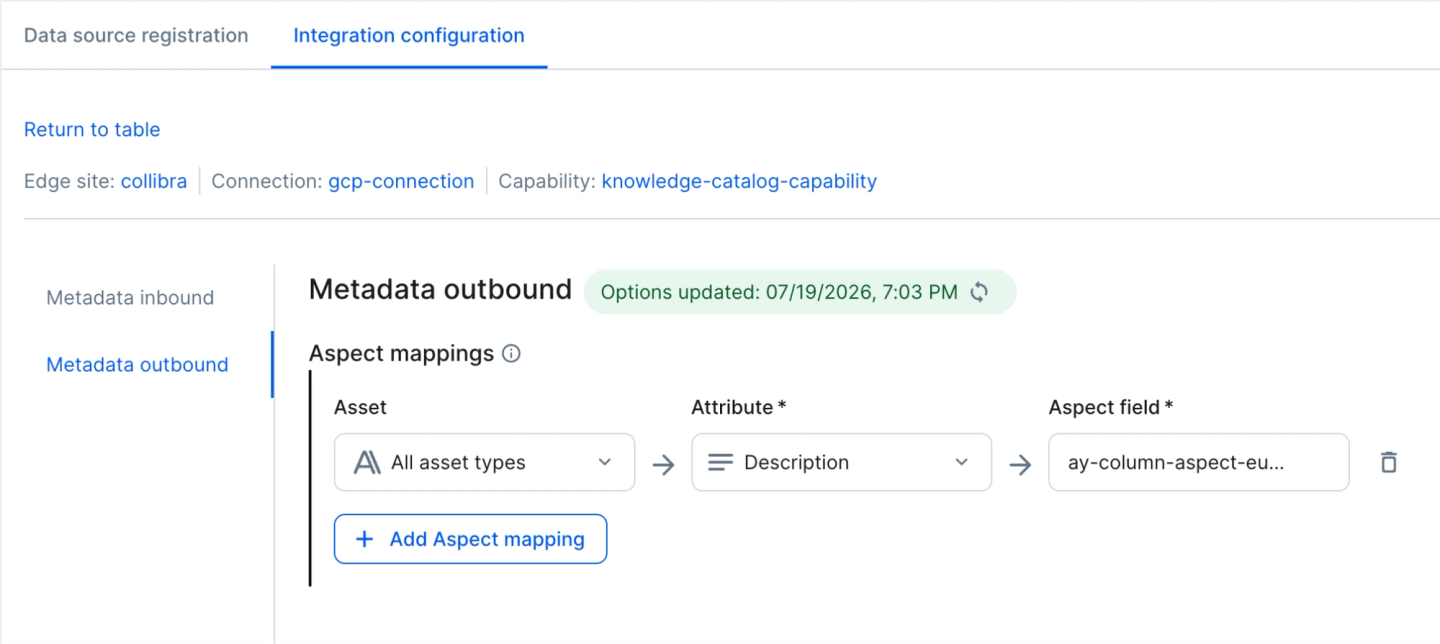
Integration configuration of pushing enriched metadata from Collibra to Google Knowledge Catalog.
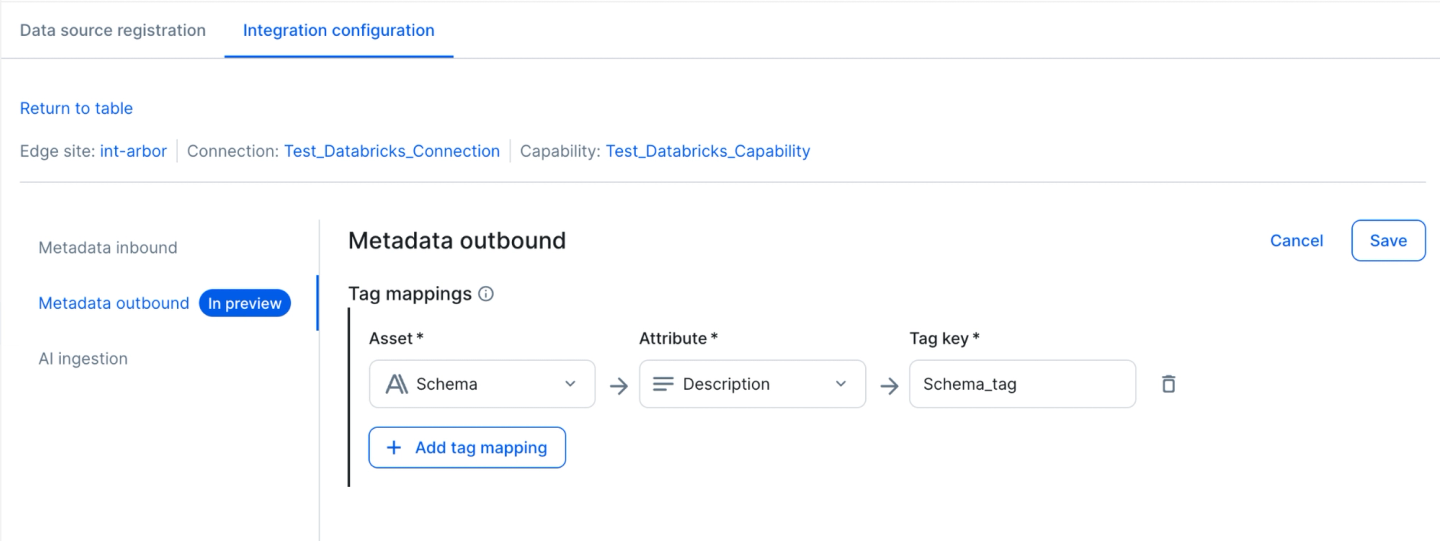
Integration configuration of propagating attribute values from Collibra to tags in Databricks Unity Catalog.
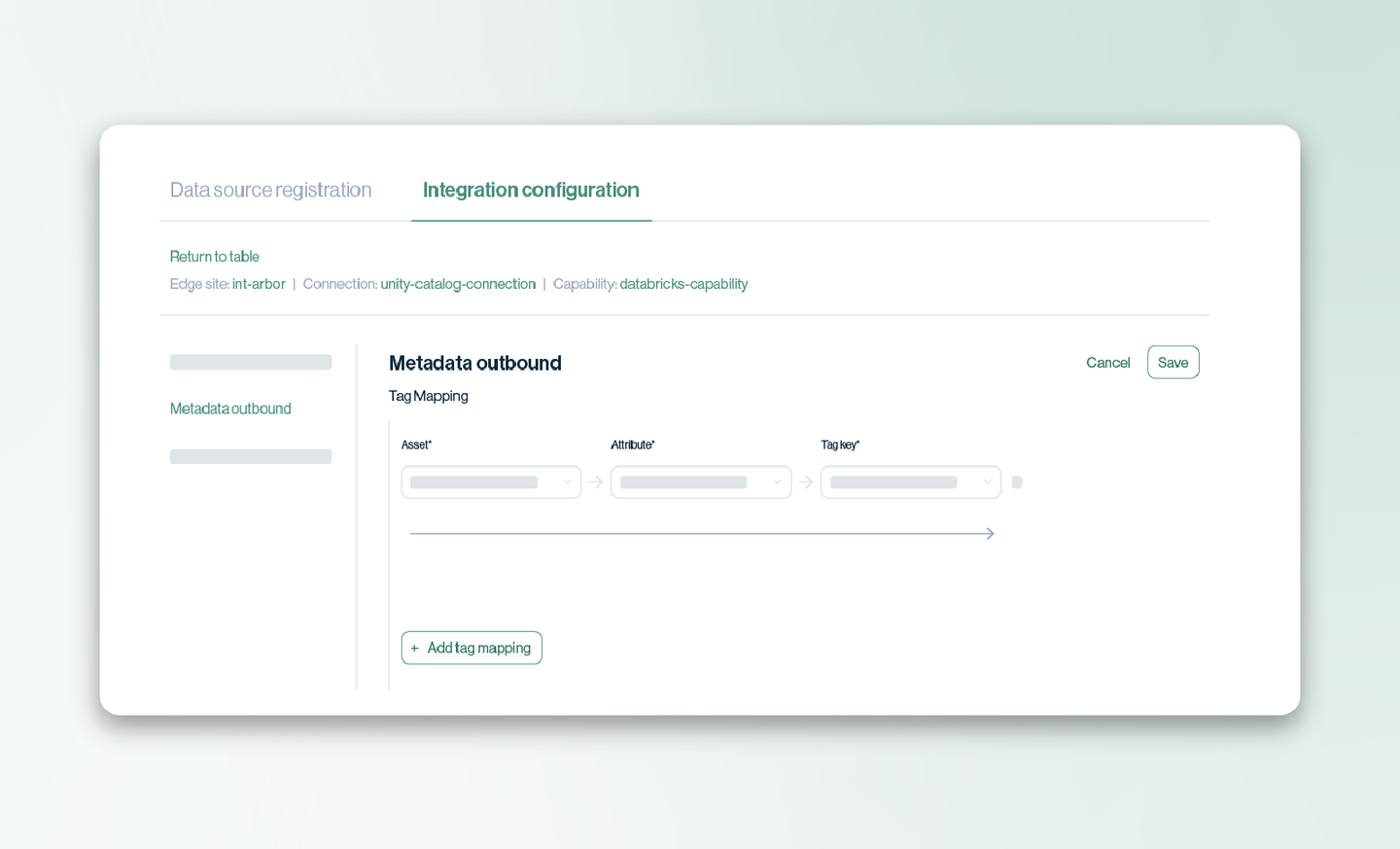
You control what leaves Collibra. Sync scope is set at configuration time: which part of the registered source is in play, which asset types are included and which Collibra attributes map to which construct in the target model. They run automatically, and each run reports per-object results, so a permissions error on one schema doesn't leave you guessing about the other four hundred.
Rendering differs by platform because each model differs. The same attribute can surface as an object tag/comment in Snowflake and Unity Catalog and an aspect in Knowledge Catalog. Writes are additive and scoped to the fields the integration manages, so outbound enriches the target catalog rather than overwriting metadata the platform's own users maintain.
Why you should be excited
- AI agents and copilots: Outbound sync puts governed definitions and classifications in their line of sight, so an agent reaches for the certified table instead of the similarly named one, while synced classifications keep sensitive columns masked at the engine level regardless of what the agent does.
- Data analysts: See certified definitions, ownership and quality scores in the tool you're already in, whether that's a notebook, a query editor or the platform catalog. Know whether a table is approved for use before you build on it, not after.
- Data stewards: Curate a definition, classification or certification once and watch it appear across every connected platform automatically, instead of maintaining parallel tagging schemes in five different tools.
Use cases
- Certified datasets surfaced across a multi-cloud estate: A finance dataset passes review and is certified in Collibra. The certification and its owner then propagate to whichever platform the dataset lives in, whether that's Unity Catalog, Snowflake or Knowledge Catalog, so analysts see the same trust signal on the same data.
- Grounding in-platform AI assistants in governed business context: Platform-native assistants answer questions using the metadata their platform holds. Where that metadata is only technical, the assistant is guessing at business meaning from column names. Syncing approved descriptions, business terms and certification status into Unity Catalog and Snowflake object tags gives those assistants governed context to reason over, so an assistant asked about quarterly revenue is working from the definition your finance team approved, against the dataset your stewards certified.
Key takeaways
Expanded outbound integrations make your metadata mobile. Completing the round trip between Collibra and Databricks Unity Catalog, Google Knowledge Catalog and Snowflake removes the tradeoff between centrally governed metadata and platform-native metadata. You don't have to pick between the version that's trustworthy and the version people can actually see.
Metadata stops being an inventory people visit and becomes a property of the data itself, wherever it sits. That is what makes governance across a multi-cloud estate sustainable rather than merely aspirational.
Where to learn more about support for outbound metadata integrations:
Get started with our product documentation and related resources:
- Databricks Unity Catalog: https://productresources.collibra.com/docs/collibra/latest/Content/Catalog/Databricks/ta_synchronize-databricks-outbound.htm
- Google Knowledge Catalog: https://productresources.collibra.com/docs/collibra/latest/Content/Catalog/GCS/Dataplex/ta_sync-dataplex-catalog-outbound.htm

Varun Reddy
Varun Reddy
Principal Product Manager
Collibra

Sara Timermans Pastor
Sara Timermans Pastor
Product Manager
Collibra

Meredith Bailey
Meredith Bailey
Product Marketing Director
Collibra

Prachi Gupta
Prachi Gupta
Software Engineer
Collibra
Share on:
Keep up with the latest from Collibra
I would like to get updates about the latest Collibra content, events and more.
Thanks for signing up
You'll begin receiving educational materials and invitations to network with our community soon.