

















Related resources
Thought leadership
Data governance is non-negotiable for AI success—here’s why
Share on:
The more things change, the more they stay the same. Just as poor data quality compromised the 'big data' era, it remains the primary adversary for today's AI applications. Successful leaders understand a fundamental truth: AI governance is not a replacement for data governance, but a critical extension of it. To build reliable AI systems, these two disciplines must work in tandem.
By 2027, companies that do not prioritize high-quality, AI-ready data will struggle scaling GenAI and agentic solutions, resulting in a 15% productivity loss.
— IDC FutureScape: Worldwide AI and Automation 2026 Predictions, US53858125, October 2025
Why ungoverned data is AI's biggest risk
The AI revolution dramatically amplifies data risks because AI systems ingest data at scale and speed. When organizations lack a robust record of where data originated (data lineage), how it's changed and who's accountable, they introduce massive risk.
This danger is compounded by the volume of ungoverned data lurking in the enterprise. Feeding AI models with unverified or sensitive information is a recipe for hallucinations, bias and noncompliance. Equally critical is the "context gap" facing the new generation of AI agents. Without deep context, understanding the what, why and how of your data, autonomous agents are unable to execute complex workflows, rendering them a liability rather than an asset.
Automated decision-making is only as reliable as the data, processes, and controls behind it. If you want AI to work for you, your data governance must be in order.
Navigating the non-negotiable regulatory landscape
Beyond operational failure, today's AI leaders face the challenge of navigating an increasingly complex regulatory environment. Regulations like the BCBS 239, the new EU AI Act and state-sponsored rules require organizations to be ready for deep scrutiny.
The new compliance mandate is clear: transparency is the price of admission. To satisfy modern audit requirements, leaders must be able to instantly answer three critical questions:
- Traceability (Where did it come from?): Regulations require businesses to know exactly how data flows into AI systems. This means having end-to-end data lineage that maps the journey from the data source, through every transformation and ETL job, to the final model.
- Accountability (Who is responsible?): You can no longer afford the risk of deploying AI models that lack a clear chain of responsibility. Organizations must clearly define who is responsible for the data and the model at every stage. This ensures that when an error occurs or a bias is detected, there is a clear owner tasked with remediation.
- Transparency (What was used?): Regulators demand a bill of materials for your AI. You must be able to specify exactly what data was used to generate an output. Without this granular visibility, you are operating in a regulatory blind spot, unable to defend your decisions or validate your compliance posture.
Implementation advice: The four pillars of AI readiness
Governance isn't red tape; it's the engine that powers AI readiness. True readiness begins by resolving the foundational chaos and risk in your data before you embark on new AI initiatives.
To move from fragmented governance to a unified, scalable foundation, the focus must shift to four essential pillars of implementation:
1. Visibility: Eliminate blind spots
You can't govern what you can't see. The concrete action here is to establish a unified data catalog to discover, classify and centralize every data asset, application and model across all environments. This provides a single, trusted source of truth for where your data resides.
2. Context: Add meaning to data
Data is useless without meaning. Enrich the data catalog with a semantic graph to attach rich business knowledge, like ownership, definitions, quality scores and usage policies, to the technical data. This ensures users and AI agents are working with trusted, reliable data.
3. Control: Ensure consistent policy
Moving beyond traditional risk management, control ensures policies and access are applied consistently to mitigate risk. The key is to implement automated workflows for applying consistent policies and access controls, which helps democratize safe data use while accelerating innovation.
4. Tracing: Full data cycle accountability
Especially vital for AI, this pillar ensures end-to-end accountability "from input through output." You must dynamically track and document end-to-end data lineage for every dataset, model and AI use case. This automatically documents the flow, ensuring compliance and providing the necessary explainability for regulators.
Conclusion: Data governance as a launchpad
Data governance doesn't slow your AI down; it gives your data horsepower it can actually control. Clarity about data quality, ownership and usage unleashes agility.
AI cannot exist without data, and governed AI cannot exist without governed data. A robust data governance framework is the blueprint to ensure your organization’s data is prepared for AI usage, leading to more trusted AI outputs, increased transparency and better model accuracy.
By building this strong foundation, organizations can streamline processes, reduce risk and maximize the value of their data and AI initiatives.

Meredith Bailey
Meredith Bailey
Product Marketing Director
Collibra
Share on:
Related articles
AI Command CenterJune 2, 2026
Trusted data, smarter AI: Unified governance for Snowflake
AI Command CenterJune 26, 2026
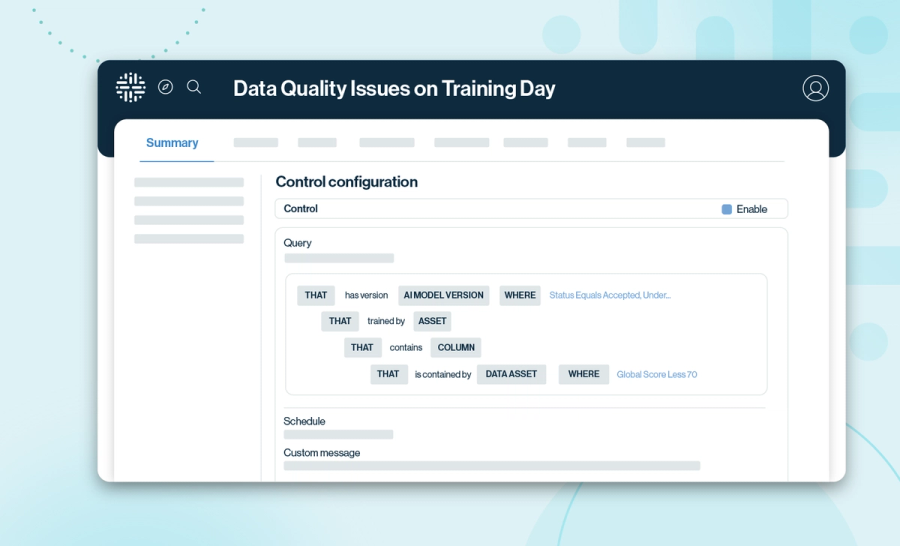
Control Tower: OOTB controls to govern AI by exception
Collibra PlatformMay 21, 2024
Collibra wins prestigious 2024 Communicator Award for AI Governance campaign
AI Command CenterMarch 31, 2026
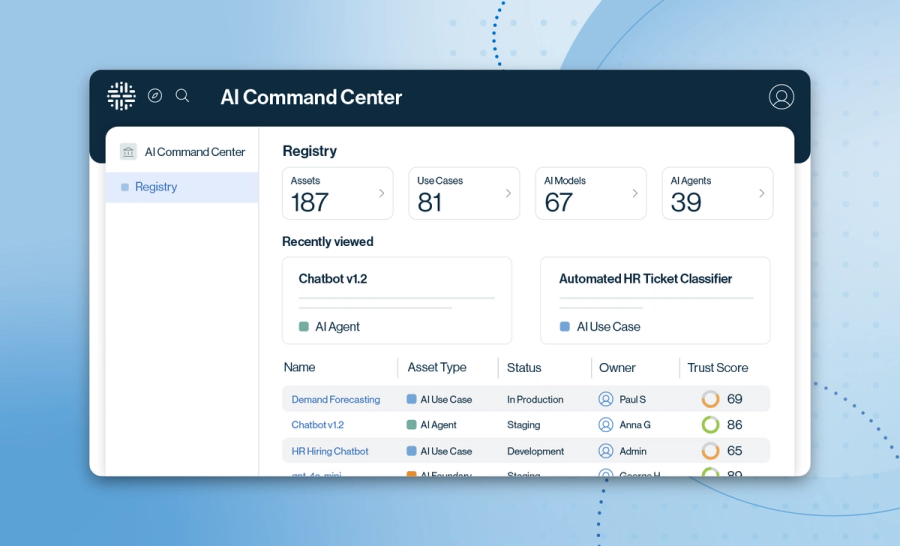
Unified AI registry: Your central inventory for AI use cases, models and agents
Keep up with the latest from Collibra
I would like to get updates about the latest Collibra content, events and more.
Thanks for signing up
You'll begin receiving educational materials and invitations to network with our community soon.