














Related resources
What is data lineage and why is it important?
Share on:

In the age of AI, data without a history is a liability, not an asset. To truly get value out of your data, you need to know the full picture.
Data lineage helps to answer the questions of:
- Where did this number come from?
- Can we prove where this data originated for the auditors?
- When was the last time this data was updated?
- Why do the Marketing and Finance numbers for 'Total Sales' differ?
Confident business decisions start with understanding your data's story. Collibra Data Lineage provides this clarity by automatically mapping relationships across systems, applications, and reports to deliver a complete, end-to-end view of your data’s journey.
Why is data lineage important?
Data lineage ensures your organization operates on facts, not assumptions. By visualizing the journey of your data, you empower business analysts to make decisions based on trusted, verified information. Simultaneously, lineage modernizes IT operations by automating manual mapping tasks and streamlining impact analysis.
This dual benefit, trust for the business and efficiency for IT, delivers value in four key areas:
- Ensure regulatory compliance: Provides a defensible, auditable trail of data transformations across the data ecosystems.
- Regulatory Reporting: A bank needs to prepare its quarterly Basel III report (or similar regulatory document). Lineage is used to prove to auditors that the final reported capital requirements number has been derived solely from approved, validated source systems, following the exact calculation rules specified by the regulatory body.
- Increase productivity: Replace Excel spreadsheets and manual documentation with automated discovery. Auto-extract and maintain lineage from various source systems.
- Better understand and trust your data: Understand the full context of your data to ensure accurate, complete and trustworthy data is used to drive business decisions.
- Discrepancy Resolution: When the Marketing and Finance numbers for 'Total Sales' differ, lineage quickly visualizes the two different calculation logic paths. For instance, the Finance report might use reconciled ledger entries, while the Marketing dashboard uses raw CRM data that hasn't excluded returned orders yet, resolving the discrepancy in minutes.
- Save time doing manual impact analysis: Enable impact analysis at a granular level (columnar, table or business report) of any changes to downstream systems.
- M&A Integration: Following an acquisition, two companies need to merge their customer databases. By running a lineage analysis, the integration team can immediately see all reports, dashboards and applications that rely on the legacy customer ID field from the acquired company, ensuring zero downtime and a smooth transition to the new standardized field.
Ultimately, automated data lineage provides the end-to-end visibility you need to save time, resolve issues quickly and ensure every business decision is based on trustworthy data.
What to look for in a data lineage tool
A data lineage tool automatically maps relationships between data points, providing a native, end-to-end visualization of how data moves, transforms and fuels your business. To truly unlock visibility, an enterprise-grade solution should include:
- Automated lineage extraction: Automatically stitch together flows from SQL, ETL and BI tools.
- Support for OpenLineage: Ensure interoperability with native support for the OpenLineage standard.
- Dual perspectives: Offer both summary views (Business Lineage) and granular details (Technical Lineage).
- Indirect lineage: Visualize hidden logic like conditional statements and joins.
- In-line code context: Drill down into the specific SQL or transformation logic within the diagram.
Implementation insight: Start with strategy
To minimize disruption and prove ROI, start implementing lineage on your most critical data assets, such as regulatory reports or key performance indicators (KPIs). This phased approach demonstrates immediate value.
The two lenses of lineage: Business vs. Technical
To truly understand your data, you need to see it from two perspectives. Modern lineage solutions combine these views to serve the entire organization:
- Business lineage: Provides a high-level view of data flow in the context of business processes and decisions. Business lineage helps stakeholders verify sources and understand how datasets contribute to organizational outcomes without getting lost in the weeds.
- Technical lineage: Provides a detailed view of data transformations and system interactions. Technical lineage helps technical teams identify precisely how columns get calculated, transformed or affected by changes in informational pipelines within an organization.
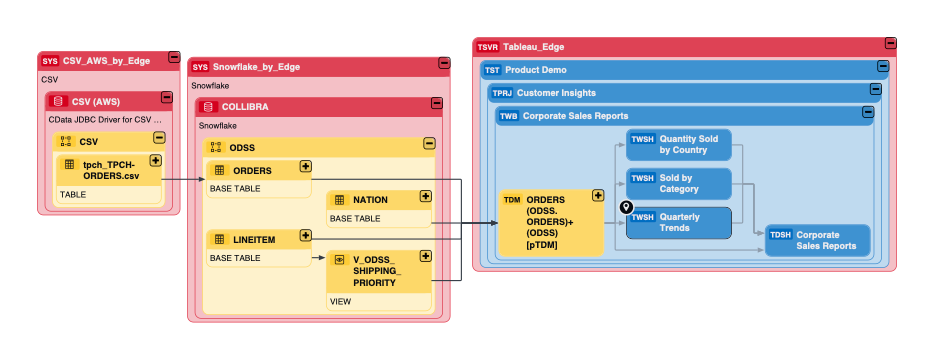
Business lineage diagram for the "Quarterly Trends" Tableau Worksheet, illustrating the connections to various data attributes, tables and systems.
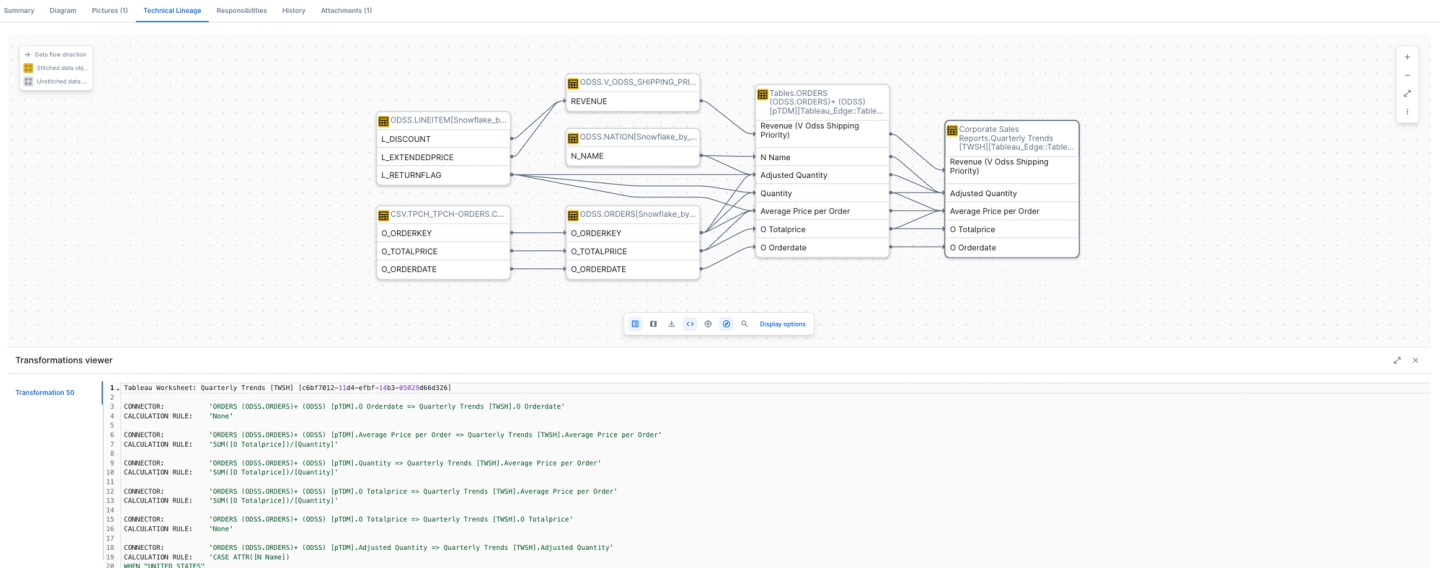
Technical lineage diagram exposing the column-level dependencies and transformation logic for the 'Quarterly Trends' Tableau Worksheet.
Together, business lineage and technical lineage provide a holistic view of an organization’s data so that data citizens in all departments and roles can use data to make accurate business decisions.
Turn visibility into value
Maintaining lineage in Excel is a relic of the past. Automated data lineage breaks this cycle by visualizing the entire journey of your data from origin to outcome. By ensuring your data is meaningful and traceable, you enable your organization to move beyond guesswork and base every decision on undeniable truth.

Meredith Bailey
Meredith Bailey
Product Marketing Director
Collibra
Share on:
Related articles
Collibra PlatformFebruary 14, 2025
Why we are the data and AI leader for you

Data GovernanceAugust 27, 2025
Why predictive modeling matters to higher education institutions

Data GovernanceJanuary 25, 2022
Gaining control of personal information ahead of CPRA

Data LineageJanuary 27, 2022
Accelerate IFRS-17 Compliance with Data Intelligence Platform
Keep up with the latest from Collibra
I would like to get updates about the latest Collibra content, events and more.
Thanks for signing up
You'll begin receiving educational materials and invitations to network with our community soon.