










The semantic layer has always been essential. Now it's existential.
Share on:


The semantic layer is not a new idea. It has existed for decades, and for most of that time it operated quietly in the background, doing unglamorous but essential work: making enterprise data legible to the people who needed to act on it.
What has changed is not the concept. What has changed is the cost of getting it wrong.
In the BI era, a poorly governed semantic layer meant inconsistent dashboards and frustrated analysts. In the agentic AI era, it means autonomous systems making high-stakes business decisions on a foundation of conflicting, ungoverned definitions. The stakes are categorically different, and organizations that underestimate the semantic layer are taking on risk they cannot yet fully measure.
From readability to reliability
In the BI era, a human analyst querying a dashboard could exercise judgment. If "Revenue" looked inconsistent between two reports, they could flag it, investigate it or apply contextual knowledge to reconcile the discrepancy. The semantic layer was a guide, not a gatekeeper, because humans could compensate for its gaps.
AI agents cannot. Autonomous systems operate on what they are given. They do not pause to question whether the definition of "Active Customer" in the CRM aligns with the definition used in the data warehouse. They do not recognize when two metrics that share a name actually measure different things.
This fundamentally changes what a semantic layer must do. In the BI era, the semantic layer was built for readability. In the AI era, it must deliver reliability. It must be the authoritative, machine-interpretable source of truth for what every data asset in the enterprise actually means, how it relates to other assets and under what conditions it should be used.
When that foundation is absent or fragmented, AI agents fill the gaps with inference. And in an enterprise context, inferred logic that goes unchallenged is far more dangerous than a factual error a human might catch. This is the hallucination risk that rarely gets discussed: not models fabricating information, but models operating on logically flawed premises that were never corrected because no authoritative definition existed to correct them.
Gartner has recognized this shift explicitly, projecting that by 2030 semantic layers will be viewed as critical infrastructure, a fundamental reclassification of where the semantic layer sits in enterprise architecture.
"By 2030, semantic layers will be viewed as critical infrastructure, right alongside your data platform and cybersecurity."
Gartner
Your tools do not agree. Your AI does not know that
Most enterprises today do not operate with a single semantic layer. They have many, scattered across BI tools, data platforms, analytics environments and increasingly AI applications, each maintaining its own definitions, its own logic and its own version of business truth.
This is semantic fragmentation, and it is one of the most underestimated structural risks in enterprise AI today.
A universal semantic layer centralizes the authoritative definitions of your business, then makes those definitions portable. It does not require every tool to abandon its native semantic capabilities. It requires every tool to operate from the same governing source of truth. When a definition changes, it changes everywhere. When an AI agent queries across platforms, it draws from a single, consistent vocabulary regardless of which system it reaches.
It is an architectural requirement for any organization that intends to deploy AI agents at scale. Without it, governance remains aspirational. With it, governance becomes operational.
How Collibra builds your universal semantic layer
Collibra was built for exactly this problem, not as a point solution for a single platform or use case, but as the governed semantic foundation that spans your entire data estate and extends to wherever your AI operates.
Semantic Mapping Agent: Collibra's Semantic Mapping Agent uses machine learning to scan your physical data and automatically surface links to existing business definitions. Rather than relying on manual curation to build semantic alignment, Collibra surfaces those links programmatically, reducing the time and effort required to establish a governed semantic foundation and ensuring coverage scales with your data.
Semantic Model Generation Agent: Collibra eliminates the need to build semantic models from the ground up. It auto-generates business-ready models from your existing organizational context, incorporating metric catalogs and governance rules at the point of creation. As your business evolves, those models are continuously extensible, meaning your semantic layer grows with your organization rather than lagging behind it.
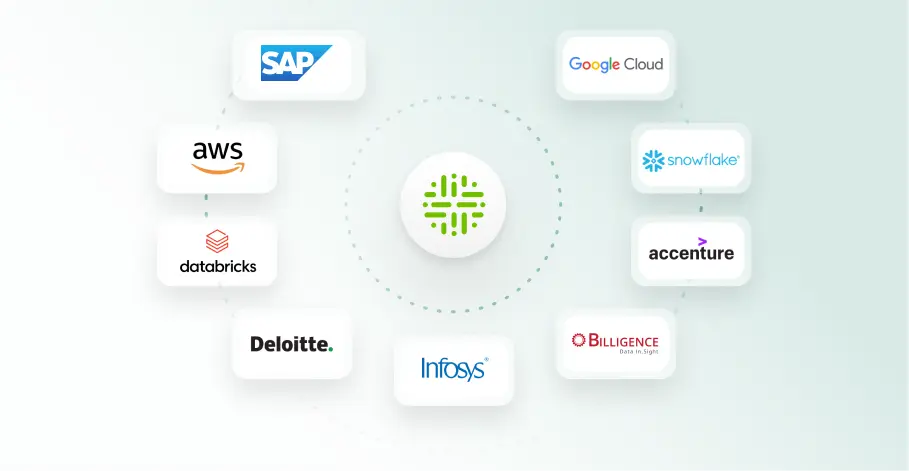
Open Standards and Model Context Protocol: A semantic layer is only as valuable as its reach. Collibra ensures that governed business context does not stay locked inside a single platform, but is portable. By leveraging the Open Semantic Interchange (OSI) format and the Model Context Protocol (MCP), Collibra actively pushes trusted, machine-readable context outward to execution platforms like Snowflake and Databricks, as well as directly to autonomous AI agents. This includes data quality signals, data minimization policies and point-in-time access controls, so every system in your stack is operating on the same governed truth, in real time.
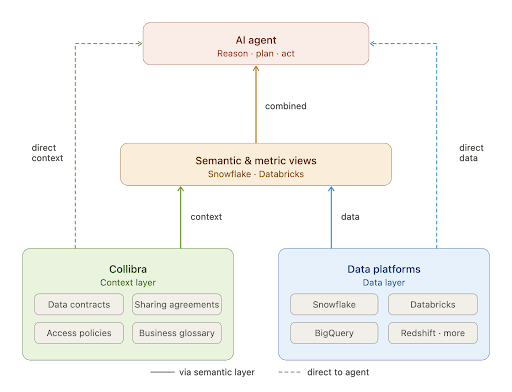
This combination of automation, governance and portability is what distinguishes Collibra from point solutions that address one part of the semantic problem. Collibra addresses the whole of it: creating meaning, governing it and ensuring it reaches every system and every agent that needs it.
The infrastructure that makes AI trustworthy
The semantic layer has always been important. In the AI era, it has become the difference between AI that executes reliably and AI that operates on a foundation no one can fully account for.
Organizations that invested early in a governed semantic foundation will find their AI agents performing with a consistency and accuracy that organizations still managing semantic fragmentation will not be able to match. The gap will widen quickly, because AI compounds on the quality of the context it is given.
According to Gartner,
“By 2027, organizations that prioritize semantics in AI-ready data will increase their agentic AI accuracy by up to 80% and reduce cost by up to 60%.”
The enterprises moving now to establish a universal semantic layer are not just preparing for the next wave of AI capability. They are building the infrastructure that makes every future wave trustworthy.
See how Collibra builds a universal semantic foundation for your enterprise: Request a demo.

Meredith Bailey
Meredith Bailey
Product Marketing Director
Collibra
Share on:
Related articles
Data GovernanceFebruary 14, 2025
Why we are the data and AI leader for you

August 27, 2025
Why predictive modeling matters to higher education institutions

Data GovernanceJanuary 25, 2022
Gaining control of personal information ahead of CPRA

Data LineageJanuary 27, 2022
Accelerate IFRS-17 Compliance with Data Intelligence Platform
Keep up with the latest from Collibra
I would like to get updates about the latest Collibra content, events and more.
Thanks for signing up
You'll begin receiving educational materials and invitations to network with our community soon.