












Delivering AI at race pace without losing control
Share on:



At the Gartner Data & Analytics Summit, one theme came up in almost every conversation I had with organizations: the pace of AI is accelerating, and agents are now at the center of that shift. Teams are no longer just experimenting; they are deploying agents, embedding them into workflows and allowing them to take action across business processes.
But as this acceleration takes hold, a more difficult question quickly emerges: how do you scale AI and agents without losing control? Because this is no longer experimental. AI is becoming part of the operational backbone of the enterprise. And what I consistently see is that the challenge is no longer building AI systems. It is operating them.
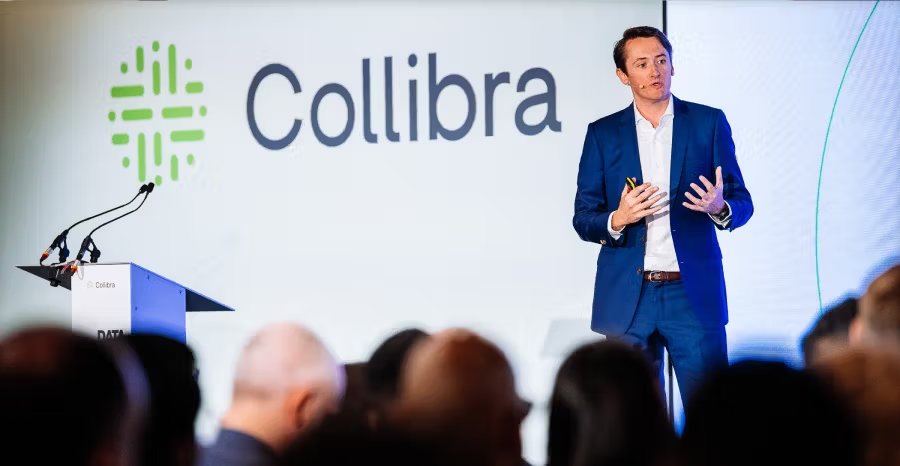
As I shared during my session, when acceleration outpaces control, progress doesn’t continue—it drifts, and systems go off track.
The new blind spot in AI
AI systems do not fail loudly. They fail silently. Behavior evolves as data changes, dependencies shift and systems interact in ways that are not always visible. The impact shows up gradually, embedded in decisions or automated actions, long before it is formally detected. This creates a blind spot I see repeatedly. Most organizations cannot answer, in real time, what AI systems are running, how they are connected or where risk is emerging. The information exists, but it is fragmented. A model is tracked in one place, the data in another, and the business context somewhere else. Agents operate across environments with limited visibility into their behavior or the reasons behind it. What’s missing is a continuous, connected view of the system. Without it, organizations react to AI rather than operate it.
From pipelines to systems
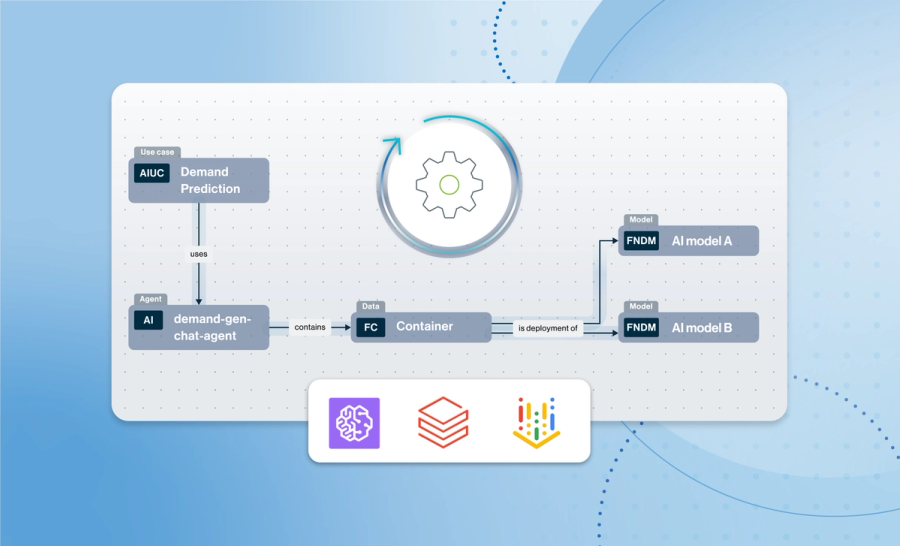
AI is no longer a pipeline. It is a system of systems. A single outcome may depend on multiple datasets, several models, and agents interacting with applications and workflows. These components evolve independently but influence one another continuously. Yet they are still often managed in isolation. This becomes critical when something changes. A dataset is updated, a model is retrained or an agent adapts its behavior. Without understanding how these elements are connected, the impact is difficult to anticipate. I often use the example of a bank using AI for credit decisions. A subtle shift in data can alter model outputs, which then influence approvals. Without traceability across that chain, risk accumulates silently. This is why linking use cases, models, data and agents into a connected system is foundational.
What it takes to deliver ai at scale
What I see in organizations that are successfully scaling AI is not just better technology, but a different way of operating. It comes down to a set of capabilities that build on one another and enable AI to be observed, understood and controlled in motion.
1. Continuous visibility across ai systems
The starting point is visibility. Organizations need a real-time understanding of what exists across their AI landscape—use cases, models, data and agents—and how these elements are connected. This is not about static inventories. It is about a live system view that reflects reality as it evolves. Without this, everything else becomes reactive.
2. Signals that turn activity into awareness
Visibility only becomes useful when it turns into awareness. Signals capture how systems behave in real time and surface deviations from expected patterns. They connect events to context, making it possible to understand not just that something changed, but why it matters. A shift in model performance or unexpected agent behavior only becomes actionable when it is surfaced as a signal. This is what allows governance to keep pace with AI.
3. Managing by exception at scale
As AI expands, manual oversight becomes impossible. Organizations need to shift from trying to control everything to focusing on what actually matters. This aligns with insights shared by Svetlana Sicular at Gartner, who emphasized prioritizing critical use cases and adapting governance to AI speed rather than trying to “boil the ocean.”
Managing by exception means attention is triggered only when signals indicate meaningful deviation—when risk increases, behavior shifts, or impact becomes significant. Instead of reviewing everything, teams focus on where it matters most. This is how you reconcile speed and control.
4. Acting and automating intervention
Detecting a signal only creates value if it leads to action. Organizations must be able to respond quickly and consistently—adjusting models, updating data, enforcing constraints or limiting system behavior. In more advanced environments, parts of this response become automated, allowing issues to be contained before they escalate. This closes the loop between detection and control.
From observation to control
When these capabilities come together, governance changes fundamentally. It is no longer something applied after deployment. It becomes embedded into how AI systems operate. Visibility, signals and action work together to create continuous control.
To make this more concrete, consider a supply chain environment where AI is used for demand forecasting. At first, everything appears to work as expected. But as demand patterns shift—due to seasonality, external events or changing customer behavior—the model begins to produce less stable outputs. Not dramatically wrong, just increasingly inconsistent. The kind of drift that is easy to miss but costly over time.
With the right capabilities in place, this shift does not go unnoticed. It is detected early through signals, understood in the context of upstream data changes and downstream impact, and addressed through targeted intervention, whether that means recalibrating the model, adjusting inputs or temporarily limiting its influence.
This is what it means to command AI systems, not just deploy them.
Toward continuous control
What emerges is a new model of governance—continuous, connected and adaptive. Control is no longer applied at fixed checkpoints. It evolves alongside the system. Organizations maintain visibility, understand relationships and act when it matters. Governance shifts from constraint to enablement. It allows teams to move faster because they are no longer operating blindly, and it allows organizations to scale because complexity is managed through signals rather than manual effort.
A new standard for AI
As AI evolves, especially with autonomous agents, the stakes increase. We are moving from systems that support decisions to systems that make them. In that world, success will not be defined by how many agents are deployed, but by how well they are commanded.
Commanding AI goes beyond monitoring. It requires continuous visibility, meaningful signals, managing by exception and acting with precision. It’s about understanding what’s happening in real time and maintaining control with confidence. Because as AI accelerates, the real challenge is not just to keep up but to command it.

Teresa Rojas
Teresa Rojas
Senior Director of Product Management, AI Governance
Collibra
Share on:
Related articles

Data LineageJanuary 27, 2022
Accelerate IFRS-17 Compliance with Data Intelligence Platform

Data LineageSeptember 12, 2024
What is data observability and why is it important?
Data Quality & ObservabilityJune 17, 2026
Data observability platform: How to proactively monitor and trust your data at scale
AI Command CenterMarch 31, 2026
Automated AI traceability across Vertex AI, SageMaker, Databricks
Keep up with the latest from Collibra
I would like to get updates about the latest Collibra content, events and more.
Thanks for signing up
You'll begin receiving educational materials and invitations to network with our community soon.