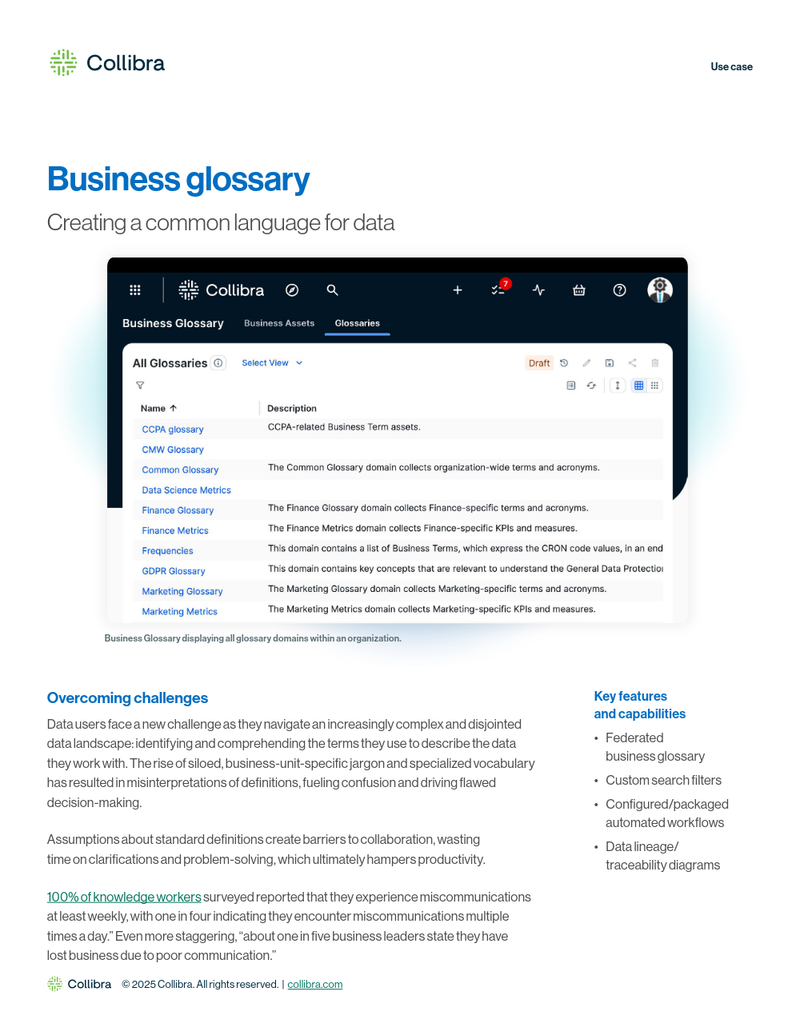
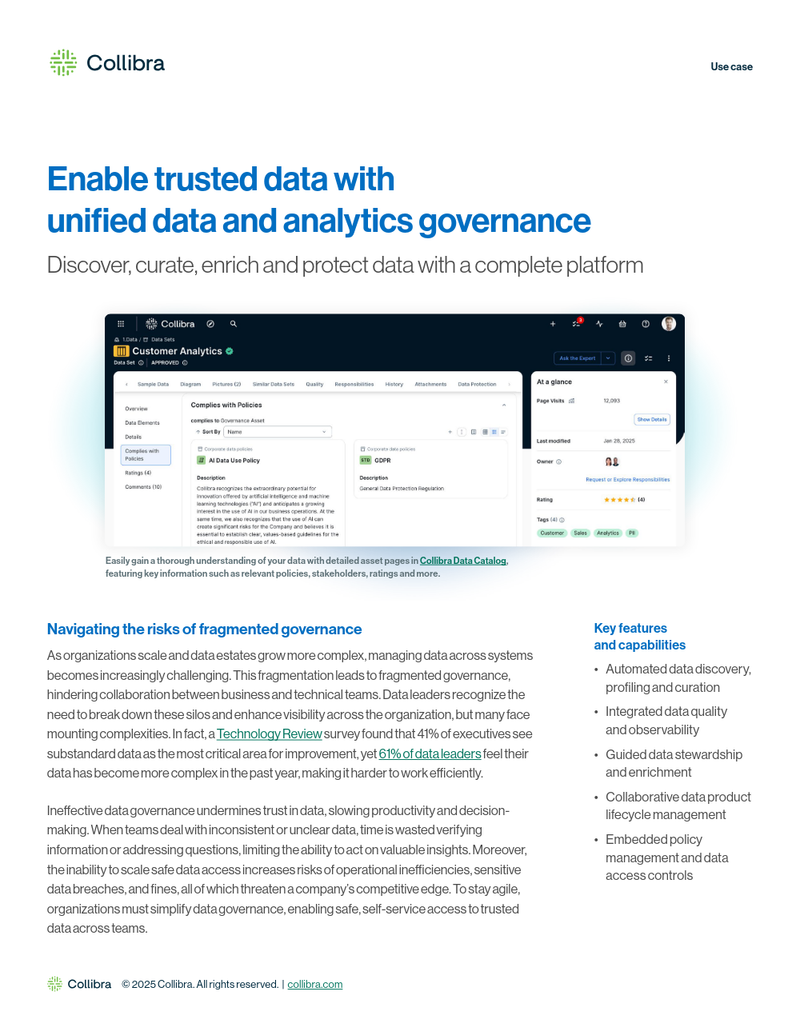
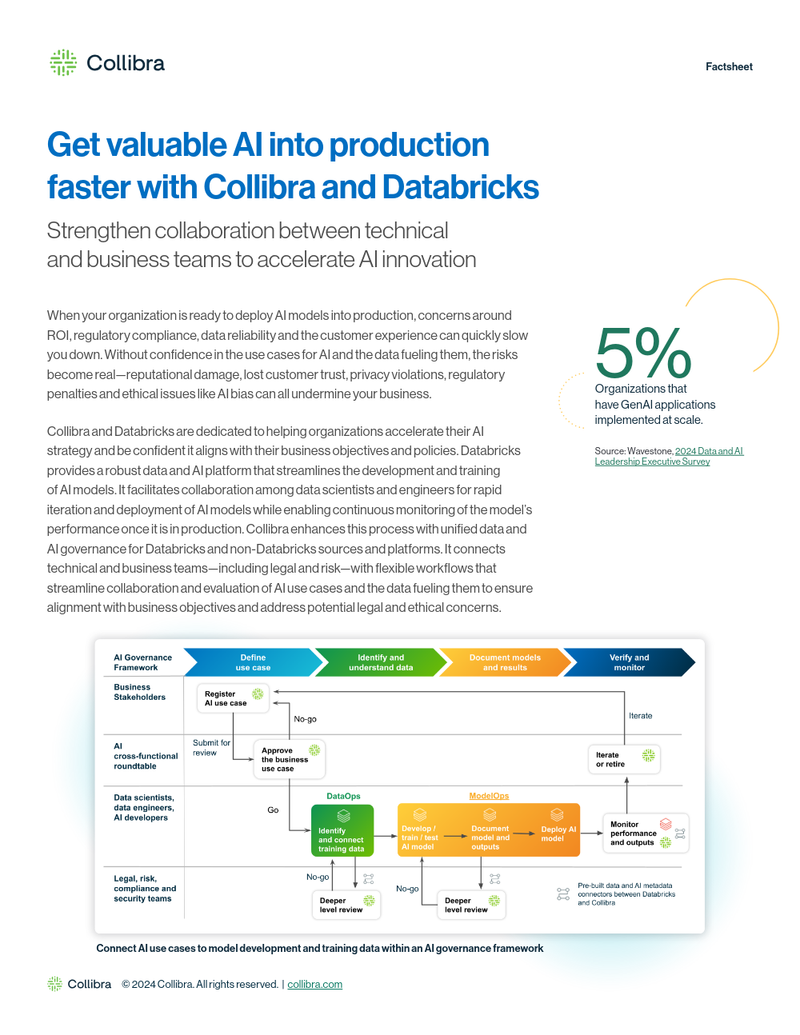
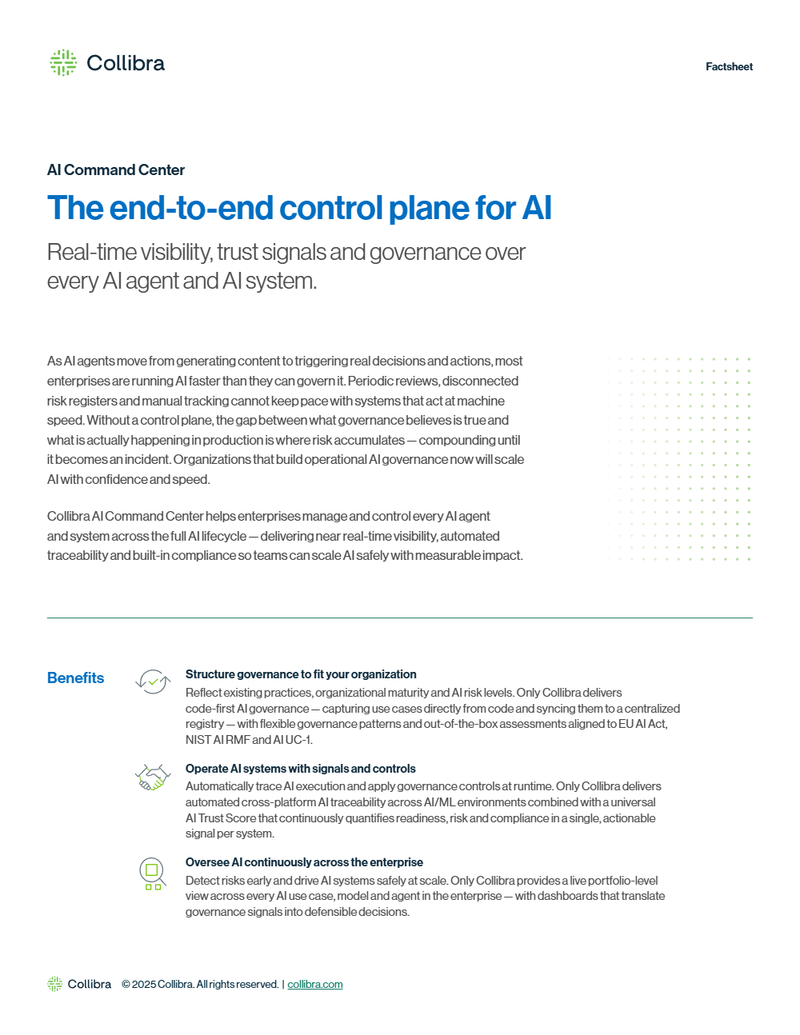
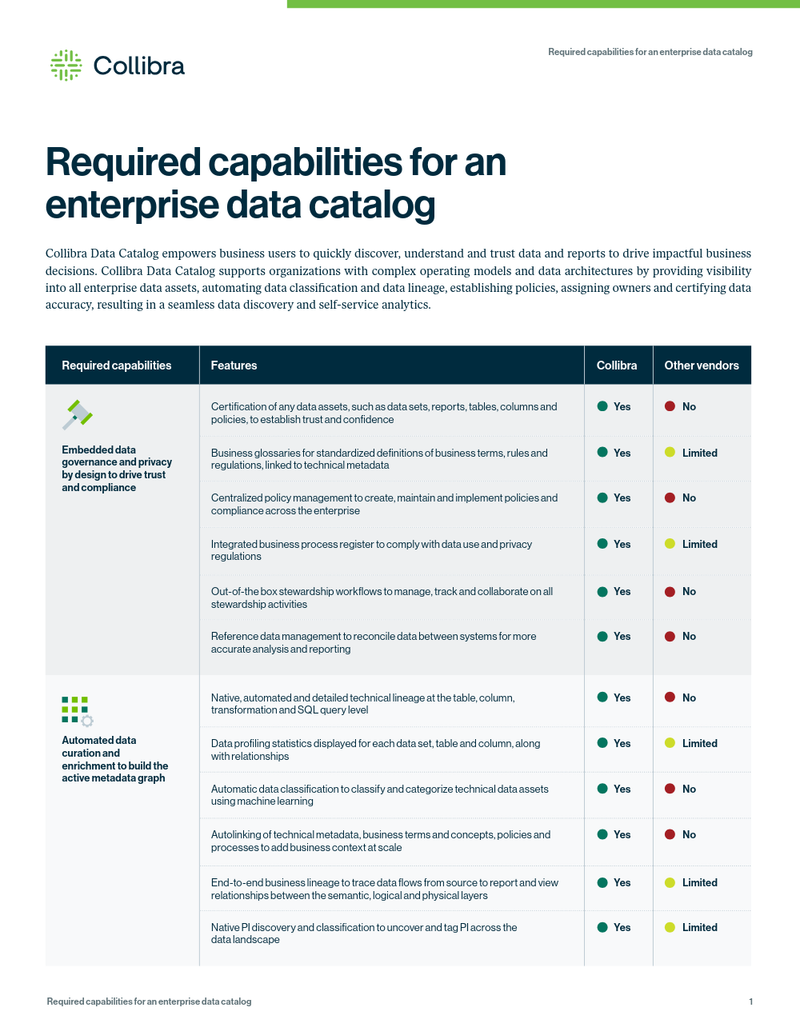
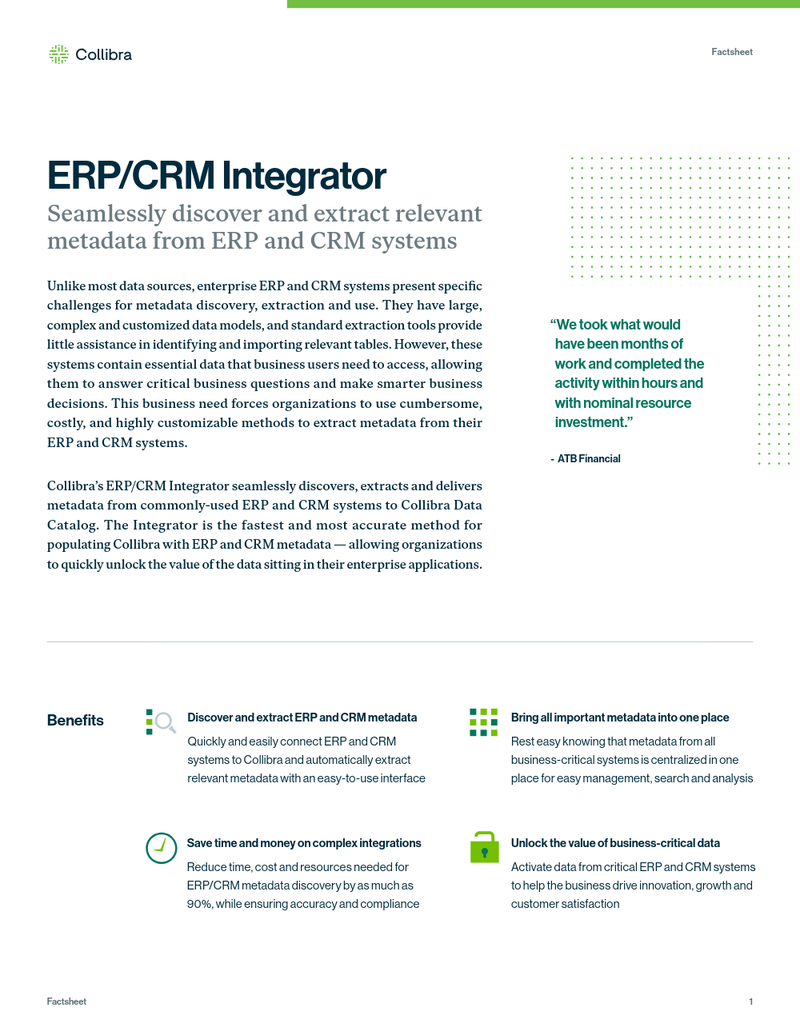
Collibra’s Business Semantics Glossary is a web-based workspace in which both business and technical users collaboratively define and govern the meaning of the business assets in their business context. With one click, it automatically generates technical models (UML, XML, ER, OWL, RDF, ...) from natural-language based busi- ness facts and rules to truly align business and IT understanding.
Downloads
We've compiled the downloads from across our website into a centralized library, so you can easily find them all in one place.
Don't forget to also visit our extensive product demo movie section to get a good grasp on how the Business Semantics Glossary can help you with Data Governance.
Product data sheets
Basel III is a is a new global standard created by the members of the Basel Committee on Banking Supervision “to strengthen global capital and liquidity rules with the goal of promoting a more resilient banking sector”. The standard will require banks to hold more capital, and higher quality capital, as well as to have sufficient liquidity in case of crisis. This in turn will have a big impact on the business intelligence (BI) systems of banks. More internal monitoring will be needed, and more disclosures to regulators.
For instance, liquidity risk reporting must be provided to the regulators on at least a monthly basis, and if the situation demands it, the frequency for these reports can be increased to monthly or even daily. Such requirements in Basel III add up to present a considerable challenge to banks, and this challenge must be met by a new level of data management.
Solvency II aims to codify and harmonize European Union (EU) insurance regulations, primarily from the perspective of reducing the risk of insolvency of insurance companies. Many of the new and higher standards are targeted to data management. Insurers will have to strengthen and deepen their existing data management practices, as well as extend them to new areas.
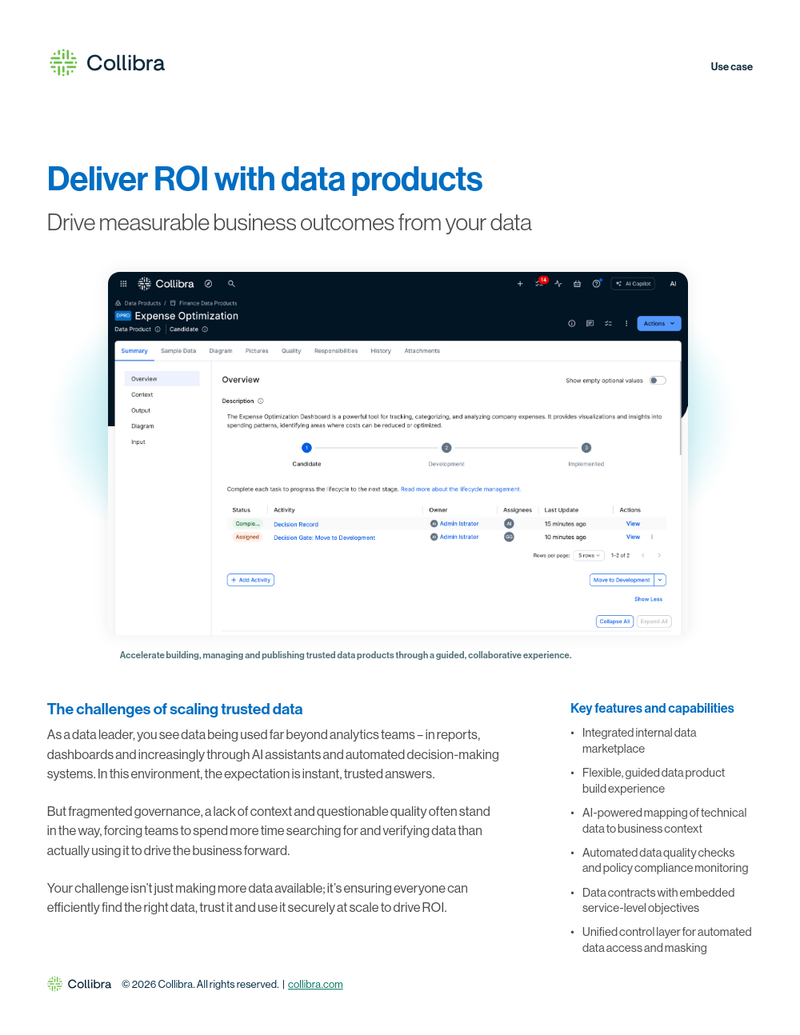
Collibra’s Business Semantics Glossary provides innovative capabilities that insurers can quickly deploy to meet the new world of Solvency II requirements: a business-facing, enterprise-wide, collaborative and fully governed information management repository. Collibra’s platform also provides a general Data Governance solution that will drive company revenue and growth.
The Foreign Account Tax Compliance Act (FATCA) is a new set of regulations from the US authorities that seeks to ensure that US individuals report all income earned outside the US. It will affect financial institutions that interact with US clients and US markets. However, it will also affect multinational non-financial enterprises that may have payment interactions with US clients. Basically, a 30% withholding tax will be imposed on certain US source payments made to foreign enterprises that are unable to satisfactorily identify US investors.
Detailed aspects of FATCA remain to be finalized, and, as with much regulation, future changes can be expected. However, the prospect of such a high withholding tax requires that enterprises start planning for FATCA now. There will be a significant impact for data management.
The Dodd–Frank Wall Street Reform and Consumer Protection Act is going to have a profound effect on the way financial institutions with a presence in the US manage their data. Although a significant amount of regulatory detail remains to be defined, the outlines are clear and financial institutions should begin aligning to Dodd-Frank now.
Dodd-Frank is ushering in a new attitude to data and information management in US financial services. Once a topic that was seen as something for the back office, it is now front and center as the regulators have discovered how essential it is for gauging systemic risk. Collibra provides a powerful set of capabilities that are fundamentally aligned with the needs behind Dodd-Frank. With these capabilities, financial institutions can master the new regulatory needs being imposed on them, and move successfully to the new information-centric paradigm.
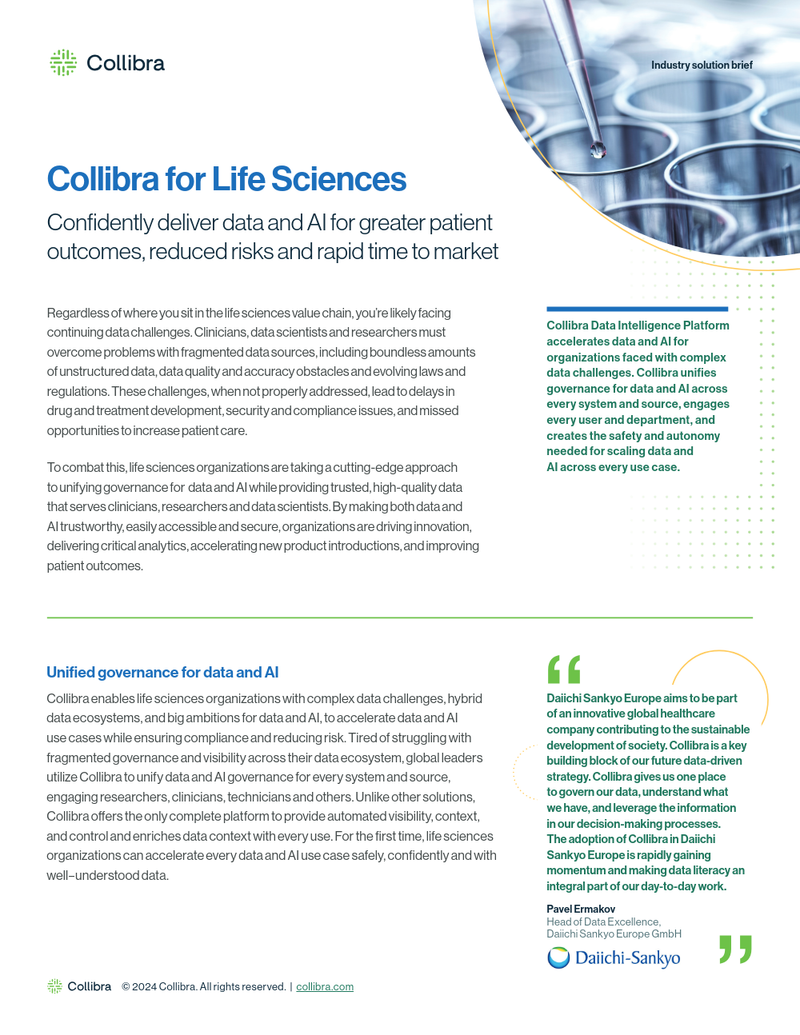
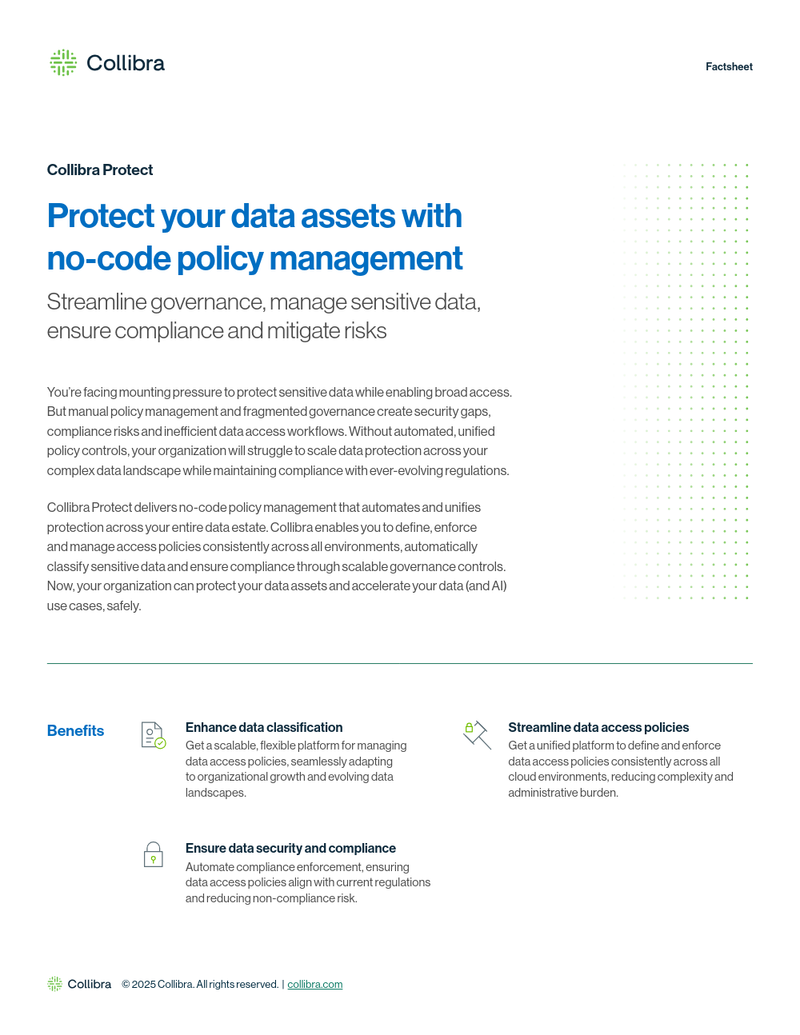
The pharmaceutical industry is heavily regulated, and non-compliance directly affects top line revenue. GxP quality guidelines and regulations are extremely important and grounded in the organizational culture. Applying Data Governance with the Collibra platform provides the level of control needed for regulatory compliance, the engagement to achieve adoption from various parts of the organizations, as well as a repository of knowledge that increases the overall efficiency around data management in critical business processes.
Analyst reports
The PwC Center for Technology and Innovation team spent several months researching and analyzing the problem of data silos in enterprises - and what solutions are being developed to help with that problem. The answer, according to PwC, is semantic technology. PwC believes that the semantic technologies offers a practical way to address the problem of large-scale data integration.
"Collibra's three levels of Business Semantics Management tools include one each at the services (Information Enabler), governance (Platform), and data integration layers (Studio)."(Page 15 of the report)
White papers
Starting from three simple but serious questions regarding data semantics, data utilization, and data governance that pop up daily in information-intensive enterprises, we easily identify a value proposition for semantic alignment. However, current techniques that claim to create semantic alignment in this sense are unsatisfactory, both theoretically and as far as the quality of the results is concerned. They systemically ignore the subtle gap that looms between information sharing among people (i.e. knowledge sharing) at the business/social level on the one hand; and information sharing between computer systems (i.e. data exchange) at the operational/technical level on the other hand.
Adequate information management requires more than persistently storing data, a function databases already provide. Despite the rigorous structure that may have been imposed on data, if it cannot be disclosed to third parties, their value is practically zero. The ICT-outsourcing partnership between the Flemish Ministry of Education and Training (FMET) and EDS-Telindus, now HP, recognizes the need for data governance. This is shown by initiatives such as the development of a Data Warehouse and an Information Governance Organization.
In this article, we describe the support of the Flemish Ministry of Education and Training (FMET) in their next big leap towards information maturity. Using a Metadata Roadmap we combine metadata technology, methodology, culture, and organization that will allow FMET to semantically unlock their earned information and so revalue it.